Rachel’s alcoholism
The Girl on the TrainRachel Watson’s alcoholism shapes her daily routines, her relationships, and her ability to trust her own memory. Drinking offers brief access to remembered intimacy and a way to endure loneliness, but it also leaves ordinary tasks unfinished, damages her connection with others, and turns the next morning into an exercise in shame and reconstruction. The narrative neither makes her drinking a simple consequence of grief nor treats it as detached from her losses: Rachel recognizes both the pressures around her and her own responsibility.
Pattern and Immediate Effects
On a Friday evening, Rachel drinks canned gin and tonic on the train. Its taste recalls a holiday with Tom on the Basque coast in 2005: swimming to an island in the mornings, making love on secluded beaches, and drinking bitter gin and tonics at a bar in the afternoons. The memory gives the drink an emotional charge beyond its taste. She has already emptied half a can and has three more in a plastic bag at her feet; because it is Friday, she tells herself she need not feel guilty. That permission turns drinking into a small ritual of anticipated pleasure, even as the recollection attached to it belongs to a past life.
The sunny weekend around her intensifies the contrast. Rachel remembers earlier outings to Corly Wood, barbecues, and afternoons at The Rose, when drinking belonged to shared leisure. In the present, she has no one to join her and nothing to do. Summer’s long daylight and other people’s conspicuous happiness make her feel more exposed and exhausted. The change is not simply from drinking to abstinence: the same substance once associated with company and ease now accompanies solitude.
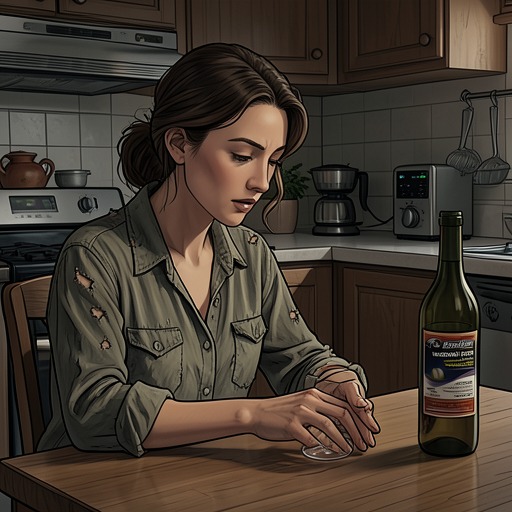
A domestic episode shows how drinking can compromise Rachel’s capacity to complete even a planned meal. After Cathy is out, Rachel buys two bottles of wine and drinks the first before deciding to cook steak with red-onion relish and salad. While chopping onions, she cuts the top of her forefinger deeply enough to need a plaster. She cleans the wound, then lies down and forgets the kitchen. When she wakes around ten, the steak is still on the counter, turning grey; blood remains on the chopping board, and the room smells of raw meat. The intended healthy dinner has become evidence of an evening she cannot fully account for.
Isolation and Relationships
The episode also makes the social consequences of Rachel’s drinking tangible. Cathy checks on her gently and asks her to clean up; Rachel apologizes without knowing exactly what she is apologizing for. Cathy’s partner, Damien, reacts with visible disapproval. Their responses mark a household in which Rachel’s drinking is no longer private, while her uncertainty about the apology reflects how little of the evening she can reliably hold onto.
After Cathy and Damien go to bed, Rachel remembers that she has not opened the second bottle and does so. She watches television with the sound turned very low so they will not hear it. She cannot remember what she watched, only that she wanted to talk to someone and felt an overwhelming need for contact. The only person she wants to call is Tom. Her phone log records four calls—at 11.02, 11.12, 11.54, and 12.09—and the call lengths suggest that she left two messages. She remembers asking him to call her in the first message, but cannot be sure what she said in the second or whether he answered. The record preserves a sequence of actions that her memory cannot.
Rachel describes loneliness and drinking as mutually reinforcing: she drinks because she is lonely, then becomes lonelier because people do not want to be around someone drunk. The repeated movement from loss to drinking and back to loss gives the habit a self-perpetuating shape. Her account of friends and colleagues underlines how grief over not having children compounds that isolation. She resents hearing about other people’s children and struggles to face a colleague’s casual account of abortion; her university friend Lara eventually stops speaking to her. These experiences do not make every later act of drinking inevitable, but they show the social world in which Rachel’s sorrow narrows her connections rather than drawing comfort from them.
Infertility, Grief, and Responsibility
Rachel’s account of infertility explains the intensity of a grief that Tom did not experience in the same way. He wanted to be a father, she believes, but could imagine a happy life without children. Rachel could not accept that alternative: she mourned something she had never had. She connects her isolation and despair to drinking, and to a sense that women are valued chiefly for appearance and motherhood. Because she sees herself as neither beautiful nor able to have children, she describes herself as worthless. This is Rachel’s bleak judgment of her position, not an objective measure of her worth; its force lies in how thoroughly that judgment has become part of her account of herself.
At the same time, Rachel refuses to make infertility, her upbringing, or an unspecified childhood injury a complete explanation for her alcoholism. She acknowledges that she had always liked drinking, distinguishes that earlier identity from becoming a drunk, and says plainly that the responsibility is hers. Her refusal of a single exculpatory cause complicates the narrative: her drinking is connected to grief, but she does not present grief as absolution. The distinction preserves her agency while showing how sadness can become, in her words and experience, tedious both to the person living with it and to those around her.
Relapse, Memory, and the Possibility of Change
Rachel’s efforts to change remain tentative rather than conclusive. She says she has become better able to face children and has read books and articles, considered strategies, and found some hope in the possibility of adoption if she can get sober and put her life in order. She is not yet thirty-four and does not regard that possibility as closed. Her account contrasts this hope with an earlier period when crowded supermarkets full of mothers and children could drive her to abandon her trolley and leave. She has also reached a point where she can sit near a park playground and watch toddlers on a slide—an ability that signals a change in what she can endure, not proof that the grief has disappeared.
On Saturday, 20 July, Rachel wakes with shame and a powerful sense that she has done something foolish. After searching her memory, she realizes that she sent Tom an email the previous night. The laptop beside her bed seems accusatory; she drinks water from the tap, sees that she looks unwell, and notes that she has been off drinking for three days before deciding to start again that day. The passage places a small period of abstinence beside the expectation of relapse. Its movement from an unexplained wrongness to the recovered fact of the email echoes the earlier calls: Rachel’s actions persist in records or consequences after their circumstances have become unclear to her. Her alcoholism is therefore represented not only through what she drinks, but through the recurring work of discovering what happened, regretting it, and trying once more to stop.