Scott Hipwell
The Girl on the TrainScott Hipwell, the husband of Megan Hipwell, enters the story first as a figure glimpsed across the railway and later as a grieving spouse under police suspicion. Rachel Watson’s impressions of him shift from an imagined, handsome stranger to a man confronting his wife’s disappearance, a pregnancy she had concealed, and Rachel’s false claim to have known Megan. The narrative keeps those impressions close to Rachel’s limited perspective: Scott is at once a person in crisis and someone she has projected onto from a distance.
Identity and Introduction
A missing-person notice identifies Scott as Megan’s husband and says he last saw her on Saturday night, when she left their home on Blenheim Road to visit a friend at about seven. The notice describes Megan as twenty-nine and says her disappearance was completely out of character. Its account makes Scott the key witness to her last known movements, though it does not establish what happened after she left.
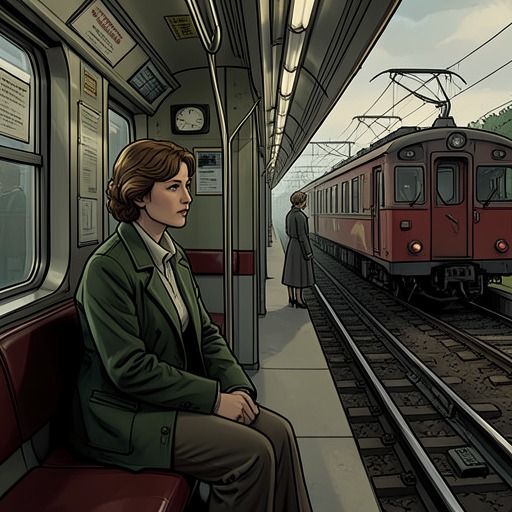
Rachel’s first sense of Scott comes from watching the Hipwells’ home from the train. She imagines the man she sees as a protective partner beside a woman she calls Jess, before learning their real identities. That private renaming matters: at first Scott is less a known individual than a part in the domestic scene Rachel invents for the couple. Her view of him is therefore shaped by longing and conjecture well before they speak.
The Train, the Police, and the Investigation
Rachel eventually tells the police that she often saw Megan on the terrace and that, on the Friday before Megan disappeared, she saw her kissing a man on the lawn. When Rachel passes Scott at the police station, she recognizes him immediately. She remembers him looking toward the railway and wonders whether he recognizes her in return. In person, he appears beautiful to her, but also hollowed out and tense. The encounter connects the distant figure she had watched with a husband now caught inside an investigation.
When Rachel tells Scott what she witnessed, he says he was away at a conference and returned on Friday evening. His absence makes the sighting newly consequential: the man Rachel saw kissing Megan was not her husband. Scott reacts with anger, and the disclosure sharpens his suspicion about Megan’s relationships. Rachel’s account gives him information, but her position as a witness is compromised by the fact that she has not been honest about who she is or how she knew Megan.
Police attention soon makes Scott a public suspect. A news report says a man in his thirties has been arrested in connection with Megan’s disappearance, while withholding whether the man is Scott; it also says police are searching an address believed to be a crime scene. Rachel, who has recently been inside Scott’s home, reads the report on a train and fears that he may have harmed Megan. Later, Scott tells her that police questioned him that morning and that they think he killed his wife. These accounts establish the pressure surrounding him, but Rachel’s fear and Scott’s own report do not independently settle the case.
Grief, Pregnancy, and Paternity
The news that Megan was pregnant changes the meaning of her death for Scott. When he tells Rachel, he describes having longed for the possibility of a child and imagined the child’s future and appearance. The disclosure overwhelms him; Rachel sees him begin to cry and recognizes that he is grieving not only Megan but also the future he had pictured. His response gives a private dimension to the investigation’s facts: the pregnancy is not merely a clue but a lost possibility he had hoped for.
Later, Scott tells Rachel that DNA results show he was not the father. He adds that Kamal Abdic was not the father either, and concludes that Megan had another man. His manner turns the result into an accusation as he presses Rachel to say whether Megan confided in her. The discovery does not identify the father in the account presented here, but it deepens Scott’s sense of betrayal and redirects his attention toward Rachel’s knowledge.
Rachel’s Deception and Their Confrontation
Rachel has approached Scott while pretending to be Megan’s friend, although she had never met Megan. Her claim grows out of her wish to enter the story and persuade Scott to talk to her; she later recognizes that, while drunk, she lied about the connection. That invented intimacy lets her move closer to Scott, but it also makes the relationship fundamentally unequal: he believes she has personal knowledge of his wife, while she has built her account from what she saw from the train and what she wants to believe.
During their later meeting, Scott is drinking and appears distressed. After telling Rachel about the DNA results, he questions her about whether Megan had mentioned another man. He prevents her from leaving and takes her handbag; when he realizes that her story about knowing Megan was false, he confronts her about the lie. The encounter exposes the consequences of Rachel’s deception and shows Scott’s anger turning toward the person who has presented herself as a confidante. It also makes concrete the danger that Detective Sergeant Riley had warned Rachel about: Scott is under severe strain, and her decision to approach him has not helped the investigation.
Narrative Role and Limits of Rachel’s View
Scott’s place in the narrative is defined by the gap between observation and knowledge. Rachel first sees him at a distance and supplies the reassuring gestures and private life she longs for; later, the police investigation and Scott’s own words force those projections into contact with a more complicated reality. The recurring train view makes him familiar without making him known, while Rachel’s invented friendship with Megan repeats that mistake in a more consequential form.
His grief, his account of the pregnancy, and his anger at Rachel’s deception are all presented through encounters Rachel narrates. The evidence therefore reveals both Scott’s circumstances and the limits of the person reporting them. He is a husband whose wife has disappeared and been declared dead, a suspect questioned by police, and a man learning that the child he had hoped for was not his. Yet the account’s final tension lies less in an authoritative judgment of him than in the collision between his crisis and Rachel’s unreliable attempt to make herself part of it.