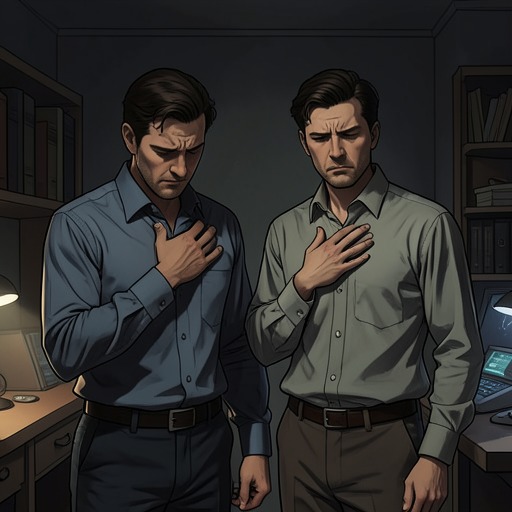
Scott and Megan’s marriage
The Girl on the TrainScott and Megan’s marriage is pieced together through a few sharply different moments: a report of Megan kissing another person, Scott’s recollection of their final argument, and the news that she had been pregnant. The relationship is presented not as a settled portrait of married life but as a bond under strain, glimpsed first through Scott’s anger and later through his account of having let Megan leave. After her disappearance and death, the pregnancy makes the marriage’s losses newly tangible: Scott had imagined becoming a father, and the possibility is now inseparable from Megan’s absence.
The Marriage Seen Through Scott’s Account
When Rachel Watson tells Scott that she saw Megan kissing someone, his response is immediate and physical: he straightens, his hands remain clenched, and his anger becomes more pronounced. The scene does not establish what the kiss meant to Megan or what Scott knew about it beforehand. It does show how Rachel’s disclosure changes the conversation, bringing the possibility of betrayal into a marriage already being discussed in the shadow of Megan’s disappearance. Scott had been away at a conference in Birmingham and says he returned on Friday evening; he was not present when Rachel says she saw Megan with the other person.
That separation in time and knowledge matters. Rachel is the witness to the kiss, while Scott must receive her account after Megan is gone. His anger is visible, but it cannot, on its own, establish what happened between the spouses or explain Megan’s disappearance. The marriage therefore enters the investigation through competing kinds of evidence: Rachel’s brief observation and Scott’s later, incomplete recollection of life at home.
The Final Argument and Megan’s Departure
Scott recalls that an argument on Saturday night became heated. He says he was unkind to Megan and that she was upset. She went upstairs and packed some belongings; he later noticed that her toothbrush was gone and understood that she did not plan to return home that night. He thought she might have gone to Tara’s, as she had once done before, but stresses that this was not a regular occurrence. His account gives the departure a domestic scale: not a clearly announced ending to the marriage, but a departure whose meaning Scott inferred from what was missing afterward.
He also says that he did not go after her. In his telling, he simply let her leave, and he identifies that Saturday as the last time he saw her. That admission is central to the relationship’s final documented turn. Scott’s recollection links the argument, Megan’s decision to pack, and his own inaction, while leaving important matters unresolved: what prompted the argument, what Megan intended beyond leaving that night, and where she went. A witness later reported seeing a woman matching Megan’s description walking toward Witney railway station at about 7:15, but the account does not confirm that Scott knew this when she left or that he understood the departure as permanent.
Pregnancy and the Future Scott Imagined
The marriage takes on another dimension when Detective Sergeant Riley tells Scott that Megan was pregnant. Scott responds with overwhelming emotion and describes having longed for the news, imagining what the child might look like and the closeness they might share. His reaction reveals that fatherhood was not an abstract possibility to him: he had privately pictured a future with a child and with Megan as the mother. The news arrives after Megan’s death, so the imagined future is presented at the instant it becomes impossible.
Scott says he knows the baby was his, although no DNA test had been done. Rachel considers whether a husband who believed his wife was carrying another man’s child might have a motive to harm her. She also considers whether Scott himself could have believed the baby belonged to someone else, but reads his shock and grief as genuine and rejects that suspicion. The distinction is important: the pregnancy introduces a possible source of jealousy or motive, but Scott’s response, as Rachel observes it, complicates rather than confirms that interpretation. The account leaves biological paternity unverified while making Scott’s emotional investment unmistakable.
What the Marriage Reveals
The marriage is reconstructed through gaps as much as through statements. Scott’s account identifies an argument, Megan’s departure, the missing toothbrush, and his decision not to follow; it does not provide Megan’s version of the conflict. Rachel’s report of the kiss supplies another fragment, but not a complete explanation of the spouses’ private life. This limited perspective keeps the relationship from being reduced to a simple cause of the disappearance: the evidence shows tension and a final rupture in their shared routine, not a complete account of what Megan wanted or what Scott understood at the time.
The later pregnancy disclosure shifts the emphasis from suspicion to bereavement without erasing the earlier conflict. Scott’s anger at the report of the kiss and his grief at the news of the pregnancy coexist in the account. His recollection that he let Megan go becomes especially stark beside the future he had imagined with her and their child. Their marriage is thus defined, in the available evidence, by an unresolved departure and a future revealed too late—a relationship whose final meaning is shaped by what Scott did not know, what he did not do, and what he can no longer share with Megan.