The 8.04 train
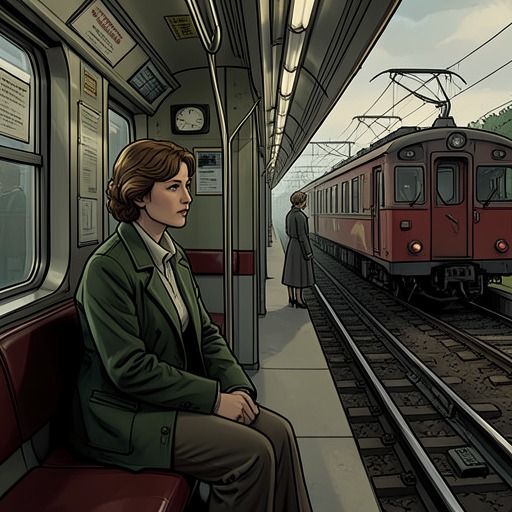
The Girl on the TrainThe 8.04 train is Rachel Watson’s regular route between Ashbury and Euston, a slow and unreliable commuter service that becomes a recurring setting for watching, remembering, and trying to recover lost knowledge. Its predictable rhythm offers Rachel comfort, while its stops beside the railway give her time to look into trackside homes and encounter fragments of a past she would rather avoid.
Route and Physical Character
The service is meant to take fifty-four minutes from Ashbury to Euston, but the journey rarely keeps to schedule. The train moves at what Rachel likens to a brisk jogger’s pace, jolting, scraping, and screeching back into motion after delays. The line is described as ancient and decrepit, troubled by signalling problems and seemingly endless engineering works; warehouses, water towers, bridges, sheds, and the backs of Victorian houses pass the carriage windows along the way. The train’s sluggishness is not incidental scenery: it repeatedly interrupts forward movement and extends the time Rachel spends looking out.
A faulty signal about halfway through the journey is almost always red. The train may wait there for seconds or for several minutes, making the pause a regular feature of Rachel’s commute. She usually sits in carriage D, where a stop gives her a clear view of a particular trackside house. The signal thus turns an infrastructure failure into a recurring vantage point: the service does not simply carry Rachel past the homes but sometimes holds her opposite them.
A Moving Vantage Point
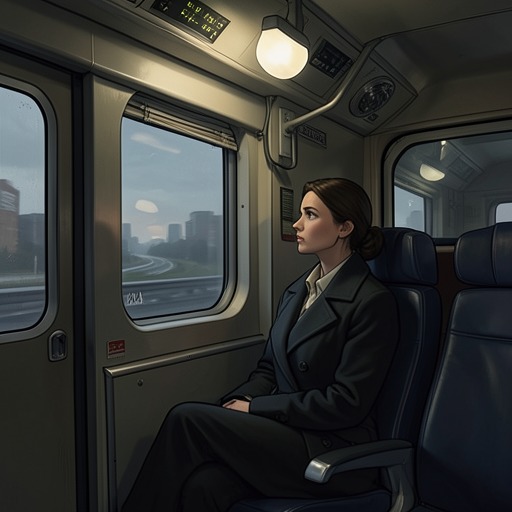
Rachel prefers the carriage to many other places. The sagging velour seat, sunlight through the window, and repeated rocking of the wheels form a soothing routine, even though she is not eager to arrive in London. From the window, houses roll past as if seen in a tracking shot; the railway offers a perspective their occupants may not share. The view lasts only briefly, but its repetition gives Rachel the impression of being admitted, momentarily, to strangers’ lives.
The train’s stops make that passing view more concentrated. At number fifteen, Rachel has learned the details of the house: its garden, beige curtains with a dark-blue print, peeling bathroom window frame, and missing roof tiles. She watches its occupants from the carriage and imagines a life for them, including the couple she calls Jason and Jess. The careful inventory of bricks and domestic details shows how the commute becomes an act of looking closely, while the lives behind the windows remain partly imagined and inaccessible.
The Trackside Clothes and Blenheim Road
The train also carries Rachel past a pile of clothing beside the tracks. At first she considers ordinary explanations: rubbish dumped in the scrubby wood or clothes left by railway engineers. Yet discarded garments prompt her to imagine the person who wore them, and the possibility that they signal something more disturbing. When the pile remains in place days later, she looks for blood and recalls having read that a train can tear clothes from someone it hits. The scene makes the railway view uncertain: what might be debris can become, in Rachel’s mind, evidence of a human story that the passing train cannot confirm.
As the service passes number fifteen, Rachel tries not to look four doors down at 23 Blenheim Road, her former home. She lived there for five years, a period she remembers as both blissful and wretched, and the train repeatedly brings the house into view despite her resolve to avoid it. Small changes register as painful signs of a life that has continued without her: a cream bedroom blind replaced by a soft baby-pink one, and Anna watering the rose bushes while pregnant. Rachel closes her eyes and counts as the train moves on, but the effort to avert her gaze underlines how the route makes the past difficult to escape.
Return Toward Witney
On 16 July 2013, Rachel boards the same 8.04 train but travels toward Witney rather than continuing to London. Megan is still missing, and Rachel hopes that reaching the station will jog her memory and help her see clearly what she cannot yet recall. She has no other course she can bring herself to take, and feels unable to call Tom. The altered destination gives the familiar service a different purpose: the train that ordinarily sustains a routine of looking becomes a means of returning toward the place where Rachel hopes memory might come back.
Across these journeys, the train links repetition with uncertainty. Its rocking motion and familiar seats offer a measure of steadiness, but its delayed progress repeatedly exposes Rachel to images she cannot fully interpret: strangers’ homes, her former home, clothes beside the track, and the route back toward Witney. The carriage window frames these fragments without resolving them. The 8.04 train is therefore both a dependable daily setting and a moving threshold between observation and memory, carrying Rachel onward while repeatedly bringing her attention back to what remains unresolved.