Tom Watson
The Girl on the TrainTom Watson emerges through Rachel Watson’s account as a figure divided between remembered intimacy and present-day refusal. Once her husband, he now tells her to stop calling and keep away from his family; the contrast makes his voice a measure of how far their relationship has deteriorated, while Rachel’s gaps in memory leave the circumstances behind his anger unresolved.
Identity and Background
The evidence offers little independent biography of Tom. Instead, it establishes him through Rachel’s recollections of their marriage and through brief, charged communications after their separation. Their fourth anniversary was approaching when Rachel tried to plan a surprise getaway, indicating a shared marital history that she still hoped to revive. In the present, however, he is associated with Anna and with a household from which he insists Rachel stay away.
The Marriage and Its Discovery
Rachel recalls that for the first five years she knew him, Tom called her Rach rather than Rachel. He also sometimes used Shelley, a name he knew irritated her; she remembers that teasing as part of a familiar intimacy, softened by the fact that his laughter could make her laugh too. When he later addresses her formally as Rachel, the changed name carries the chill of a relationship no longer lived in the old, private register.
The discovery that alters Rachel’s understanding of the marriage begins with an email on Tom’s computer. She says she was not searching for evidence of betrayal: she had gone to check his work schedule so she could arrange a surprise fourth-anniversary trip. Tom had discouraged her from using the computer after she accidentally deleted his email contacts, and had joked about her lack of technical skill. Rachel’s explanation emphasizes the accidental route by which she found out, rather than a deliberate attempt to catch him out. The passage frames the email as a modern equivalent of lipstick on a collar, but does not disclose its contents in this account.
Calls and Rejection
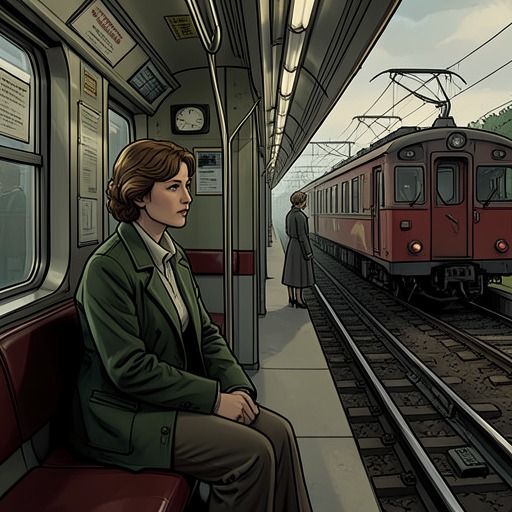
On a train passing the house where she and Tom had lived, Rachel answers his call after seeing his name on her phone. He sounds worn out and asks her to stop calling, sort herself out, and attend an Alcoholics Anonymous meeting. He says he cannot help her anymore and that her repeated calls are upsetting Anna. Rachel does not answer. Her silence, the hard lump in her throat, and the train’s proximity to her old home set his blunt boundary against her wish to see him face to face.
A later message, received at 10:15 p.m., is markedly more furious. Tom says he has spent nearly an hour driving around looking for Rachel and that she frightened Anna, who had considered calling the police. He orders Rachel to stop calling and hanging around, to stay away from his family, and not to come near them. He also says he will no longer protect her. The message makes clear that he regards her behavior as a threat to the life he has built, though Rachel cannot recall what happened during the hours he describes.
Narrative Role and Uncertainty
Tom’s communications reach the reader through Rachel’s limited, unsettled perspective: one is heard directly during a train journey, and the later one arrives as a message she listens to after returning home. Rachel’s memory does not account for the period between five and 10:15, so the accusation that prompted Tom’s search cannot be verified from her recollection at this point. Her imagined attack on Anna is explicitly a fearful reconstruction, not an established event. This uncertainty keeps Tom’s anger legible without resolving what Rachel may have done, and makes his demand for distance collide with her continued attachment to the past they shared.