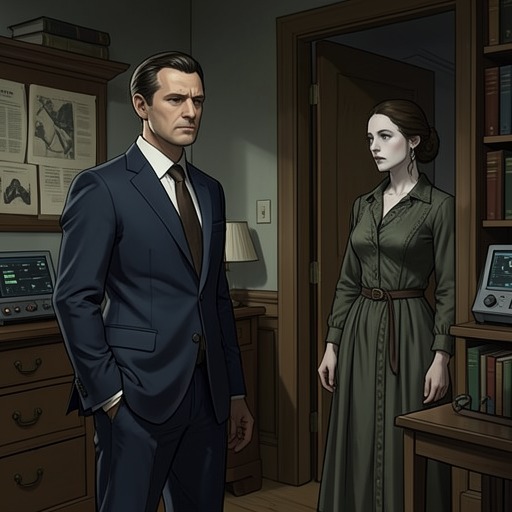
Tom and Anna’s marriage
The Girl on the TrainTom and Anna’s marriage begins in secrecy and takes on the reassuring shape of family life with Evie, but its apparent security is tested by the past it displaced and by suspicions Anna cannot settle through Tom’s reassurances. Their relationship connects a private affair to the novel’s wider conflicts over loyalty, parenthood, and what a family’s public image can conceal.
An Affair Becomes a Family
Anna recalls meeting Tom at a café when she was working in London and Rachel Watson might have passed by. The secrecy gave their meetings a thrill, and Anna once imagined Rachel appearing and understanding at once that Tom was no longer hers. Looking back, Anna is struck by how completely that wish has changed: what once felt like a daring beginning is now part of the history behind her marriage.
By 22 July 2013, Tom and Anna are raising Evie together. Tom suggests taking the child for breakfast at the café where their relationship began, and pushes the buggy while singing to Evie. Anna loves being out as a family and takes pride in how other people seem to see them. The scene gives their marriage an ordinary, affectionate surface, while its setting quietly recalls the secret arrangement from which that domestic life emerged.
Domestic Security and Its Friction
That family image does not remove the strain surrounding Rachel. Since Megan went missing, Anna has avoided passing the Hipwell home, but the café route takes the family by 15 Blenheim Road. When Rachel appears at the house, Anna abruptly lifts Evie from the buggy, startling her and making her cry. The protective gesture reflects how sharply Rachel’s presence disrupts Anna’s ease, even during a family outing she otherwise cherishes.
Anna wants the police told that Rachel was present on the night Megan disappeared. Tom doubts that Rachel is connected to the disappearance and says he will speak to her, while arguing against involving the police unless it becomes necessary. His response places him in the role of calming and managing Anna’s concern; it does not persuade her that the concern has been addressed. Later, when he points out that Rachel has stopped calling and has not come to the house, Anna acknowledges that Rachel is not actually harassing them but remains unwilling to set the matter aside. She considers seeking legal advice and decides that she will contact Detective Sergeant Riley the next time she sees Rachel. The exchange shows a practical difference between them: Tom treats the absence of further contact as grounds to wait, while Anna believes something is wrong and resents being told not to worry.
Parenthood and the Past
The family life Anna values is also shadowed by her awareness of what parenthood meant in Tom’s earlier marriage. Rachel’s account of infertility describes how the inability to have a child became a source of grief and isolation, while Tom believed that he and Rachel could still be happy without children. That history contrasts with Anna’s present pride in life with Tom and Evie, but it also places the child at the center of a complicated marital past rather than outside it.
The tension becomes more personal when Anna remembers an early occasion on which Megan came to care for Evie. Anna had gone upstairs to sleep; when she came down, Megan was leaning against the counter and Tom stood close to her, while Evie cried in her high chair and neither adult looked toward her. In the later crisis, Anna wonders whether she understood then that Tom wanted Megan. The memory does not establish what she knew at the time; instead, it shows her revising an ordinary domestic scene in light of what she now fears about her husband’s desire and choices.
Public Allegation and Private Doubt
After a news report claims, on the basis of unnamed sources, that Megan may have been involved in the unlawful killing of her child, Anna is shaken by the allegation and by the judgment she imagines others directing at her as a mother. Tom is unavailable to come home, but calls back between meetings and tries to reassure her that the report may be unreliable. Anna recalls that he had suggested Megan help with Evie and thinks he must feel horrible. At the same time, she admits to relief that Megan is gone. The episode binds their domestic arrangements to the public investigation: Tom’s earlier decision to bring Megan into their home now carries consequences for Anna’s sense of safety and for the family’s reputation.
In the later confrontation, Anna recalls Megan saying she could no longer work for them and tries to remember whether Tom seemed pleased or disappointed. She then returns to the image of Tom standing too close to Megan while Evie cried. Anna can entertain the possibility that she had recognized his desire, yet resists what that recognition might mean about him. She still describes Tom as a lover, husband, father, and provider. The marriage is thus presented neither as simple contentment nor as a fully understood partnership: its family rituals are real, but the reassuring picture Anna protects is increasingly difficult to separate from what she has seen and remembered.