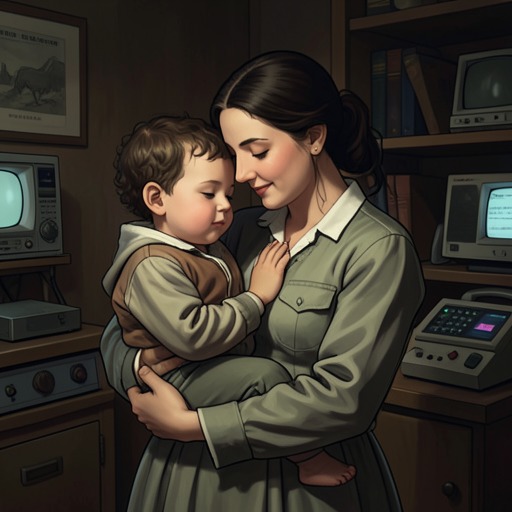
Tom and Evie’s father-daughter relationship
The Girl on the TrainTom and Evie’s father-daughter relationship is shaped by a contrast between his stated desire to be a father and the later scenes in which parenthood becomes entangled with secrecy, divided attention, and control. The novel first presents fatherhood as an anticipated source of joy; it later places Evie in the middle of a domestic crisis, where Tom’s tenderness toward her does not prevent him from using the family’s vulnerability to constrain Anna and Rachel Watson.
Identity and Early Expectations
Tom is Evie’s father, and his wish for children predates her birth. In Rachel Watson’s recollection of their marriage, he genuinely wanted to become a dad and imagined ordinary pleasures of family life: playing football in the garden with a son or carrying a daughter on his shoulders in a park. Those images make fatherhood concrete for him, not merely an abstract social expectation.
The difference between Tom and Rachel lay less in whether he wanted a child than in how he responded to their childlessness. He believed their life together could still be happy without children, while Rachel experienced the absence as a loss that she could not simply set aside. He became frustrated because he did not understand how someone could mourn a child she had never had. His imagined future as a father therefore coexisted with a willingness to accept a childless life that Rachel could not share. Evie’s eventual presence answers the future he once pictured, but it does not erase the strain that their different responses to infertility had placed on the marriage.
Fatherhood in the Household
The novel also situates Tom’s relationship with Evie within the practical routines of childcare. In an earlier scene, Rachel walks to the household to help Anna with the baby. Tom opens the door dressed for work, greets Rachel, and leaves; the immediate care of the child remains with Anna and Rachel. The scene gives little direct evidence about his interaction with the baby, but it locates fatherhood in a home where women are doing much of the visible daily caregiving.
Later, Anna’s account of Megan Hipwell’s childcare work complicates that domestic arrangement. Anna remembers coming downstairs after resting and finding Megan and Tom standing close together while Evie cried in her high chair; neither adult was looking at the child. The recollection does not establish that Tom’s relationship with Evie is generally neglectful, but it records a consequential failure of attention at a moment when he and Megan were involved with one another. Tom subsequently admits that he had been sleeping with Megan while she worked in the household. He describes the conduct as wrong and says he had not known about the history that later made Anna distrust Megan’s suitability as a caregiver. His admission acknowledges the betrayal of Anna’s trust, while the remembered scene shows how that betrayal coincided with Evie’s care being pushed aside.
Care, Protection, and Control
A different aspect of Tom’s fatherhood appears when Anna hears a phone ring and becomes unsettled. He puts his arms around her, asks whether she is all right, and tells her that she should have woken him rather than going outside alone. He presents keeping her safe as his responsibility. The moment suggests an image of Tom as a protective partner and father within the home, although the later confrontation makes that protective language more troubling: care and authority are not the same thing, and his assurances do not guarantee that he will respect Anna’s independence.
When Rachel and Anna confront him about Megan, Tom again holds Evie close. After discussing Megan’s death and his attempt to conceal what happened, he goes to Anna, kisses her on the head, lifts Evie from her chair, and takes a beer from the refrigerator while carrying her. These familiar gestures preserve the appearance of domestic tenderness amid a revelation that has shattered the family’s trust. Their juxtaposition does not prove that his affection for his daughter is false; instead, it shows that affection can persist alongside serious wrongdoing and can make his behavior harder for those around him to interpret.
Evie at the Center of the Crisis
That contradiction becomes acute when Rachel tries to escape. Tom strikes Rachel with a bottle and brings her back into the house, while Evie is still in his arms. Anna pleads for him to hand the child over because she fears Evie may be hurt. He does give Evie to Anna, who holds her against herself. The scene establishes danger and fear without showing Tom deliberately injuring his daughter; its force lies in the fact that his violence toward Rachel makes Anna question whether Evie is safe in his care.
Tom then tells Anna to go upstairs, close the bedroom door, and not call anyone, invoking Evie’s presence as a reason not to involve others. This instruction turns the child from the focus of ordinary parental tenderness into part of the pressure he places on Anna. The evidence does not resolve how Tom’s relationship with Evie would develop after the confrontation, and it offers no settled account of their future. Instead, it leaves fatherhood suspended between his earlier dreams of family life, intermittent gestures of care, and the coercive use of household authority exposed at the crisis’s end.
Narrative Significance
Evie’s presence connects Tom’s private hopes for fatherhood to the novel’s harsher account of family life. Rachel’s memories show how the prospect of a daughter once belonged to his imagined future; Anna’s recollections and the confrontation show that having a child does not itself make a household secure. The relationship is therefore neither reduced to a simple claim of affection nor defined solely by the crisis. Its tension comes from the coexistence of these facts: Tom can hold and comfort Evie, yet his secrecy and control place Anna in a position where she must protect the child from the consequences of his actions.