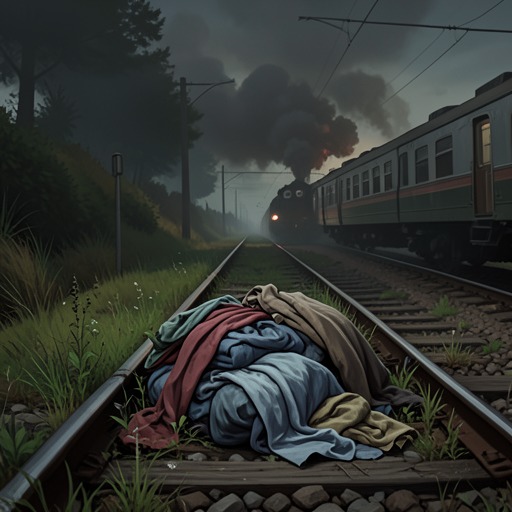
Unreliable memory and narration
The Girl on the TrainUnreliable memory and narration is a central feature of Rachel Watson’s story: recollection feels vivid without necessarily being accurate, while missing time leaves her dependent on accounts that may be false. The distinction between remembering an event and correctly identifying its details becomes decisive when Rachel recovers what happened near the underpass on the night Megan Hipwell disappeared. Her memory is not simply restored intact; she discovers that she has confused two scenes, and that recognizing the confusion changes what she knows about Tom Watson and Megan.
Alcohol, Memory, and Self-Doubt
Rachel’s memory gaps are connected to her heavy drinking. She wakes without knowing what occurred and has learned to rely on Tom to tell her what she supposedly did. He describes her as violent and presents bruises on his body as evidence; she finds his account difficult to reconcile with her own sense of herself and her recollection of fear. Over time, rather than ask for details or challenge what he tells her, she apologizes. The result is more than forgotten episodes: Rachel’s confidence in her capacity to know what happened is steadily weakened.
Tom’s version becomes especially powerful because Rachel has experienced other occasions when a memory that felt certain was wrong. At a party, she remembers a warm exchange with Clara, a colleague’s wife, including a friendly farewell. Tom later tells her that she had instead accused Clara of flirting with him and behaved abusively; in his account, he had to help Rachel leave while Clara remained frightened. Rachel accepts that her apparent memory of the farewell was not what happened. This precedent gives her a reason to doubt new recollections, even when those memories concern Tom’s own behavior. The episode establishes a crucial distinction: subjective vividness is not, by itself, proof of accuracy, but a memory’s prior failure does not establish that every later recollection is false.
Reconstructing the Underpass Memory
On an evening in Witney, Rachel deliberately returns to the underpass, following the idea of revisiting the place where something occurred. Standing at its entrance does not immediately recover the missing memory. As she turns to leave, a woman in a deep-blue coat passes her, and the sight prompts an image of Anna Watson in a blue dress. Rachel recalls Anna getting into Tom’s red car on the night Megan disappeared. That recollection conflicts with what the police had told her: that Anna was at home and was not in Tom’s car. The contradiction leaves Rachel unable to trust her own account or resolve what she saw.
A conversation with a man who encountered Rachel after that night supplies a partial external check. He remembers meeting her on the train, seeing her unsteady at Witney station, and later finding her upset near the underpass. He recalls that Tom had driven away with someone. His account supports parts of Rachel’s disordered recollection—her presence, her distress, and Tom’s departure with another person—but does not identify the woman or settle every detail. The memory therefore emerges through comparison: Rachel has an internal image, a conflicting explanation from Tom and the police, and another person’s limited recollection.
Dream, Recollection, and Correction
On the morning of 18 August 2013, Rachel describes fragments of memory coming together after a long period of uncertainty. At first, the underpass scene seems dreamlike. She recalls an encounter in which Tom approached her in anger and struck her, but her familiarity with mistaken memories makes her hesitate to accept it. The narrative places the reader inside that hesitation: the episode is initially presented as something that may belong to a dream, before Rachel recognizes it as a memory. She concludes that Tom’s claim that she had imagined his violence was false, and that the remembered golf-club incident was not evidence that she had wielded the club.
The recovered memory about the car also undergoes a precise correction. Rachel had combined Anna’s blue dress and movement away from her with a separate scene of Tom driving off with a woman. When she identifies the source of the mismatch, she remembers that the woman in the car scene wore jeans and a red T-shirt: it was Megan, not Anna. The revelation does not mean that every uncertain detail has been independently confirmed, but it does correct the mistaken identification that had obscured the significance of Tom’s departure. A displaced image had made two women and two moments seem like one.
Narrative Form and Consequences
Because Rachel narrates from within her own uncertainty, the account withholds a settled interpretation until she can revise it. The reader first encounters recollections as Rachel experiences them: incomplete, emotionally charged, and vulnerable to contradiction. Later information does not merely add a missing fact; it changes the meaning of earlier scenes. In this structure, the gap between what Rachel remembers and what happened produces suspense, while her self-doubt makes her vulnerable to accepting Tom’s version of events.
The novel also distinguishes memory’s felt certainty from its reliability without reducing recollection to a simple opposition between truth and falsehood. Rachel’s recollection of Clara is vivid but mistaken; the underpass memory initially seems dreamlike but proves accurate in its essential correction. The man’s account offers corroboration for only part of what Rachel remembers. Each source has limits, and knowledge develops through their comparison rather than through confidence alone.
The concept matters both psychologically and structurally. Rachel’s recovered memories expose how Tom’s descriptions have shaped her understanding of herself, and they redirect her interpretation of the night Megan disappeared. By revealing that a remembered scene can contain a real event and a misidentified detail at the same time, the narrative makes revision—not immediate certainty—the condition for understanding. Memory’s unreliability creates the mystery, but Rachel’s willingness to question and reassemble what she recalls allows the concealed connections to emerge.