Voyeurism and projection
The Girl on the TrainVoyeurism and projection are joined in Rachel Watson’s repeated view from the train: she watches a house beside the railway, then supplies its unseen occupants with names, histories, temperaments, and a marriage that mirrors what she believes she has lost. The habit offers comfort and a sense of intimacy, but its central irony is that the life she cherishes is largely invented. When a kiss briefly interrupts her ideal picture, her response reveals how strongly she has been using strangers to revisit her own past with Tom Watson.
The View from the Train
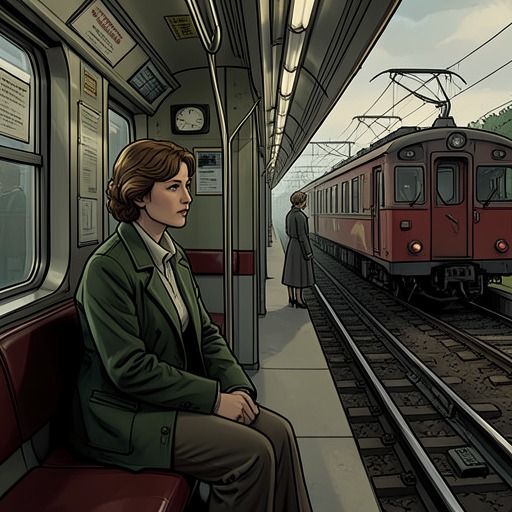
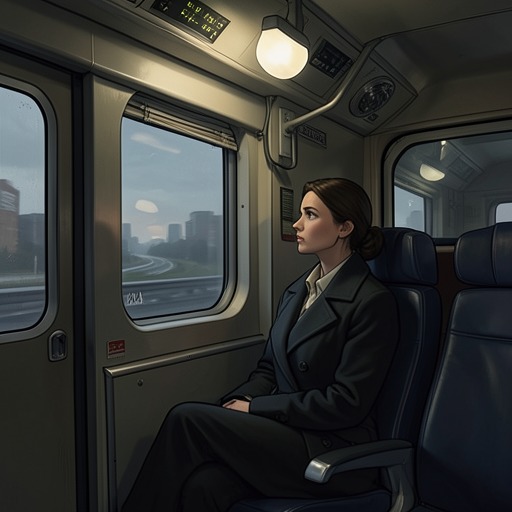
The railway window gives Rachel a recurring, restricted vantage on domestic life. She describes the houses rolling past as though in a tracking shot, a perspective their owners may never have, and takes comfort in glimpsing strangers apparently safe at home. The train’s movement makes the view temporary, while its daily repetition gives it a ritual quality: twice a day, she can look into other lives without entering them.
One house becomes the focus of that attention. Rachel usually sits in carriage D, and a signal that is almost always red brings the train to a stop with a view of number fifteen. She knows its visible details by heart: the Victorian semi’s two storeys, the garden running about twenty feet towards the fence, beige curtains with a dark-blue print, peeling paint on the bathroom window frame, and four missing roof tiles. This precision can resemble knowledge, but it is knowledge of a façade. The train provides a close, repeated look without access to the people or circumstances behind it.
Making Jason and Jess
Rachel turns that partial view into an imagined couple, whom she names Jason and Jess because she does not know their real names. In her construction, Jason is handsome, strong, protective, kind, and often away on humanitarian work; Jess is beautiful, artistic, and stylish, perhaps working in fashion, music, or advertising. Rachel pictures her painting upstairs and imagines the couple’s routines, from mornings in the garden to running together or sharing a shower. These scenarios are not reports of witnessed events: they are possibilities Rachel builds around brief glimpses and the house’s appearance.
The distinction becomes explicit when Rachel admits she cannot really see Jess, does not know whether she paints, and has never heard Jason’s voice. The couple moved into the house after Rachel left the nearby area, and she has never seen them up close. Yet, over about a year of watching, they become important to her. The vividness of the imagined portraits therefore measures not how much she knows about them, but how much she has invested in making them legible.
Projection of a Lost Marriage
Rachel’s invented couple are not independent of her own history. She decides that Jason and Jess are happy, a match, and a set, and thinks of them as what she and Tom were five years earlier. They stand for what she lost and what she wants to be. The house becomes a private screen on which she can replay an idealized version of her marriage: the pair’s imagined ease replaces the knowledge of her own relationship’s collapse.
A remembered breakfast makes the connection especially clear. As the train brakes at the signal, sunlight on the houses prompts Rachel to imagine herself at a breakfast table with Tom opposite her, her bare feet resting on his warmer feet, her eyes lowered to the newspaper. She recalls his smile and her blush. The scene is a memory, not evidence about the occupants of number fifteen; nevertheless, it arrives through the same window that frames Jess and Jason. The narrative moves between looking outward and remembering inward, showing how Rachel’s observation becomes a route back to her own intimate past.
The Kiss and the Collapse of the Picture
That morning, Rachel sees Jess in the garden and a man leave the house carrying what may be mugs of coffee. She initially assigns him possible roles—a relative, family friend, cousin, or old friend—and imagines explanations for his presence. Then Jess walks towards him, puts her hands around his waist, and kisses him. The train moves before Rachel can learn who he is or what the kiss means beyond what she has seen. Her view offers a moment of apparent intimacy, not the context needed to understand the people involved.
Rachel reacts as if the imagined marriage has been betrayed. She feels cheated and disappointed, and recognizes in the pain an ache she has experienced before. The response is disproportionate to her actual connection with the strangers, but proportionate to the role she has assigned them: their happiness had been made to carry her hopes. She condemns Jess for damaging a beautiful life, although that life was largely Rachel’s own construction.
The reaction leads directly to Rachel’s memory of discovering Tom’s affair through emails on his computer, including messages in a folder labeled Admin. She had learned that Tom was in love with Anna Watson and wanted to be with her. Recalling that discovery on the train clarifies why Jess’s kiss feels personal: Rachel’s anger at a stranger’s apparent infidelity draws on her own experience of betrayal. She imagines herself wanting to confront Jess, even as the scene has exposed the distance between her certainty about the couple and the little she actually knows.
Narrative Significance
The motif depends on a tension between looking and knowing. Rachel’s observations of the garden, windows, curtains, and kiss are specific, but specificity does not validate the stories she attaches to them. Her habit turns visual fragments into a complete domestic narrative, then treats that narrative as emotionally real. The reader is consequently placed close to her perceptions while also shown their limits: Rachel herself acknowledges that Jason and Jess are names she supplied and that many of their traits may not exist.
The imagined couple also gives the novel a way to stage Rachel’s grief and resentment without separating them from ordinary acts of watching. The red signal pauses the train; the repeated pause invites her to look; the look becomes fantasy; and the fantasy gives way to memory when the kiss ruptures it. The window is at once a boundary and a frame, allowing Rachel to feel near a life she cannot enter while making her own past seem newly visible. Voyeurism and projection thus name not merely her attention to strangers, but the emotional process by which she turns that attention into a reflection of what she lost with Tom.