Voyeurism and the act of watching
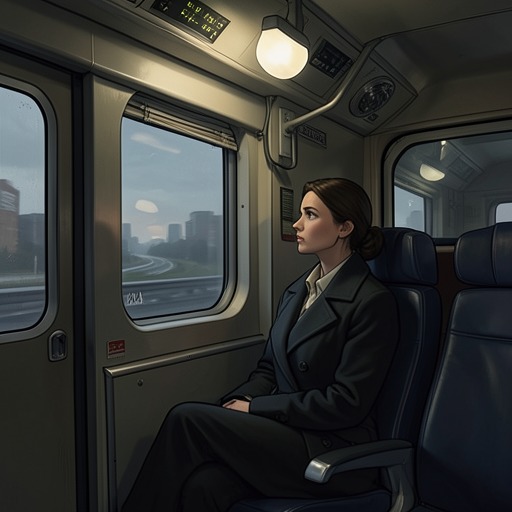
The Girl on the TrainVoyeurism and the act of watching are organized around the train window, which gives Rachel Watson repeated views of people at a distance while withholding the context that would make those views reliable. Her observation of Megan Hipwell begins as a deliberate search: Rachel knows where Megan lives, looks out for her as the train passes, and eventually tells Scott Hipwell that she saw Megan on the lawn with someone other than him. The habit makes Rachel a witness, but not an informed one; its intimacy is imagined across a gap that her looking cannot close.
The train window and deliberate looking
Rachel explains to Scott that she takes the train from Ashbury into London every day and that, because she knows where Megan lives, she sometimes looks for her as the train goes by. Megan was often outside. On the Friday before her disappearance, Rachel saw her on the lawn with another person and told Scott plainly that the person was not him. The observation matters to the investigation because it challenges Scott’s understanding of Megan’s whereabouts and company. Yet Rachel’s account also reveals that the encounter was not wholly accidental: she had made a practice of searching for Megan from the train.
That distinction unsettles Scott. He asks whether Rachel was simply looking out of the window when a woman she happened to know came into view. His doubt exposes the ambiguity of her role. Rachel has evidence, but it comes from a position of habitual watching, not from a conversation with Megan or a close view of what happened. Rachel admits that she has watched for her because she knew the house. The train allows repeated access to a private scene while preserving distance from the people in it; Rachel can see Megan, but she cannot know what Megan’s life means from the outside.
Watching, trust, and imagined intimacy
Scott’s response makes the social consequences of this distance visible. At first, he speaks to Rachel as if she were Megan’s friend and someone he could trust. Rachel recognizes that this trust is misplaced, even as she finds it gratifying. Once Scott questions why she was watching the house, however, the atmosphere changes: he is no longer sure she is an ally. What Rachel has treated as a private routine becomes, when explained aloud, something that can look suspicious. The same act supplies a clue and threatens the credibility of the person supplying it.
The watching also encourages a sense of connection that the evidence does not support. Rachel has seen Megan repeatedly from afar, but this familiarity does not make her Megan’s confidante. In another tense moment, Rachel’s attention fixes on a smile she reads as triumphant, and she thinks that she and Scott need to get away and involve the police. The shift from looking for Megan to interpreting her expression as a threat shows how little separates observation from projection. Rachel’s view may be precise about what is visible and still uncertain about what it means.
The terrace as an afterimage
After Megan’s disappearance and death, Scott describes a related but transformed compulsion. He struggles to sleep at home and keeps returning to the window to check that Megan is not sitting on the terrace. He says that she liked to sit there and watch the trains, and that he hears her calling from outside. Rachel replies that she used to see Megan there. The terrace, once a place Rachel scanned from a passing train, becomes a place Scott cannot stop scanning from within the house.
The reversal joins their different forms of looking. Rachel’s train journey once made Megan an image in a familiar landscape; for Scott, the same landscape now produces an absence that he repeatedly checks. His looking cannot undo the loss or settle his fear. Rachel’s brief admission that she saw Megan there confirms a shared visual memory, but it does not make the two characters’ experiences equivalent: Rachel watched at a distance, whereas Scott describes the intimate aftermath of living in the place where Megan is missing.
Uncertain sight and the limits of witnessing
A later early-morning train passage gives the motif a more unstable form. Rachel notices dark-blue clothing beside the tracks, thinks it may be a dress with a black belt, and cannot remember where she has seen it before. The detail is concrete, but its significance is initially inaccessible to her. Looking delivers an image before it delivers recognition, so the reader encounters the same gap between what can be seen and what can be understood.
On the same journey, Rachel watches a couple at 15 Blenheim Road. At first, the scene appears ordinary: Jess and Jason are on the terrace before half past eight, she wears a red-flowered dress and bird-shaped earrings, and he stands behind her with his hands on her shoulders. As the train remains stopped, Rachel sees his hands move to Jess’s neck and believes he is choking her. She bangs on the window and screams, but he cannot hear her; a red-haired man tells her it is already too late. The passage turns the train window into a barrier between seeing and intervening, while its heightened, uncertain perception cautions against treating Rachel’s view as neutral or complete.
Across these scenes, watching is both a means of noticing and a source of misreading. Rachel’s routine gives her a detail relevant to Megan’s disappearance, but it also encourages her to imagine an intimacy she does not possess. Scott’s checks of the terrace turn looking into grief’s repetition, while the later train scenes make the limits of visual testimony explicit: an image can be vivid, urgent, and still not explain itself.