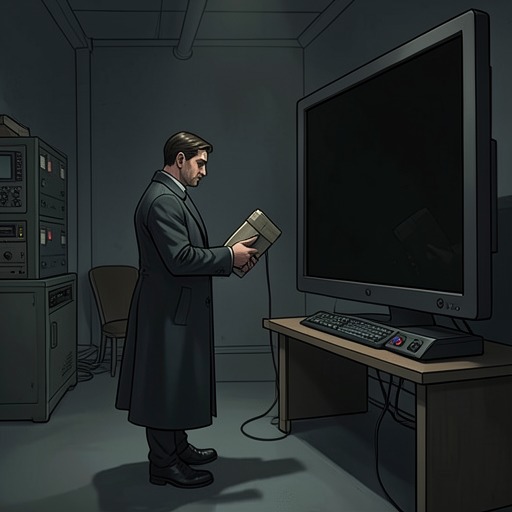
Analysis of consequences
The Girl with the Dragon TattooAnalysis of consequences is Lisbeth Salander’s defining practical discipline. It is not abstract calculation detached from emotion, but a survival method formed by dependence, institutional power, and repeated experience of the price of impulsive action. Again and again, she asks what a decision will produce, who will gain control, and whether the apparent solution will actually restore her freedom.
A Learned Rule of Conduct
Analysis of consequences first appears as a lesson Holger Palmgren had impressed upon Lisbeth Salander: every action has consequences. Five weeks after Palmgren suffered a severe cerebral haemorrhage and was left unable to speak or move, the Guardianship Agency summoned her to meet her new guardian. Her first impulse was to ignore the summons, but Palmgren’s teaching altered the calculation. She concluded that the easiest way through the immediate dilemma was to attend and behave as though she cared about what the authorities had to say.
This response shows the expression operating at two levels. Salander does not submit inwardly to the Guardianship Agency, nor does she mistake outward compliance for trust. She performs concern because doing so may reduce immediate danger. Her silence at the meeting with the elderly representative and Advokat Bjurman is therefore strategic rather than passive: she weighs the institutional situation and chooses the action most likely to preserve room for manoeuvre.
Consequences Under Guardianship
The need for such calculation is created by the legal structure surrounding Salander. Guardianship removes a client’s authority to manage money and make decisions, transferring all legal powers to the guardian. The arrangement is stricter than trusteeship, and in Salander’s case it means that her bank account and important decisions are no longer under her control. Although the Guardianship Agency must review the arrangement annually, her refusal to undergo psychiatric examination gives the authorities no reason to change it, producing a year-after-year status quo.
Holger Palmgren had interpreted the law’s requirement that guardianship be adapted to each individual case generously. He submitted the required monthly reports and annual review, while allowing Salander to control her own money and live as she chose. He did not attempt to regulate her friends, lifestyle, nose ring, or tattoo. Because he treated her as an ordinary person despite the legal arrangement, Salander paid little attention to her formal status while he remained her guardian. His collapse transforms that relatively tolerable arrangement into an immediate threat, making consequence analysis the mechanism by which she must compensate for the loss of his protection.
From Assault to Counter-Control
When Advokat Bjurman sexually assaulted her, Salander did not report him to the police. The narrative makes clear that a conventional report could have been supported by bruises on her neck and biological evidence, and that Bjurman had also violated the regulations governing guardians. Yet Salander believes the police would distrust her, that her word would carry less weight than his, and that the assault would be minimized because of her appearance. Her hostile history with the police, including an earlier confrontation with a riot officer, reinforces her conclusion that official institutions are not a safe option.
Her refusal to report the assault is not presented as indifference to what happened. The assault crosses a boundary and demonstrates that Bjurman’s legal authority places her at his mercy. Afterward, she studies the possible ways to regain control. She discovers that household products could be converted into deadly weapons and becomes convinced that killing Bjurman is technically possible. She then rejects poison because his death would not automatically return control of her life, and because his successor might be no better. Murder would remove one guardian without abolishing the system that empowered him.
Salander instead develops a plan requiring her to let Bjurman attack her again so that she can obtain evidence capable of controlling him. The plan is repellent, but its logic is exact: she seeks not revenge alone but leverage. When Bjurman later summons her to his home near Odenplan, relieved that she has called for more money but worried that she may have told an outsider, he explicitly tries to keep her in check and reassert who is in charge. Salander’s long silence before agreeing indicates that she understands the danger and proceeds because the meeting may complete her countermeasure.
Evidence as Reversal of Power
The consequence-analysis method reaches its sharpest form when Salander shows Bjurman the ninety-minute recording of his abuse. The video ends with him naked beside the bed, drinking wine while Salander lies with her hands fettered behind her. She turns off the television, waits, and then explains that she had initially misjudged the degree of his depravity. Her speech converts the recording from private evidence into a threat against his public identity, legal position, and future freedom.
Salander tells him that the video shows a guardian raping a twenty-four-year-old woman under his care and warns that observers will see him not merely as a pervert but as a sadist. She reverses his earlier manipulation of credibility: the evidence now makes his conduct visible, while his authority becomes a liability. Her use of the whip after the warning makes the reversal physical as well as rhetorical. The same expression that once restrained her hand at his desk now structures a retaliation designed to prevent further assault and restore control.
Investigation, Pursuit, and Moral Choice
Analysis of consequences also governs Salander’s investigative work. While considering the disappearance of Harriet Vanger, she identifies the possibility that a sadistic killer’s history might include tortured animals, arson, and a dysfunctional home. The parsonage fire in the late 1970s therefore becomes a lead rather than a conclusion: she notes that it occurred in the same broader pattern as animal abuse and unexplained fires associated with the murder cases, while acknowledging that the connection is only a long shot. Her method joins pattern recognition to restraint; she follows an implication without pretending that it proves the case.
The same discipline appears during the motorcycle pursuit on the E4. After seeing the suspect’s tail lights heading south, she accelerates to roughly ninety miles per hour, closes to about two hundred yards, and then deliberately asks herself what to do next. She decelerates to seventy-five and keeps pace rather than pursuing blindly. Even at speed, the question is not simply whether she can catch him but what catching him would accomplish and what risks the pursuit creates.
The expression becomes an explicit moral issue in the discussion of the Vanger murders. Mikael Blomkvist explains that Gottfried Vanger was responsible for the first series of murders between 1949 and 1965, and that Martin Vanger was drawn into the crimes after puberty. Martin witnessed the murder of Lea in Uddevalla in 1962 at fourteen and actively participated in the murder of Sara in 1964 at sixteen. Blomkvist further infers that Gottfried sexually abused Martin and called the abuse his duty.
Blomkvist argues that upbringing leaves a mark, pointing to Gottfried’s own history of being beaten by his father. Salander rejects the consequentialist explanation when it threatens to become an excuse. She insists that mistreatment does not give Gottfried or Martin the right to murder women and that each made a choice. Her objection distinguishes explanation from responsibility: causes may clarify how violence develops, but they do not erase the consequences that perpetrators impose on others or their accountability for choosing violence.
Recurrence and Narrative Meaning
Near the end of the book, after working through the night, Salander sits with her mind operating at top speed. Her chain of associations moves through her mother, sister, Mimmi, Holger Palmgren, “Evil Fingers,” Dragan Armansky, the job, Harriet Vanger, Martin Vanger, the golf club, and Advokat Bjurman. The sequence gathers apparently separate episodes into one mental ledger. Each name carries an unresolved action, a danger, an obligation, or a practical task that she cannot forget.
The recurrence of analysis of consequences gives Salander’s intelligence an ethical and political dimension. She is forced to calculate because guardianship has deprived her of legal autonomy, because Bjurman exploits the dependence created by that system, and because institutions appear unlikely to believe her. Yet the same habit prevents her from reducing other people to simple products of circumstance. It enables tactical resistance, preserves investigative caution, and insists that suffering may explain a violent history without excusing the violence that follows.