Cecilia Vanger
The Girl with the Dragon TattooCecilia Vanger is Harald Vanger’s daughter and one of the Vanger family members whose testimony helps Mikael Blomkvist revisit the unresolved disappearance of Harriet Vanger. She is introduced as an apparently open and engaging woman, but her resemblance to her sister Anita Vanger becomes central to the investigation, turning her from a seemingly familiar face in the family record into part of the case’s most consequential visual mistake.
Identity and Introduction
Cecilia first appears during Blomkvist’s second week in Hedeby, when she visits him at his office and introduces herself. She is blonde, warmly dressed against the cold, and socially direct. Over coffee, she tells him that she understands he is writing a book about the Vanger family and admits that she is not sure she approves of the idea. Her visit establishes her as both a member of the family under examination and someone willing to address Blomkvist personally rather than remain merely an archival subject.
The family’s internal geography gives Cecilia an important but strained position. She is Harald Vanger’s daughter and lives next door to him, yet the two are not on speaking terms. Henrik Vanger had spoken appreciatively of her, which gives Blomkvist a favorable preliminary impression, while her estrangement from Harald reveals the family’s apparently close estate life as divided by private antagonisms. Cecilia is not presented as a detached observer: she belongs to the family whose history Blomkvist is trying to reconstruct, but she also stands at a distance from one of its senior members.
Connection to the Disappearance Investigation
Cecilia was on Hedeby Island during the crisis surrounding Harriet Vanger’s disappearance. Blomkvist recognizes that she was present on the island that day, and she confirms that she witnessed the commotion. The fact makes her a potential eyewitness to the locked-room mystery formed by the island, the bridge accident, and Harriet’s vanishing. Her position is especially valuable because the official investigation had already gathered accounts from Henrik Vanger, Isabella Vanger, Ulrika Vanger, Harald Vanger, Greger Vanger, Martin Vanger, and Anita Vanger, yet the essential question remained unanswered.
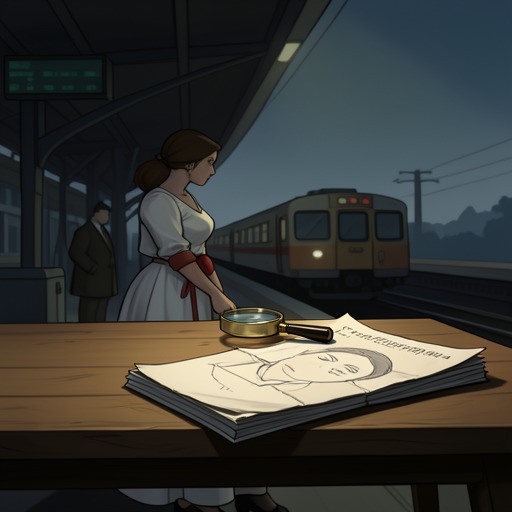
Her connection to the case is also mediated by records. Detective Inspector Gustaf Morell’s typed reports preserved the police response to Harriet’s disappearance in unusually readable and detailed prose, while the family’s photographs preserved fragments of the same day. Cecilia becomes entangled with this documentary structure when Blomkvist studies a photograph from the 1966 accident photograph album. The image was taken at the Children’s Day parade on Järnvägsgatan in Hedestad, several hours before the bridge accident, and was the last picture taken of Harriet Vanger on that fateful day.
Blomkvist’s breakthrough begins when he notices a woman behind the accident scene whose height, light-coloured clothing, and flowing hair fit the figure he has been trying to identify. In the sequence of photographs taken from the window of Sundström’s Haberdashery, Harriet appears in seventeen of eighteen images. One woman, approximately five foot seven, seems to match the description, and the person who fits it appears to be the twenty-year-old Cecilia Vanger. This interpretation initially gives Cecilia a direct visual connection to the moment surrounding Harriet’s disappearance.
The Photograph and the Misidentification
The apparent identification collapses when Blomkvist examines the Vanger family album again. In photographs from the family council of 1966, Cecilia sits at the far end of a formal dinner table in a light-coloured dress. Beside her is another blonde woman with long hair wearing an identical light-coloured dress. The two women resemble each other so closely that they could have been twins. Blomkvist realizes that the woman in the window was not Cecilia but her sister, Anita Vanger, who was two years younger and later lived in London.
The error had persisted because Cecilia and Anita had never previously appeared together in the same frame. In black-and-white photographs, especially when seen from a distance, they looked identical. Henrik Vanger could presumably distinguish them, but Blomkvist and Lisbeth Salander had assumed that repeated images of a similar blonde woman showed Cecilia. No one corrected the mistake because no one had thought to ask whether the figure was Cecilia or Anita. Cecilia’s role thus exposes how an archive can seem to offer certainty while concealing an elementary question of identity.
The revelation is marked by Blomkvist’s physical shock: he chokes on his coffee, begins coughing, and sits upright when the puzzle falls into place. The reaction does not merely signal a new clue. It shows the case changing shape through retrospective perception. A familiar family photograph, once treated as confirmation, becomes evidence of a mistaken reading, and Cecilia’s apparent presence near the accident is replaced by Anita’s. The sisters’ resemblance has functioned as a visual double, allowing the investigation to preserve the wrong person in the wrong place for decades.
Relationships and Witness Position
Cecilia’s relationship to Blomkvist is initially that of a family member confronting an outsider who has been commissioned to write about the Vangers. Her visit combines openness with reservation: she speaks to him directly, shares coffee, and raises the family chronicle’s implications, but also signals that she does not automatically welcome his project. That ambivalence places her between cooperation and resistance, reflecting the larger tension between the family’s desire to control its history and Blomkvist’s effort to make its silences legible.
Her relationship to Harald is more explicitly fractured. Although they are immediate neighbours on the Vanger estate, they are not on speaking terms. The contrast between physical proximity and emotional distance is significant in a family whose houses, albums, police reports, and memories all place its members close to the disappearance while leaving the truth inaccessible. Cecilia’s estrangement from Harald also prevents the family from functioning as a unified source of testimony; proximity does not guarantee knowledge, trust, or communication.
Cecilia’s relation to Anita is the decisive hidden connection in her narrative function. Their likeness makes them visually interchangeable to investigators, yet their actual identities and circumstances are not interchangeable. Cecilia is the woman Blomkvist first thinks he sees; Anita is the sister who occupies the decisive image. The investigation’s delay therefore depends not on the absence of evidence but on the failure to distinguish two women whom the photographic record repeatedly places within the same visual pattern.
Narrative Role and Significance
Cecilia Vanger represents the unstable boundary between witness, subject, and mistaken image. She was present during the crisis and was believed to appear in the photographic evidence, but the crucial figure was ultimately Anita. Her significance lies less in a completed account of Harriet’s fate than in the way her identity redirects the investigation. Once Cecilia is removed from the photograph, the evidence points toward a different sister and makes the family’s unexamined assumptions newly consequential.
Her role also links the official archive with private memory. Morell’s formal police reports preserve interviews and investigative measures; the family album preserves faces and arrangements; Blomkvist’s reading supplies the connection between them. Yet none of these records speaks by itself. The photograph has to be revisited, compared, and interpreted, and even then it first produces a confident mistake. Cecilia’s image demonstrates that memory can be preserved materially while remaining misunderstood.
Cecilia’s importance is consequently retrospective. She helps define the case’s method: the truth emerges through delayed scrutiny of ordinary documents, and a clue becomes decisive only when an unnoticed relation—in this instance, the resemblance between sisters—is recognized. Her presence in the story turns photographic similarity into a narrative mechanism of concealment and makes the reconstruction of Harriet Vanger’s disappearance a struggle not only against missing information but also against information that has been seen incorrectly.