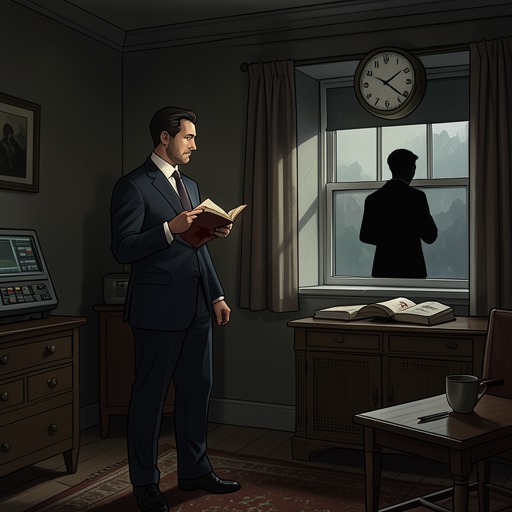
Christer Malm
The Girl with the Dragon TattooChrister Malm is the art director and designer of Millennium, one of the magazine’s three part owners alongside Erika Berger and Mikael Blomkvist. His importance lies not only in giving the publication its modern visual identity but also in providing a measured, unexpectedly decisive voice when the partnership is placed under strain.
Identity and Background
Malm is a sought-after professional photographer and designer. At thirty-six, he operates his own business from an office on the same floor as Millennium and contributes graphic design to the magazine for one week each month. His professional role makes him responsible for the publication’s visual presentation, while his ownership gives him a direct stake in its survival and editorial direction.
Malm is also a public figure whose private life has become part of the media landscape. He is openly gay and has appeared with his boyfriend in “at home with” features. Public interest in him increased after he moved in with Arnold Magnusson, an actor associated with the Royal Dramatic Theatre who achieved a major breakthrough by playing himself in a docu-soap. Malm and Magnusson consequently became a media item, placing Malm on both sides of the publicity process: he helps shape a magazine’s public image while experiencing celebrity attention himself.
Role in Millennium
Malm’s connection to Millennium was encouraged by Berger, who persuaded him to buy into the magazine. His participation reflects the mixed social and professional world from which the publication emerged. Millennium is described as a joint creation of Berger and Blomkvist, but its early financing depended heavily on Berger’s ability to secure investment; Malm became part of that enterprise as both a creative professional and an owner.
His design work contributes to the magazine’s modern appearance, complementing its frank and reliable editorial style. Millennium has a small staff and is not highly profitable, although it breaks even and has seen circulation and advertising revenue increase gradually. Within that modest structure, Malm’s specialized labor is unusually consequential: the magazine’s identity depends on the combination of investigative journalism, editorial control, financing, and visual design.
Judgment During the Crisis
When Blomkvist considers the magazine’s difficulties, he remembers having regretted the decision to hire Janne Dahlman, whose outlook is persistently negative. Malm stands in contrast to that enervating pessimism. He is not presented as someone who dominates the newsroom or routinely makes dramatic interventions; instead, his significance emerges when he decides that responsibility requires action.
During the debate over Blomkvist’s future at Millennium, Berger is told that, as editor in chief and senior shareholder, she can dismiss him. She replies that the magazine has never fired anyone and that the accumulating decisions have made going to the office unpleasant. Malm then surprises both of them by standing up and entering the discussion directly. He acknowledges that the situation is bad, but accepts Blomkvist’s assessment that Blomkvist is close to breaking point. From that premise, Malm reaches a practical conclusion: Blomkvist must leave for his own sake, and Millennium owes him that much. His intervention converts an emotionally charged dispute into an act of institutional responsibility.
Relationships and Collective Responsibility
Malm’s relationship with Berger and Blomkvist is simultaneously collegial, financial, and creative. As co-owner, he cannot regard the magazine’s problems as someone else’s concern; as designer, he belongs to its working structure; and as a friend and colleague, he is capable of recognizing the personal cost of decisions that might otherwise be treated as business matters.
His response to Blomkvist also reveals a form of loyalty different from simple agreement. Malm does not merely defend Blomkvist or attack those who oppose him. He listens to the claim that Blomkvist is about to collapse, accepts the need for separation, and frames departure as something the magazine owes its partner. That combination of realism and care is why his brief intervention carries disproportionate weight.
Later, Malm continues to function as a responsible organizational figure. At a conference meeting attended by six people, he looks tired and has deliberately kept the purpose of the meeting from the staff, although one employee has sensed that something unusual is happening. He has also arranged for Magnusson to attend despite Magnusson still being on holiday. These details show Malm managing communication and attendance in a tense moment, balancing confidentiality with the need to assemble the relevant people.
Narrative Role and Significance
Malm is not the central investigator or the magazine’s most visible public voice, but he embodies the collective infrastructure that allows Millennium to exist. His photography and design make the magazine legible to the public; his ownership ties his livelihood and reputation to its fortunes; and his interventions demonstrate that the publication’s principles depend on ordinary acts of judgment as much as on spectacular revelations.
His narrative function is therefore grounded in contrast. Against Dahlman’s habit of seeing everything negatively, Malm offers a clearer form of practical judgment. Against the pressure to treat Blomkvist’s crisis as an administrative inconvenience, he recognizes a human obligation. Even his later tiredness at the conference table reinforces this characterization: responsibility has a cost, but he continues to perform it. Malm’s contribution to Millennium is consequently both aesthetic and ethical—he helps shape what the magazine looks like, and he helps determine how its people treat one another when its stability is threatened.