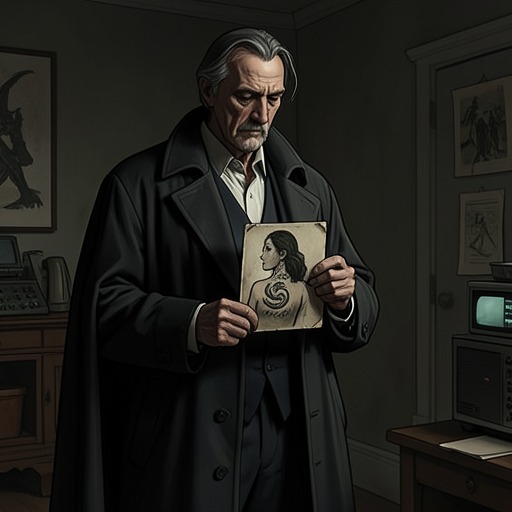
Dirch Frode
The Girl with the Dragon TattooDirch Frode is Henrik Vanger’s longtime corporate lawyer, sole client, and trusted intermediary. His apparently modest administrative role becomes decisive: he brings Mikael Blomkvist into contact with Henrik, helps open the investigation into Harriet Vanger’s disappearance, identifies Lisbeth Salander as a possible research partner, and later communicates Henrik’s refusal to pressure Blomkvist over publication.
Identity and Background
Frode introduces himself to Blomkvist by telephone as a lawyer representing a client who wants to meet in person. He is careful, formal, and slightly apologetic in his approach, presenting the request as an interruption before making clear that the meeting cannot be handled by another phone call. The client is Henrik Vanger, whose private investigation will redirect Blomkvist’s life after the collapse of his case against Hans-Erik Wennerström.
Frode explains that he was born in Skåne and began working for Henrik in 1962, immediately after graduating. Over the years, the professional relationship developed into a friendship. By the time he contacts Blomkvist, Frode is officially retired, but Henrik remains his only client. Henrik no longer needs frequent legal services, so Frode’s continuing work is selective rather than routine: he is called upon when Henrik needs a discreet, reliable person to handle an unusual matter.
Function in the Investigation
Frode is the human gateway between Henrik’s private grief and Blomkvist’s investigative work. He arranges the meeting that allows Henrik to offer Blomkvist the task of reconstructing Harriet Vanger’s disappearance, and his knowledge of Henrik’s intentions gives the request a legitimacy that a stranger’s approach would not have carried. He also understands the unusual nature of the assignment: Henrik wants a journalist with a ruined reputation, not simply a conventional investigator, because the project requires both persistence and a willingness to examine the Vanger family’s history.
Frode’s own legal and institutional knowledge places him close to the documentary record surrounding the case. The investigation depends on materials such as police reports, family archives, photographs, and Henrik’s accumulated records. The police documentation identifies Detective Inspector Gustaf Morell as the officer who arrived at Hedeby Island, took command, and prepared a formal report on Harriet’s disappearance. Frode is not presented as the detective who solved that case; his importance lies in helping place its surviving records and witnesses before Blomkvist, who can read their omissions and misidentifications anew.
His practical judgment also leads him to recognize that Blomkvist cannot complete the work alone. When Blomkvist says that he needs a professional researcher who understands archives and can be trusted, Frode immediately thinks of Salander, adding that she had conducted the background investigation on Blomkvist. The remark escapes before he can retract it, revealing both his awareness of Salander’s abilities and the guarded manner in which information is managed around Henrik’s enterprise. Through Frode, Salander’s hidden professional competence becomes available to the investigation.
Relationship with Henrik Vanger and Blomkvist
Frode’s relationship with Henrik combines legal representation, friendship, and personal loyalty. He has worked for Henrik since 1962 and now serves a client whose needs are infrequent but emotionally consequential. This long association gives Frode the authority to speak for Henrik while preserving Henrik’s distance from the early stages of the inquiry. Frode does not replace Henrik’s judgment; he translates it into meetings, contracts, research arrangements, and written communications.
With Blomkvist, Frode is simultaneously courteous and strategic. He knows that Blomkvist has just lost a public contest with Hans-Erik Wennerström, yet he refuses to treat the journalist as merely disgraced. When Blomkvist dismisses himself as someone sought out only because of his ruined reputation, Frode answers that Blomkvist should not sell himself short and reminds him that he is not the first person to lose a match against Wennerström. The reassurance is also recruitment: Frode frames Blomkvist’s defeat as a reason to understand him, not as proof that he lacks value.
The Contract and Freedom to Publish
Frode’s later role concerns not discovery but independence. He delivers Henrik’s letter to Blomkvist, beginning with a declaration of respect for Blomkvist’s integrity. Henrik states that he does not intend to tell Blomkvist what to write and will not exert pressure over whatever Blomkvist chooses to publish. The existing contract remains valid if Blomkvist wishes to continue, and Henrik acknowledges that Blomkvist already possesses enough material to complete the Vanger family chronicle.
Frode’s act of delivering the letter preserves the ethical distinction between patronage and control. Henrik has financed or commissioned access to the family history, but the letter rejects the idea that such support gives him editorial authority. Frode therefore becomes the channel through which a potentially coercive arrangement is made less coercive: he carries the client’s assurance while leaving the final decision with Blomkvist.
Narrative Role and Significance
Frode is a restrained but structurally important character. He does not dominate the investigation, uncover the decisive photographic mistake involving Cecilia Vanger and Anita Vanger, or provide the psychological explanation for Gottfried Vanger and Martin Vanger’s crimes. Those discoveries belong to the investigators and to Harriet Vanger’s testimony. Frode’s contribution is different and foundational. He creates the chain of trust through which the discoveries can occur.
His presence also links several forms of memory and authority. Harriet’s last known image appears in the photograph taken during the Children’s Day parade, while the 1966 accident photographs, police reports, and family records preserve competing fragments of the past. Frode stands on the side of organized access to those fragments: as lawyer, representative, and custodian of Henrik’s intentions, he helps convert private documents into an investigation that can be interpreted, challenged, and eventually published.
The contrast between Frode’s discreet professionalism and the violence uncovered in the Vanger family history is central to his function. The investigation exposes murders committed by Gottfried Vanger between 1949 and 1965, Martin Vanger’s participation in that legacy, and the sexual abuse that shaped Martin’s relationship with his father. Blomkvist and Salander debate whether childhood mistreatment explains later violence, with Salander insisting that abuse does not remove personal responsibility. Frode does not settle that argument; instead, his careful mediation makes it possible for the evidence, rather than family prestige or institutional convenience, to become the basis of judgment.