Harald Vanger
The Girl with the Dragon TattooHarald Vanger is Henrik Vanger’s ninety-two-year-old brother and the only one of Henrik’s four brothers still alive. A shareholder in the family firm, he has nevertheless remained almost completely separate from Henrik: the two men have disagreed over the company and, by Henrik’s account, have barely spoken in nearly sixty years. Harald returned to Hedeby Island at the age of seventy after spending most of his professional life in Uppsala, making him both a permanent neighbour and an almost inaccessible presence in the village.
Identity and Background
Harald Vanger trained as a doctor in Uppsala, where he entered circles devoted to race hygiene and race biology. For a period he worked at the Swedish Race Biology Institute and became a prominent medical campaigner for the sterilisation of people classified as undesirable. His professional history links him to the eugenic thinking that circulated through Swedish fascist and nationalist networks, rather than presenting his politics as a merely private eccentricity.
In 1930 Harald and his brother Greger followed their older brother Richard to Uppsala. The brothers had been close to one another, although Henrik was uncertain how closely Harald and Greger had associated with Richard there. All three joined Per Engdahl’s fascist movement, The New Sweden. Harald followed Engdahl through successive political formations, including Sweden’s National Union, the Swedish Opposition group, and, after the Second World War, The New Swedish Movement. He remained a member until Engdahl’s death in the 1990s and at certain periods was one of the principal contributors to the dormant Swedish fascist movement.
Presence on Hedeby Island
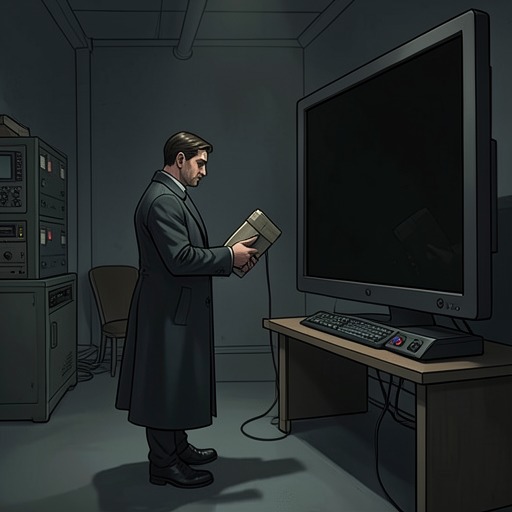
Harald’s house is the first building in the village when approached from the road, closest to Mikael Blomkvist’s guest house and the Vanger estate. It is a rectangular, two-storey stone building that appears deserted at first sight. Its curtains remain drawn, and the path is left under roughly a foot and a half of snow, although footprints show that someone has recently crossed from the road to the door.
During Mikael Blomkvist’s first month on the island, Harald remains unseen. The house’s blackout curtains give it a gloomy, ominous appearance, and Blomkvist occasionally imagines a ripple behind them or notices a brief light in an upstairs room. On one occasion he watches a gap in the curtains and the light beyond it for more than twenty minutes from his own darkened kitchen before giving up and going to bed; by morning, the curtains have been closed again. Harald consequently becomes an invisible but persistent force in Blomkvist’s imagination, taking on the shape of a hostile recluse watching the village from behind the barriers of his home.
Harald receives a daily visit from the home-help service, whose worker brings groceries through the snow. He refuses ordinary neighbourly assistance. When Gunnar Nilsson offers to shovel the snow, Harald will not allow anyone onto his property; during the first winter after Harald’s return, Nilsson once drove a tractor up to clear the courtyard, as he did for the other driveways, and Harald emerged rapidly, shouting and gesticulating until Nilsson left. His withdrawal is therefore not simple incapacity. It is an actively defended isolation that makes his absence seem to shape village life.
Conflict with Henrik Vanger
Henrik openly describes Harald as a recluse with whom he has never seen eye to eye. Their hostility combines a personal estrangement with disagreement over the family firm. Henrik finds Harald detestable and would have preferred him to remain in Uppsala, yet Harald’s ownership of the house makes separation impossible. The contradiction is characteristic of the Vanger family world: deep antagonism coexists with property ties, shared history, and unavoidable proximity.
Harald’s political and medical past intensifies this conflict. Henrik’s account places him not only among fascist movements but also within the institutional culture of race biology and compulsory sterilisation. Thus the disagreement between the brothers is set against a larger moral and historical divide, even though the novel provides no evidence that Henrik’s personal quarrel with Harald is itself a political confrontation.
Suspicion and the Investigation
Harald’s physical appearance briefly reinforces the sinister image created by his house. When he finally emerges, he is an extremely tall old man now stooped by age, with liver spots on his face and neck, dressed in pyjamas and a brown dressing gown and leaning on a cane. He confronts Blomkvist outside Cecilia Vanger’s house and crudely insults the woman Blomkvist is seeking, repeating the insult when challenged. The encounter confirms his aggression and contempt, but it does not establish that he is involved in Harriet Vanger’s disappearance or the murders under investigation.
The investigation instead uses Harald as part of a wider pattern of suspicion surrounding the Vanger family. The murder inquiry turns toward the sadistic killing of women, animal torture, arson, and dysfunctional homes. The investigators note that some convicted serial killers had tortured animals as children or had been arrested for arson, and they connect those patterns to cases associated with Harriet’s disappearance, including the burning of the parsonage in the late 1970s. None of the supplied evidence identifies Harald as the perpetrator of those crimes. His importance lies in the way his fascist history, eugenic convictions, hostility, and barricaded domestic life make him an apparently plausible object of suspicion without yielding a confirmed criminal role.
Narrative Significance
Harald embodies the family’s buried political and ethical inheritance. His long allegiance to fascism and his advocacy of sterilisation reveal how respectable institutions, professional authority, and private family life can coexist with doctrines that classify some people as disposable. His character therefore broadens the novel’s account of violence beyond the individual murderer: violence also appears as ideology, medical policy, inherited power, and the refusal to recognise the humanity of others.
At the same time, the later discussion of Gottfried Vanger and Martin Vanger establishes an important limit on deterministic explanations. Gottfried is identified as responsible for the first series of murders between 1949 and 1965, and Martin is described as having been drawn into his father’s crimes after puberty, including participation in the murders of Lea in 1962 and Sara in 1964. Blomkvist considers the effects of beatings and sexual abuse within the family, while Lisbeth Salander insists that mistreatment does not excuse murder and that both Gottfried and Martin made their own choices. Harald’s history belongs to this same moral landscape, but the evidence does not turn his fascism into proof of murder. The novel’s treatment of him is consequently marked by suspicion without resolution: he remains a disturbing survivor of the family’s past, a neighbour whose sealed house and political record keep the island’s history visibly, and uneasily, alive.