Harriet Vanger's escape
The Girl with the Dragon TattooHarriet Vanger's escape transforms the central mystery from a presumed murder into a survivor's flight from a violent family history. On the day of the Hedeby bridge accident, while the island was absorbed by the blocked crossing and the ensuing confusion, Harriet sought out Anita Vanger, concealed herself, and left Sweden rather than remain exposed to Martin Vanger. Her disappearance defeated the police investigation led by Detective Inspector Gustaf Morell and allowed her family to believe that she had died in the 1966 catastrophe.
The Threat Behind the Flight
Harriet's decision was driven by the danger posed by Martin Vanger, whose violence was part of a wider inheritance of abuse. Mikael Blomkvist and Lisbeth Salander establish that Gottfried Vanger was responsible for the first series of murders between 1949 and 1965 and that Martin had been drawn into the crimes during adolescence. Martin told Blomkvist that he had witnessed the murder of Lea in Uddevalla in 1962, when he was fourteen, and had actively participated in the murder of Sara in 1964, when he was sixteen. He also indicated that Gottfried had sexually assaulted him, presenting the abuse as a duty imposed by his father.
The investigation links this family history to patterns of animal torture and arson associated with serial killers. Salander notes that the murder cases connected with Harriet include tortured animals and arson, while the local parsonage had burned down in the late 1970s; she therefore proposes checking earlier unexplained fires and cases of animal abuse. The evidence creates a background of inherited violence without making it an excuse. Blomkvist argues that Gottfried's own childhood beatings left a mark, but Salander rejects the idea that mistreatment removes personal responsibility: neither Gottfried nor Martin acquired the right to murder women because they had been abused.
The Decision on the Day of the Accident
Harriet's disappearance was not an impulsive response to the bridge accident itself. She had already been living under Martin's power and had spent months trying to avoid him. After Gottfried's death, Isabella Vanger or Henrik Vanger arranged for Martin to spend much of the following year in Uppsala, a measure that kept him away from Harriet. During school holidays, Anita stayed close to Harriet and helped prevent Martin from approaching her.
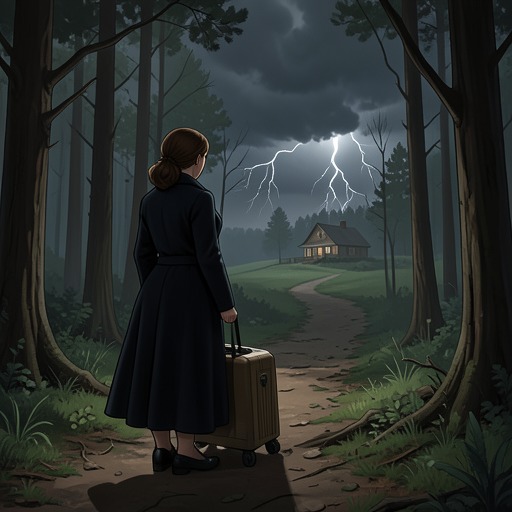
The arrangement failed when Harriet saw Martin on Järnvägsgatan. She had been told that he would remain in Uppsala and would not attend the family gathering, but he appeared across the street and stared at her. His smile made Harriet understand that she would never be free of him. She had considered suicide, but instead chose to flee. The decision is therefore both an act of terror and an act of agency: Harriet does not simply vanish into the confusion surrounding the bridge; she uses that confusion to escape a threat she believes will otherwise follow her for life.
Anita Vanger's Assistance
Anita Vanger was the essential accomplice in the escape. Blomkvist reconstructs that Harriet could not have disappeared without help and that Anita, who had spent the summer with her and was the only person Harriet could have trusted, was the obvious confidante. Harriet confirms that she went to Anita when she realised she had to escape. She hid on the floor of the back seat under a blanket while Anita drove her away after the bridge reopened the following day.
Before leaving, Harriet returned to Anita's room in Stockholm, where she stayed for several weeks. Harriet had written down everything that had happened in a diary and needed to take both the record and some clothing; Anita obtained the clothes and helped her preserve the account of her experience. Anita also lent Harriet money and gave her passport. Because the two women looked almost exactly alike, Harriet dyed her hair blonde and could pass as Anita without immediately attracting suspicion.
Reinventing a Life Abroad
Harriet's escape developed through several stages rather than ending at the Swedish border. She spent four years living in a convent in Italy, not as a nun but as someone renting an inexpensive room in a place where she could find peace and think. She then met Spencer Cochran, an older English-educated traveller hitchhiking through Europe. They fell in love, married in 1971, and built the identity under which Harriet would remain hidden.
Harriet lived in Australia as a sheep farmer and eventually became the owner of the station after Spencer Cochran died eight years before her conversation with Blomkvist. Publicly, however, the marriage belonged to Anita Vanger. The deception functioned because the Anita Vanger living in London could be understood as Spencer Cochran's estranged wife, while the woman in Australia appeared to be his present wife. Swedish and Australian records were not cross-matched in a way that exposed the duplication, and Harriet later obtained an Australian passport in her married name.
The arrangement had one significant vulnerability: Anita's own future. Harriet explains that the story could have been disrupted if Anita had wanted to marry, because Harriet's marriage had to be registered in Swedish national records. Anita nevertheless remained loyal and did not, according to Harriet, form another marriage for Harriet's sake. Their secrecy was not merely a practical operation but a long-term friendship in which Anita continued to protect the person she had helped rescue.
Discovery and Return
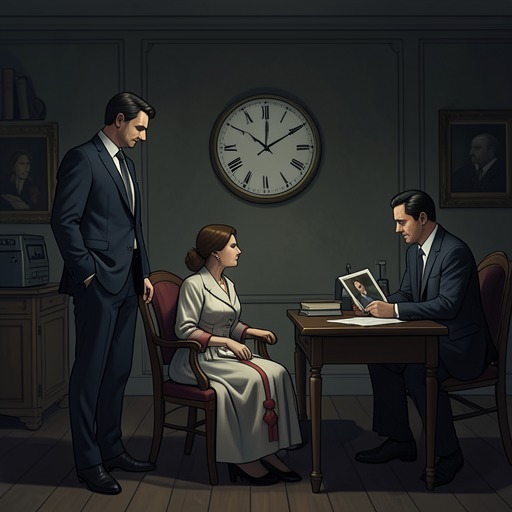
The escape remained hidden because investigators interpreted the available evidence through the assumption that Harriet had died. Detective Inspector Gustaf Morell arrived on Hedeby Island by boat, took command, interviewed Henrik Vanger, Isabella Vanger, and other members of the family, and prepared a detailed formal report on the disappearance. The official record preserved the investigation but not the truth of Harriet's survival.
The breakthrough came when Blomkvist reconsidered the first photograph in the album: the last image of Harriet on Järnvägsgatan, taken while she watched the Children's Day parade several hours before the bridge disaster. Later, a 1966 family-council photograph revealed that the woman Blomkvist and Salander had repeatedly identified as Cecilia Vanger was actually Anita, Cecilia's younger sister. Their near-identical appearance had allowed the mistaken identification to persist, and it supplied the crucial connection between Harriet's disappearance and the person who could have helped her leave.
When Blomkvist finally meets Harriet, she explains the escape herself. She knows that he and Salander have discovered that she is alive, and she asks what they intend to do with that knowledge. Her return does not erase the decades of concealment. Instead, it converts a cold case into a testimony about survival, showing that the absence at the centre of the investigation was created by Harriet's deliberate refusal to remain available to the family and to Martin.
Narrative Significance
Harriet Vanger's escape is the story's reversal of the locked-room logic surrounding her disappearance. The bridge accident, photographs, police reports, and family memories make her absence look like a death that requires a murderer; the hidden movement through Anita's car reveals it as an act that required planning, trust, and a new identity. The mistaken reading of the photographs is especially important because the truth is not concealed by a missing image but by an image whose subject has been misidentified.
The escape also establishes a contrast between two responses to inherited violence. Gottfried Vanger and Martin Vanger turn abuse into further violence, while Harriet turns it into flight and self-preservation, aided by Anita Vanger's solidarity. Her eventual disclosure to Blomkvist gives the past a voice, but the decisive act remains the original refusal to be trapped by the family history. Harriet survives not because the institutions investigating her disappearance understand her, but because she and Anita create a private route out of the story everyone else thinks they already know.