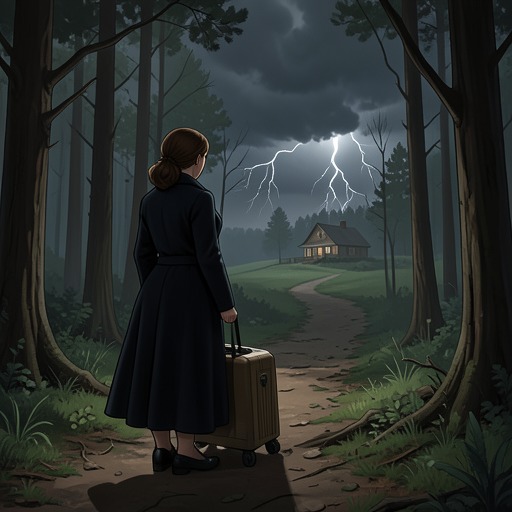
Harriet Vanger–Anita Vanger relationship
The Girl with the Dragon TattooThe Harriet Vanger–Anita Vanger relationship is the hidden infrastructure of Harriet Vanger’s disappearance and later life. In 1966, Anita Vanger is not merely a relative or a witness but Harriet Vanger’s closest friend and confidante. Their intimacy gives Harriet Vanger somewhere to turn, a means of escape, and eventually a new identity; it also explains why the investigation can remain trapped for decades inside the mistaken assumption that Harriet Vanger died on Hedeby Island.
Friendship Before the Disappearance
Harriet Vanger and Anita Vanger were close during the summer of 1966, when Anita Vanger, two years older than Harriet Vanger and the daughter of Harald Vanger, spent the season on Hedeby Island. Their friendship was grounded in ordinary youthful companionship rather than family obligation. They swam, walked, discussed movies, pop bands, and books, and Anita Vanger sometimes accompanied Harriet Vanger while she took driving lessons. On one occasion they happily became drunk after stealing a bottle of wine from the house, and for several weeks they stayed together at Gottfried Vanger’s cabin at the far end of the island.
This recollection mattered because it contradicted the family’s and classmates’ description of Harriet Vanger as withdrawn and uncommunicative. Anita Vanger did not remember an introverted girl sealed off from others; she remembered a companion with whom she shared movement, talk, mischief, and private time. Yet Anita Vanger initially offered no definite information about what had happened to Harriet Vanger. The friendship was visible in its everyday details while its most consequential secret remained inaccessible.
The Confidante Who Knew the Danger
The investigation later identifies Anita Vanger as the person Harriet Vanger approached with her terrible story. Mikael Blomkvist tells Anita Vanger that she was Harriet Vanger’s closest friend in the family and the one Harriet Vanger turned to after revealing what had been happening to her. Anita Vanger first denies knowing what he means, but photographic proof places her in Harriet Vanger’s room on the day of the disappearance, despite what she had told Inspector Morell.
Anita Vanger’s silence therefore has a double character. It obstructs the investigation, but it also protects Harriet Vanger from being exposed before she was safe. The relationship depends on a form of loyalty that cannot be separated from concealment: Anita Vanger knows enough to challenge the official story, yet refuses to make Harriet Vanger’s private trauma public. Her silence helps preserve the disappearance as a mystery while also preserving the possibility that Harriet Vanger is alive.
Escape and Assumed Identity
After the Hedeby Bridge accident, Harriet Vanger went to Anita Vanger and told her that she had to escape. Anita Vanger was the only person Harriet Vanger could realistically consider asking for help. She had shared the summer with Harriet Vanger, had been her confidante, and had recently obtained her driving licence. When the bridge reopened the day after the accident, Anita Vanger smuggled Harriet Vanger away from Hedeby Island in the back of her car. Harriet Vanger later clarified that she lay on the floor of the back seat under a blanket while no one was looking.
The escape continued through a carefully improvised exchange of identities. Harriet Vanger stayed for several weeks in Anita Vanger’s room in Stockholm. Anita Vanger lent her money and gave her her passport; because the two women looked almost exactly alike, Harriet Vanger only had to dye her hair blonde to pass as Anita Vanger. This resemblance turned their emotional intimacy into a practical instrument. Their relationship did not merely offer comfort after a crisis; it supplied the documents, shelter, mobility, and physical likeness needed to make disappearance possible.
A Life Built on Loyalty
Harriet Vanger first lived quietly in a convent in Italy for four years, renting a room there without becoming a nun. She eventually met Spencer Cochran, fell in love with him, and married him in 1971 under the name Anita Vanger. The arrangement worked because records in Sweden, London, and Australia were not automatically matched, and because Anita Vanger herself remained part of the original identity structure. Harriet Vanger could inhabit the name without immediately exposing the substitution.
The deception was not presented as a short-term trick that ended once Harriet Vanger reached safety. It became the basis of her adult life. Harriet Vanger moved to Australia, became Spencer Cochran’s wife, and after his death eight years before her reunion with Mikael Blomkvist became the owner of the station. She states that she never regretted the marriage and describes Spencer Cochran as a wonderful man. Anita Vanger’s assistance thus enabled not only flight from Sweden but also the long, stable life Harriet Vanger constructed afterward.
Meaning and Consequences
The relationship explains why Harriet Vanger could vanish from a crowded island without leaving a conventional trail. The investigation begins from the locked-room mystery of a girl who disappeared while the bridge was blocked, with witnesses and photographs apparently accounting for everyone’s movements. Anita Vanger’s cooperation reveals the crucial difference between being unaccounted for and being deliberately hidden. Harriet Vanger was not simply lost in the confusion; she used the one relationship strong enough to convert panic into a plan.
Their bond also exposes the limits of the family’s understanding of Harriet Vanger. The Vanger family searched for signs in relatives, friends, photographs, and reports, but the decisive evidence was held by the person who understood Harriet Vanger as a trusted friend rather than as an enigmatic family member. Anita Vanger’s eventual role connects the private truth of Harriet Vanger’s fear with the public reconstruction undertaken by Mikael Blomkvist and Lisbeth Salander.
At the same time, the relationship carries a moral burden. Anita Vanger’s loyalty protects Harriet Vanger, but it leaves the fate of other victims tied to Martin Vanger’s crimes concealed for years. The later investigation establishes that Martin Vanger had killed women since the 1960s, often targeting new arrivals, immigrant girls without Swedish friends or social contacts, prostitutes, and social outcasts. His death book recorded and graded victims, described their suffering, and preserved killings through photographs and videotapes. Harriet Vanger’s escape was necessary for her survival, yet the secrecy surrounding it existed within a wider system in which murdered women had already been rendered socially invisible.
The relationship therefore ends not with the recovery of a lost girl alone but with a complicated restoration of testimony. Anita Vanger’s friendship gives Harriet Vanger a future, while the disclosure of that friendship gives the dead a chance to be named and investigated. Its decisive significance lies in that tension: private loyalty saves one woman from violence, but the return of the truth demands that protection no longer depend on silence.