Harriet Vanger’s Escape and Return
The Girl with the Dragon TattooHarriet Vanger’s Escape and Return is the decisive reversal in the investigation into Harriet Vanger’s disappearance: Harriet was not killed on Hedeby Island in 1966 but fled from Martin Vanger, with Anita Vanger’s assistance, and remained alive under an altered identity in Australia. Her return corrects the record preserved in photographs, police reports, and family memories, while allowing Henrik Vanger to meet the granddaughter he had mourned for decades.
The Disappearance Reconsidered
The mystery begins with the Children’s Day parade and the bridge accident that immobilized Hedeby Island. Harriet Vanger returned from Hedestad shortly after 2:00 p.m., while dinner was scheduled for 5:00. At 2:15, Gustav Aronsson collided head-on with an oil truck on the bridge. The tanker overturned, heating oil began spurting from the damaged tank, and the injured drivers drew police officers, an ambulance, rescue workers, firefighters, reporters, and sightseers to the mainland side. The accident created a public emergency that concealed a private crisis: Harriet could move, hide, or leave while attention concentrated on the wreck.
Photographic evidence preserved the apparent impossibility. A picture taken between 3:40 and 3:45 showed that the window of Harriet’s room, closed in an earlier photograph, had been opened. Henrik Vanger concluded that someone had entered the room, although nobody admitted opening it. The same album also contained the last photograph of Harriet, taken earlier that day while she watched the Children’s Day parade in Hedestad. For years, the image of the crowd and the bridge accident held the family’s attention, turning Harriet into a figure of archival absence rather than a person whose decisions could still be recovered.
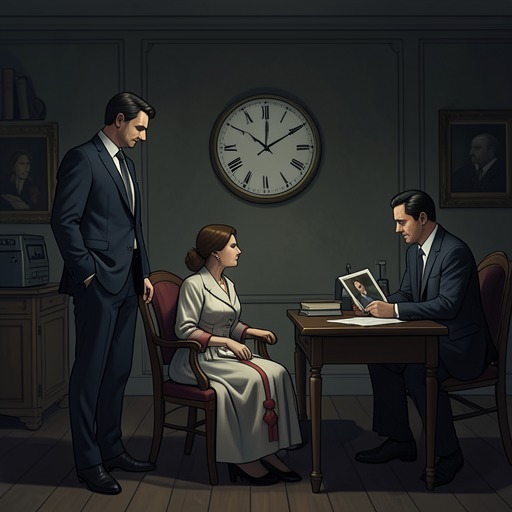
The investigation was further delayed by mistaken identification. A family photograph eventually showed Cecilia Vanger seated beside a blonde woman in an identical light-coloured dress. The second woman was Anita Vanger, Cecilia Vanger’s younger sister, who had later moved to London. Because the sisters looked almost identical and had not previously appeared together in the same frame, Mikael Blomkvist and Lisbeth Salander had treated Anita Vanger and Cecilia Vanger as the same person. That error made Harriet’s escape route harder to see: the woman associated with the window was not Cecilia Vanger but Anita Vanger.
Harriet’s Flight from Hedeby Island
Harriet’s disappearance was an escape prompted by fear, not a disappearance caused by the bridge accident. She had become afraid of Martin Vanger, and Martin Vanger’s presence in Hedestad made her understand that remaining in Sweden would never be safe. She moved between the wish to tell Henrik Vanger the truth and the impulse to flee. When Henrik Vanger was unavailable to speak with her, she wandered through the village in an agitated and unreal state, scarcely registering the accident that occupied everyone else.
Harriet then encountered Anita Vanger, who was staying in a guest cottage on the family compound. Harriet decided to remain with her and did not dare go outside. She needed to take clothes and a diary in which she had written down everything that had happened; Anita Vanger obtained the clothes and helped her prepare. The diary gives the escape a second dimension: Harriet was not merely leaving a place but preserving a private testimony that might later establish what had been done to her and why she had vanished.
When the bridge reopened the following day, Anita Vanger smuggled Harriet away from Hedeby Island. Harriet later clarified that she lay on the floor of the back seat with a blanket over her rather than in the boot of the car. The distinction makes the escape concrete and precarious: it depended on concealment during the moment when authorities and family members were still trying to understand the disappearance.
A New Identity in Australia
After leaving the island, Harriet stayed in Anita Vanger’s room in Stockholm for several weeks. Anita Vanger lent her money and gave her passport. Their close physical resemblance made the substitution workable; Harriet dyed her hair blonde and could pass within the limited assumptions made by officials and acquaintances. The escape therefore depended not only on courage and loyalty but also on the bureaucratic weakness of an identity system that did not reliably connect records in different countries.
Harriet spent four years living in a convent in Italy, although she was not a nun. The convent provided an inexpensive room and the quiet she needed to think. Her route was not a direct flight to a settled future but a prolonged interval of withdrawal, in which survival required distance from the Vanger family and time to understand her experience.
Harriet’s life changed when she met Spencer Cochran, an older man who had recently completed his degree in England and was hitchhiking through Europe. They fell in love, married in 1971, and established the identity under which Harriet remained hidden. She lived as “Anita” Cochran, eventually becoming the owner of the station after Spencer Cochran died eight years before her reunion with Henrik Vanger. She expressed no regret about the marriage and remembered Spencer Cochran as a wonderful man.
The double identity endured because the two Anita Vangers occupied different national and administrative settings. Anita Vanger in London was Spencer Cochran’s estranged wife, while Harriet, presenting herself as Anita Vanger, was his present wife in Australia. Records in Canberra and London were not automatically matched, and Harriet soon obtained an Australian passport under her married name. The arrangement would have been endangered if Anita Vanger had married, since that marriage would have had to appear in Swedish national registration files; Anita Vanger’s decision not to marry preserved Harriet’s safety.
The Return and Recognition
Harriet’s survival is first stated as a direct correction to Henrik Vanger’s belief that she died in the 1960s. Mikael Blomkvist tells him that he knows what happened to Harriet, and when Henrik Vanger asks how she died, the answer is that she did not die and remains alive. The revelation changes the emotional stakes of the investigation immediately: the object of Henrik Vanger’s mourning becomes someone capable of choosing whether and when to return.
Mikael Blomkvist finds Harriet at a sheep station in Australia. A woman with short blonde hair, jeans, and a red-and-white checked shirt emerges among ranch hands slaughtering sheep. When she recognizes the danger posed by the unexpected visitor, Harriet Vanger raises a peaceful hand and the men withdraw. She is visibly changed from the girl in the confirmation portrait: her face is older and thinner, her hair has darker roots, and her face is sweaty and dirty. Yet the encounter also confirms the continuity of the person who disappeared. She meets Mikael Blomkvist’s gaze and asks whether they have met before, testing the distance between her concealed life and the investigation that has finally reached her.
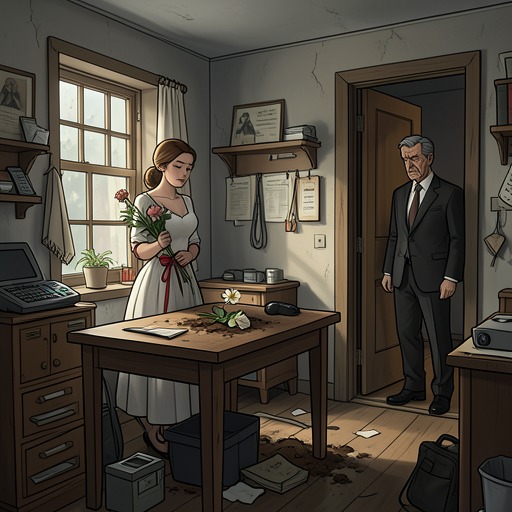
Harriet returns to Sweden and prepares to meet Henrik Vanger. By then she has dyed her hair brown again and wears black trousers, a white blouse, and an elegant grey jacket. Mikael Blomkvist initially fails to recognize her at the lift in the lobby, a final echo of the mistaken identities that shaped the case. Once brought to Henrik Vanger, Harriet takes a deep breath and greets him. The simple greeting carries the weight of decades: the missing granddaughter does not return as an abstract solution but as a living woman confronting the man who believed she was dead.
Consequences and Narrative Significance
Harriet’s escape changes the meaning of every earlier clue. The bridge accident was not the cause of her disappearance, but the distraction that made escape possible. The opened window was not proof of a murderer entering a sealed room; it was evidence of a movement that the family failed to interpret. The photographs did not simply document an unsolved crime. They preserved the conditions under which Harriet escaped and the mistaken visual assumptions that concealed Anita Vanger’s role.
Her return also restores the connection between private testimony and public investigation. Detective Inspector Gustaf Morell’s typed report had documented the early police response with unusual clarity, while Henrik Vanger’s albums and family records preserved images whose meaning remained unstable. Mikael Blomkvist’s later reconstruction brings those forms of memory into contact with Harriet’s own account. The result is not merely the closure of a case but the replacement of an inherited story of death with Harriet’s testimony about fear, concealment, loyalty, and survival.
The return gives Henrik Vanger an answer to the grief that had governed his life, but it does not erase the violence that made Harriet flee. Her safety required years of silence, a borrowed passport, a changed name, international distance, and Anita Vanger’s sustained loyalty. The reunion therefore functions as both resolution and reckoning: Harriet comes back with a life that was built elsewhere, while the Vanger family must face the fact that its apparently complete history depended on a young woman disappearing in order to remain alive.
The event also completes the investigation’s movement from spectacle to truth. In 1966, public attention gathered around wreckage, spilled fuel, cameras, and the visible emergency on the bridge. Decades later, the decisive evidence is a living witness whose existence had been misread as absence. Harriet Vanger’s reappearance turns the disappearance from a monument to loss into an encounter with survival, and it gives the recovered history a future rather than only an explanation of the past.