Harriet Vanger's Bible
The Girl with the Dragon TattooHarriet Vanger's Bible is the central religious and material clue in the investigation into Harriet Vanger's disappearance. Initially a quiet remnant of Harriet's adolescence, it becomes an interpretive instrument when Mikael Blomkvist discovers that the numbers in her date book correspond not to telephone contacts but to underlined verses from Leviticus. The Bible therefore carries two histories at once: Harriet Vanger's increasingly urgent search for religious meaning and the violent script by which the murderer organized a series of crimes.
Identity and Physical Presence
Harriet Vanger's Bible is the confirmation Bible Harriet received during her religious upbringing. Mikael Blomkvist finds it on a bookcase in Gottfried Vanger's cabin, among old magazines, mystery paperbacks, children's novels, books on astronomy and short-wave radio, Luther's catechism, the Book of Hymns, and other religious material. The Bible is not presented as an isolated sacred object but as part of a modest, dated intellectual world preserved in the cabin.
The inside cover bears the inscription “Harriet Vanger, May 12, 1963.” That inscription fixes the book to Harriet's childhood and makes it an unusually direct physical trace of her presence. Blomkvist recognizes it as her Confirmation Bible and, confronted with the evidence of a girl who has vanished, sadly returns it to the shelf. Its emotional force comes from its ordinariness: it is an intimate possession left behind in a place associated with her family and with the death of her father, Gottfried Vanger.
Harriet Vanger's Religious Development
Harriet Vanger had been Christian in the customary childhood sense. She attended Sunday school, said evening prayers, and was confirmed. During the final year before her disappearance, however, religion became more intense and unsettled. She read the Bible and attended church regularly, but did not seek guidance from Otto Falk, the pastor connected to the Vanger family. Instead, she joined a Pentecostal congregation in Hedestad, left it after only two months, and began reading about the Catholic faith.
The Bible consequently records more than formal affiliation. Harriet's movement from childhood Christianity to Pentecostalism and then to Catholic reading suggests a search whose direction remained unclear to those around her. During the same period she became withdrawn and stopped confiding in friends, although Anita Vanger remembered her as less introverted than classmates and relatives had reported. The book's later function as a code gives these changes a retrospective gravity: religious language was not merely decorative in Harriet's life, but part of the means by which she attempted to register something troubling her.
Discovery of the Leviticus Code
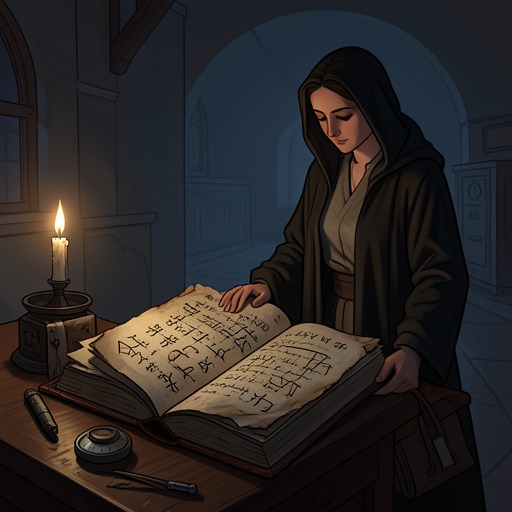
The Bible becomes decisive after Blomkvist revisits the final page of Harriet Vanger's date book. That page contains five names and number sequences—Magda, Sara, Mari, R.J., and R.L.—which had appeared to be telephone numbers. By taking Harriet Vanger's Bible from Gottfried Vanger's cabin, Blomkvist discovers that the figures instead indicate chapters and verses in Leviticus, the third book of the Pentateuch. Every relevant verse has been underlined.
The references lead to passages involving extreme punishments and ritualized violence. Magda points to Leviticus 20:16, concerning a woman and a beast being put to death. Sara points to Leviticus 21:9, concerning a priest's daughter being burned for prostitution. R.J. points to Leviticus 1:12, describing an animal cut into pieces and arranged on the altar fire. R.L. points to Leviticus 20:27, prescribing death by stoning for a medium or wizard. Mari points to Leviticus 20:18, concerning sexual violation and expulsion from the community. The Bible turns the apparently mundane numbers into a sequence of textual accusations, while leaving the identities represented by the names unresolved.
This discovery changes the investigation's scale. Harriet's date book had contained the visible pattern, but the Bible supplies the reference system that makes the pattern legible. The object does not simply confirm that Harriet read scripture; it shows that her reading had been organized into a deliberate index. Blomkvist's realization converts a private religious artifact into forensic evidence.
Interpretation, Misuse, and Violence
Otto Falk's remarks help establish the religious context surrounding the Bible without solving it. He insists on “sola scriptura,” “sufficientia scripturae,” and “sola fide,” and suggests that Harriet was a Catholic who loved magic and had not yet found her God. Erika Berger later interprets Falk's references to material excluded from the canon as an allusion to Josefus and the Apocrypha—the “hidden” books associated with controversial additions to the Old Testament. The exchange places Harriet's Bible within a conflict over authority: which texts count, who may interpret them, and what kinds of religious knowledge are treated as dangerous or illegitimate.
The Leviticus references also reveal how scripture can be appropriated as a violent system of classification. The murderer follows the basic story of the biblical sacrificial passages while translating them into modern crimes; in one discussion, Salander observes that the killing of a cat may function as a parody of a sacrifice involving an ox. The Bible is thus caught between Harriet's search for guidance and the killer's ritualized use of biblical punishment. Its sacred authority is not treated as benign: it becomes the vocabulary through which women are condemned, bodies are violated, and murder is made to resemble religious procedure.
Role in the Investigation and Narrative
The Bible's importance depends on its relation to other preserved objects. The recurring pressed flowers sent to Henrik Vanger each November are beautiful, framed specimens whose unexplained arrival has been investigated for decades. Harriet's date book preserves names and numbers in a form that conceals their meaning. The Bible supplies the missing key, while police files and Detective Inspector Gustaf Morell's formal report preserve the earlier investigation into Harriet's disappearance. Together these objects create a layered archive in which memory, misreading, and delayed interpretation coexist.
The Bible also connects Harriet's private history to the broader record of violence surrounding the Vanger family. Its verses help identify a pattern behind murders that had seemed separate, and they redirect attention from the disappearance as an isolated mystery toward a continuing system of sexual and religiously coded brutality. Much later, evidence such as photographs of a victim, the murderer’s binders, and the contents of his computer exposes the material scale of that violence and other crimes; in the financial investigation, emails and computer files likewise turn hidden wrongdoing into demonstrable evidence. Against these more overt archives, Harriet Vanger's Bible remains quieter but more intimate: a childhood possession whose underlined pages preserve the first intelligible map of the crimes.
The Bible's decisive narrative function is therefore transformational. On the shelf in Gottfried Vanger's cabin, it appears to be a relic of a missing girl's past. In Blomkvist's hands, it becomes a codebook. Its inscription identifies Harriet, its contents illuminate her religious concerns, and its marked verses provide the textual structure through which the investigation recognizes the murders as connected. The object does not speak by itself; its meaning emerges only when the date book's numbers, the biblical passages, and the surrounding evidence are read together.