Henrik Vanger
The Girl with the Dragon TattooHenrik Vanger is the former head of the Vanger companies and the figure whose nearly forty-year inability to accept Harriet Vanger’s disappearance drives the central investigation. At eighty-two, he is both a diminished industrial patriarch and the keeper of a private archive of grief: photographs, family records, and the official documentation of the day Harriet vanished. His decision to hire Mikael Blomkvist transforms an old family mystery into an active inquiry, while his memories and surviving documents show how personal trauma can outlast institutions, businesses, and generations.
Identity and Background
Henrik Vanger once stood among the major figures of Swedish industry. Blomkvist associates him with sawmills, mines, steel, metals, and textiles, and with the reputation of an honourable, old-fashioned patriarch who would not bend in a strong wind. He belonged to an older industrial order, described as part of the backbone of the welfare state. That public stature forms a sharp contrast with his later isolation: the Vanger companies remain family-owned, but reorganisations, stock-market and interest crises, competition from Asia, declining exports, and other pressures have pushed the Vanger name into the industrial backwater.
By the time Blomkvist is approached, Henrik has been out of public view for at least twenty years. The companies are now run by Martin Vanger, a younger man whom Blomkvist knows mainly as a short, plump figure who occasionally appears on television. Henrik therefore enters the narrative as a relic of lost economic power, but not as a powerless man. His authority has moved from the industrial world into the realm of memory, family history, and investigation.
When Blomkvist reaches the Vanger residence, he recognises Henrik from photographs taken when he was younger. The eighty-two-year-old is still surprisingly vigorous, with a wiry body, a rugged weather-beaten face, thick grey hair combed straight back, a narrow moustache, and thin steel-rimmed glasses. He introduces himself directly and thanks Blomkvist for agreeing to visit. Anna Nygren looks after him, while Henrik personally receives the investigator and arranges his guest room, establishing both his physical age and his continuing control over the household.
Recruitment of Mikael Blomkvist
Henrik’s invitation initially appears to be a request for a private meeting, but it conceals a carefully defined commission. Through Dirch Frode, Henrik explains that he wants Blomkvist to work for him, and Blomkvist is startled when he learns the client’s identity. The choice of investigator is significant: Blomkvist is a journalist whose career is temporarily suspended after his legal and professional troubles, while Henrik needs someone capable of reconstructing a family history rather than merely conducting a conventional police inquiry.
Henrik offers to buy a year of Blomkvist’s life. He proposes a salary of 200,000 kronor a month, or 2.4 million kronor for a full year, and promises a bonus of double payment if Blomkvist solves the mystery, later rounded to five million kronor. The scale of the offer communicates both Henrik’s remaining wealth and the intensity of his need. He does not pretend that success is likely; he explicitly recognises that the possibility is minimal. The offer is consequently not presented as ordinary employment but as a wager against decades of failure.
The purpose of the commission is finally stated with brutal clarity. Henrik wants Blomkvist to discover who in the family murdered Harriet and who has spent almost forty years trying to drive him insane. The investigation therefore has two connected targets: the disappearance itself and the continuing psychological persecution that Henrik believes followed it. Harriet’s fate is not an obsolete family anecdote for him. It remains an unresolved crime and an ongoing assault on his sanity.
Harriet Vanger and the Burden of Memory
Henrik remembers Harriet as the apple of his eye. He tried to give her security and develop her self-confidence, and their mutual attachment made her closer to him than to her parents. He regarded her as his own daughter, not simply as a niece within the extended family. This emotional bond explains why the disappearance becomes the governing fact of his later life: Harriet represented both intimate affection and the future of the family he had built.
Henrik also saw Harriet as unusually capable. She was introverted like her brother, but she became deeply involved in religion as a teenager, unlike the rest of the family. He considered her clear-minded, tremendously intelligent, morally serious, and possessed of backbone. When she was fourteen or fifteen, he decided that she—not her brother or the mediocre cousins, nephews, and nieces around him—was destined to run the Vanger business or at least play a central role in it. Harriet thus embodied a possible future for the Vanger companies, making her loss simultaneously emotional, dynastic, and economic.
The preserved records reveal how Henrik’s memory has been mediated by documents. Detective Inspector Gustaf Morell’s typewritten report records the police response to Harriet’s disappearance with an objectivity and wealth of detail that surprises Blomkvist. Morell interviewed Henrik, Isabella Vanger, Ulrika Vanger, Harald Vanger, Greger Vanger, Martin Vanger, and Anita Vanger, beginning with the family members judged most important. The report gives institutional form to an event that Henrik has carried privately for decades, but it cannot resolve the difference between an official account and the suffering of the person who commissioned the search.
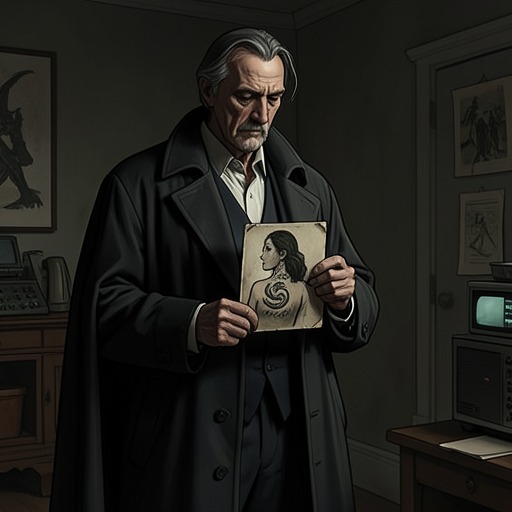
The photograph album becomes another vessel for Henrik’s memory. The first photograph is the last picture taken of Harriet on the day she vanished, while she watched the Children’s Day parade in Hedestad. It is the only image in the album not showing the bridge accident, yet Henrik must have looked at it a thousand times as a sorrowful reminder that he would never see her again. The image’s repeated viewing turns an ordinary public scene into a private memorial, preserving Harriet’s last known presence while withholding the answer to what happened afterward.
The Investigation and Its Reversals
The case remains closed in practice for years, but Henrik’s archive keeps it available for reinterpretation. In June, after six months of fruitless thought, Blomkvist experiences a sudden breakthrough while travelling by bus through Hedestad. He realises that the first photograph in the album, rather than the more dramatic bridge images, may contain the crucial clue. Henrik’s repeated attention to that photograph demonstrates both the strength and limitation of memory: he has preserved the image, but its meaning has remained hidden behind habitual ways of looking.
A later family photograph produces another reversal. While studying a 1966 family council album, Blomkvist sees Cecilia Vanger seated beside a blonde woman in an identical light-coloured dress. The two women look so alike that they could be twins. He realises that the woman previously mistaken for Cecilia in Harriet’s window was actually her younger sister Anita Vanger, who now lives in London. Henrik could distinguish the sisters, but Blomkvist and Lisbeth Salander had assumed that apparently identical images represented one person because the sisters had never been seen together in the same frame. The discovery exposes how Henrik’s archive contains the truth while also enabling prolonged misrecognition.
Henrik’s role in the investigation is therefore more complex than that of a simple client. He supplies the emotional motive, the family access, the historical materials, and the central interpretation that Harriet was murdered. Yet the evidence must be re-read by others. Police reports, photographs, family albums, and testimony do not speak with one voice; their significance emerges only through comparison, correction, and delayed recognition. Henrik’s persistence keeps the question alive, but the investigation advances when Blomkvist learns to see the archive differently.
Harriet’s Survival and Henrik’s Continuing Choice
Harriet’s later account changes the meaning of Henrik’s original accusation. On the day of the bridge accident, she was not primarily preoccupied with the public disaster. She was afraid of Martin Vanger, who had appeared in Hedestad, and realised that she would never be safe for the rest of her life. She had considered telling Uncle Henrik but also wanted to flee. When Henrik had no time to talk to her, she wandered restlessly around the village before encountering Anita Vanger.
Anita then became Harriet’s refuge. Harriet stayed with her in a guest cottage and did not dare go outside. Before escaping, Harriet needed to take the diary in which she had written down everything that had happened, as well as some clothes; Anita supplied the clothes. This account recasts the central mystery from a murder investigation into a story of concealment, terror, and survival. Henrik’s conviction that Harriet had been killed was understandable within the evidence available to him, but it was also the product of decades without direct testimony.
The revelation does not erase Henrik’s suffering or make his search meaningless. Instead, it shows that his devotion preserved the possibility of Harriet’s return even while his interpretation of the evidence remained wrong. The photographs, police report, and family history have carried the case across nearly forty years, from Henrik’s private grief to Blomkvist’s reconstruction and finally to Harriet’s own account.
Narrative Role and Significance
Henrik functions as the story’s initiating force, patron, witness, and keeper of a damaged public memory. His wealth allows him to commission an investigation that ordinary institutions have abandoned, but money cannot purchase certainty. His position as a former industrial giant gives the inquiry unusual resources, while his age and isolation make the case feel like a final attempt to impose meaning on a lifetime marked by loss.
His significance also lies in the tension between authority and error. Henrik is a respected patriarch whose testimony commands attention, yet the family archive associated with him contains a fundamental identity mistake. He has looked repeatedly at the last photograph of Harriet without understanding its place in the sequence, and the investigators initially confuse Anita Vanger with Cecilia Vanger. The case suggests that memory is not simply the preservation of facts: it is shaped by grief, expectation, repetition, and the limits of perception.
At the end of the supplied evidence, Henrik’s relationship with Blomkvist remains open rather than coercive. In a letter, he says that he respects Blomkvist’s integrity, will not insult him by telling him what to write, and will not exert pressure. He confirms that their contract remains valid if Blomkvist wishes to continue, while acknowledging that Blomkvist already has enough material to complete the chronicle of the Vanger family. Henrik’s final position is consequently one of relinquished control. He began by purchasing a year of investigation in the hope of recovering the truth; he ends by allowing the investigator to decide how that truth should be written.