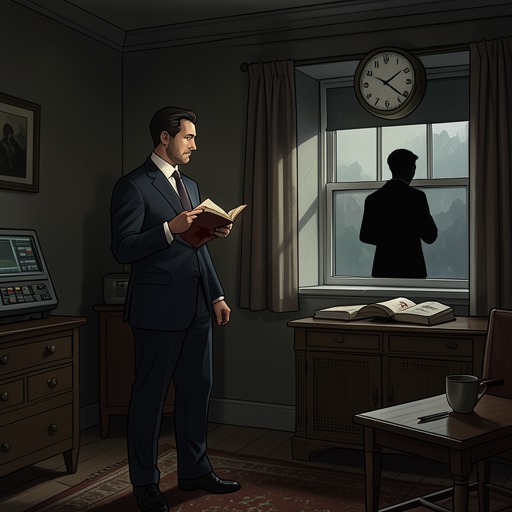
Janne Dahlman
The Girl with the Dragon TattooJanne Dahlman is a managing editor at Millennium whose professional competence is repeatedly set against his corrosive attitude and questionable loyalty. He occupies an important position during the magazine’s crisis, but the people around him increasingly suspect that he is not committed to the publication’s interests. His significance lies less in a decisive public action than in the unease he creates inside an already vulnerable editorial institution.
Identity and Professional Background
For nine months, Dahlman has served as managing editor. He joined Millennium just as the Wennerström affair began, placing him on an editorial staff operating in crisis mode. Before that appointment, he had worked at the TT news bureau, the evening papers, and Eko on the radio. These credentials explain why Mikael Blomkvist and Erika Berger originally judged him competent enough to hire, even though their later experience made the decision increasingly regrettable.
Dahlman’s position gives him practical authority within the magazine, especially at a moment when its leadership and finances are under pressure. The evidence does not identify him as an incapable employee. Instead, it presents a more troubling combination: he can perform the work, but his disposition appears to weaken the collective effort required to survive the crisis.
Temperament and Conduct
Blomkvist remembers Dahlman as someone who does not like sailing against the wind. During the previous year, Dahlman had developed an enervating habit of viewing everything in the most negative light possible. The description is not merely a complaint about pessimism; it identifies a recurring workplace behavior that drains momentum from an editorial staff already forced into emergency mode.
Erika Berger gives the suspicion a sharper moral and interpersonal edge. She tells Blomkvist that Dahlman is competent but does more harm than good, and that she does not trust him. She has noticed him moving around gleefully during Blomkvist’s troubles throughout the autumn. That apparent pleasure in a colleague’s difficulties makes his negativity seem less like private temperament and more like a possible source of active harm.
The staff’s response confirms that Dahlman’s isolation is not confined to Blomkvist and Berger. He keeps to himself, and tension exists between him and the rest of the editorial team. Christer Malm cannot stand him and makes no effort to conceal it. Dahlman therefore becomes a divisive presence within Millennium: not an outsider without influence, but a manager whose presence aggravates existing strain.
Suspected Disloyalty
The strongest accusation against Dahlman remains unproven. Berger says she has no proof, but has a persistent feeling that he is not working for Millennium. Her suspicion is linked to the timing of his arrival: he was hired about a year earlier, when the staff was first discussing the trouble connected with Hans-Erik Wennerström. The implication is that Dahlman’s role may intersect with the magazine’s central conflict, although the evidence never establishes what he might have done or for whom.
Blomkvist acknowledges that Berger may be right. Their exchange raises two possible explanations for Dahlman’s conduct: he may hope to take over Blomkvist’s role, or the hostility may arise from personal chemistry between him and the rest of the staff. Neither possibility is confirmed, and the uncertainty is important. Dahlman is defined by suspicion rather than by a revealed betrayal; the narrative makes his unreadable motives part of the pressure inside the newsroom.
When Blomkvist asks what Dahlman is suspected of doing, the answer is that nobody can prove anything. The response is not an exoneration, however, because the staff’s instincts have been shaped by repeated behavior: his withdrawal, his tension with colleagues, his bleak assessments, and his apparent satisfaction at Blomkvist’s troubles. Dahlman’s threat is consequently atmospheric as well as factual. He may not yet be caught in an act, but he has ceased to be trusted.
Role in the Magazine’s Crisis
Dahlman’s presence dramatizes the difference between formal competence and institutional loyalty. Millennium needs people capable of resisting pressure, yet Dahlman is characterized as someone uncomfortable with opposition and inclined to interpret events negatively. In a newsroom confronting the Wennerström affair, that disposition becomes especially damaging because editorial work depends on collective confidence, judgment, and the willingness to endure conflict.
His role also exposes the fragility of Millennium’s internal structure. Blomkvist and Berger must consider whether a competent manager should be dismissed because his influence is harmful, while the available case against him consists largely of observation, distrust, and instinct. The question of what to do with Dahlman thus becomes part of the magazine’s broader struggle to distinguish ordinary disagreement from disloyalty.
Narrative Function and Assessment
Dahlman functions as an internal pressure point rather than as a fully disclosed conspirator. The narrative gives him a concrete professional history and a visible place in Millennium, then surrounds that position with negative impressions and unresolved suspicion. His characterization depends on contrast: competence against destructiveness, managerial authority against social isolation, and the appearance of ordinary employment against the possibility that he is not working for the magazine at all.
Because the evidence never confirms Dahlman’s motives or actions, his importance rests on the consequences of uncertainty. He makes the newsroom’s crisis feel internal as well as external. Even before any decisive revelation, the staff must spend trust, attention, and emotional energy deciding whether the danger comes from the public enemy represented by Hans-Erik Wennerström or from a colleague already inside Millennium’s own structure.