Maja Blomberg
The Girl with the Dragon TattooMaja Blomberg, also called Madeleine Blomberg, is the pictures editor of the Hedestad Courier and an important archival ally in Mikael Blomkvist’s investigation of Harriet Vanger’s disappearance. Her significance lies less in a large personal subplot than in the professional competence, access, and trust that allow a buried photographic record to become active evidence. Through her, the newspaper’s accumulated images shift from neglected storage to a means of correcting decades of misrecognition.
Identity and Professional Background
Maja Blomberg is presented as a long-serving newspaper professional whose career followed the changing technologies and hierarchies of journalism. She began at the Hedestad Courier as a proofreader in 1964, moved into photo-finishing, spent years working in the darkroom, and occasionally photographed assignments when the regular staff was unavailable. She eventually became a full-time member of the picture desk and, ten years before Blomkvist’s visit, succeeded the retiring pictures editor as head of the department.
Her career also gives her a distinctive position in a field still described as primarily male. Blomkvist notes that she was the first woman pictures editor he had encountered in journalism. The detail makes her professional authority concrete: she is not merely a gatekeeper of old files, but a woman who has advanced through several forms of photographic labor into departmental leadership.
The Archive and the Investigation
Blomkvist approaches Maja Blomberg after realizing that the first photograph in the 1966 accident album was not a bridge photograph at all, but the last known picture of Harriet Vanger watching the Children’s Day parade in Hedestad. He therefore decides that the unpublished photographs from the parade and from that week may contain what the familiar accident images had failed to show.
Blomberg explains that the archive is in considerable disorder. Current material is stored on CDs, while only a small proportion of older photographs has been scanned and catalogued. The older negatives remain in dated folders, either in the newsroom or in the attic storeroom. The scale of the problem is substantial: the Courier, founded in 1922, had maintained a pictures department since 1937, and its attic held roughly 1,200 binders. The negatives from September 1966 occupied four inexpensive cardboard binders.
This material abundance contrasts with the archive’s practical neglect. Newspaper photographers could expose several rolls of film each day, with thirty-six negatives on each roll, producing hundreds of images while publishing only a few. The department retained the negatives because they might possess historical value, even though they had little commercial value. Blomberg’s description establishes the archive as both an institutional memory and an almost unusable mass of unindexed traces.
Assistance to Mikael Blomkvist
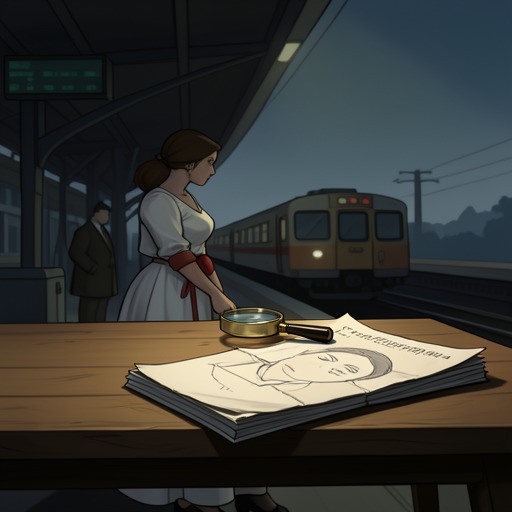
Maja Blomberg responds to Blomkvist’s request with guarded practicality rather than melodrama. Once he explains the purpose of the search, she locates the relevant people, meets him at the office, and shows him how the archive is organized. She provides a chair at a light table, switches on a computer and scanner, and explains that the newspaper’s modern equipment can be used to examine and copy the old negatives.
Blomkvist already knows how to work with a negative scanner and uses image-editing software, so the arrangement is efficient rather than ceremonial. Blomberg permits him to work alone, while requiring him to call her when he leaves so that she can return and set the alarm system. Her cheerful farewell, telling him to enjoy the work, conveys an ordinary professional generosity that proves consequential within the mystery.
She also identifies the photographer who covered the parade in 1966: Kurt Nylund, then a young staff photographer who later moved to Stockholm and became a well-known photographer associated with Scanpix Sweden. Nylund had used a standard daylight film that day. By supplying both access and context, Blomberg helps Blomkvist narrow an enormous archive to a particular photographer, date, and type of negative.
Archival Memory and Misrecognition
Maja Blomberg’s contribution exposes the limits of official memory. The accident album had preserved the bridge disaster and the family’s retrospective grief, but the decisive image was the apparently incidental first photograph, taken hours earlier at the Children’s Day parade. Blomkvist’s renewed attention to the image sends him back from the island to the town, and Blomberg’s archive provides the possibility of seeing the day before its meaning was fixed by the disappearance.
The later discovery that a photograph believed to show Cecilia Vanger actually showed her sister Anita Vanger demonstrates why the archive had remained inconclusive for so long. The sisters resembled each other so closely that, in distant black-and-white photographs, even Blomkvist and Lisbeth Salander treated them as one person. They had never appeared together in the same frame, and nobody had thought to question the assumption. The photographic record had not simply preserved the truth; it had preserved an error that became more persuasive through repetition.
Blomberg therefore stands at the meeting point of technical preservation and interpretive failure. The negatives survive, but survival alone does not produce knowledge. They require someone with access to retrieve them, someone with photographic skill to read them, and someone willing to challenge the identities that earlier viewers had taken for granted.
Narrative Role and Significance
Maja Blomberg is a supporting character whose role is defined by the circulation of evidence. She does not solve Harriet Vanger’s disappearance herself, but she makes the investigation’s decisive visual re-examination possible. Her professional history connects older darkroom practices with digital scanning, allowing a 1966 record to enter a contemporary investigation without losing its material specificity.
Her presence also broadens the novel’s treatment of testimony. The case is preserved in police reports, private albums, family recollections, notebooks, and photographs, yet each record carries omissions or distortions. The Hedestad Courier’s archive contains thousands of images that were never published, while the most important photograph had been visible for years but misread. Blomberg’s practical custodianship enables Blomkvist to turn that passive archive into a questioning one: not merely what was kept, but what viewers failed to see in what had been kept.
In this sense, Maja Blomberg represents the uncelebrated labor behind public memory. Her career in proofreading, photo-finishing, photography, and editorial management culminates in a modest act of cooperation that helps reopen the past. The investigation advances not only through dramatic confrontations, but also through the patient reopening of a newsroom attic and the willingness of a professional archivist to let old images speak under new scrutiny.