Martin Vanger's house
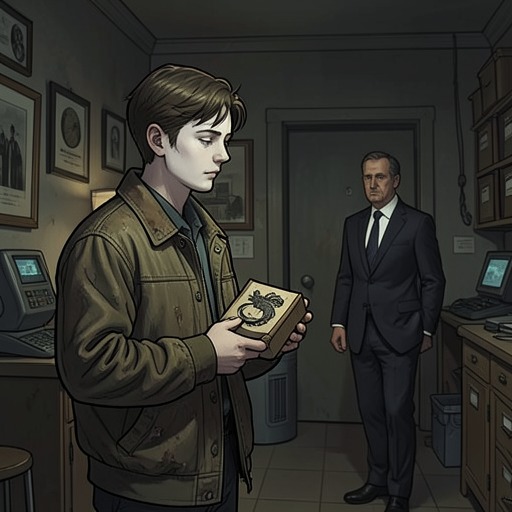
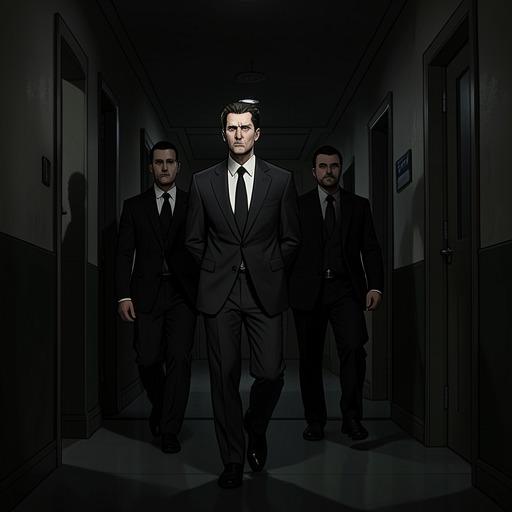
The Girl with the Dragon TattooMartin Vanger's house is the modern residence on Hedeby Island where Martin Vanger lives as chief executive of the Vanger Corporation and where the investigation into Harriet Vanger's disappearance reaches its most terrifying discovery. Its white-brick exterior and commanding position conceal a basement arranged as a private torture chamber, turning an apparently respectable family home into the principal scene of Martin Vanger's criminal life.
Setting and Public Identity
The house stands at the end of the road through the Vanger family settlement, noticeably different from the older stone buildings around it. It is a modern, architect-designed home of white brick with black window frames, situated so that its upper floors must have a magnificent view toward the sea to the east and Hedestad to the north. The parsonage once occupied the site, but it was destroyed by fire in the 1970s; Martin Vanger built the present house in 1978 when he took over as chief executive of the Vanger Corporation.
That history gives the building a double public identity. It belongs to the visible order of the Vanger family and is associated with Martin's position, wealth, and authority, yet it also occupies ground marked by an earlier fire. The house therefore appears as both a corporate residence and a replacement structure, its clean modern design standing over a past that has not been fully explained. The contrast becomes more disturbing as the investigation links fire, sadistic violence, and the Vanger family history.
Visibility, Access, and Suspicion
The house first becomes an active investigative space when Mikael Blomkvist approaches it at night. Most of the family homes are dark, but lights remain on downstairs in Martin Vanger's house. Blomkvist sees no one through the windows, then notices that the small side door into the garage is slightly open. Inside, an open box of ammunition for a moose rifle lies on a carpenter's bench, while two gasoline cans stand on the floor beneath it. The objects suggest preparations for another nocturnal visit and transform an ordinary garage into a threatening threshold.
Martin Vanger is already associated with the unresolved danger surrounding Harriet Vanger. The earlier accident on the bridge created a temporary bottleneck that drew police officers, an ambulance, rescuers, firefighters, reporters, and sightseers to the mainland side, while people on Hedeby Island tried to free the injured Gustav Aronsson. Photographs taken during the response show Harriet's bedroom window closed in one image and open between 3:40 and 3:45 in another, even though no one admitted opening it. The house is consequently part of a wider spatial puzzle: public attention is concentrated at the bridge while a private room, hidden from the crowd, may be entered or used without detection.
The surrounding island offers further concealed routes and abandoned spaces. Near the shoreline, the Fortress consists of Second World War bunkers, trenches, and a command building overrun by grass and scrub; paths lead toward a boathouse, fields, marshland, and the road to Östergården. When Mikael Blomkvist is shot at from the direction of the farm, he must move between artillery batteries and brush while the sea blocks him behind. These locations do not prove that the house itself provides every route or hiding place, but together they establish the island as a landscape in which visibility is intermittent, movement can be obstructed, and violence can remain concealed within an apparently familiar environment.
The Basement and the Torture Chamber
Martin leads Blomkvist into the basement rather than allowing him to continue through the house. A passage near the kitchen gives way to a staircase, a boiler room, and a storage room filled with old furniture and boxes. At the rear stands a steel security door with a deadbolt. Martin gives Blomkvist a key ring and orders him to open it; after the door is unlocked and the light switched on, the basement is recognized as a place of extreme horror.
The chamber occupies approximately ten by twenty feet and has been contrived with deliberate care. Chains and metal eyelets are fixed in the ceiling and floor. A table fitted with leather straps allows victims to be restrained. Video equipment forms a taping studio, while a steel cage stands at the back for captives. A bench, a bed, and a television corner with videos on a shelf complete the room. The space is not an improvised site of violence but a designed environment whose furnishings separate restraint, recording, confinement, and prolonged abuse.
Martin's control of the room is demonstrated immediately. Once inside, he points a pistol at Blomkvist and tells him to lie face down. When Blomkvist refuses, Martin threatens to shoot him in the kneecap. The basement thus changes from evidence site to active trap: the investigator is not merely discovering what happened there but is being forced into the same system of domination that imprisoned earlier victims.
Evidence of a Serial Killer
After Blomkvist is rescued, Lisbeth Salander returns to the basement to examine and photograph the crime scene. In addition to the torture instruments, she finds violent pornographic magazines and a large collection of Polaroid photographs pasted into albums. She also discovers two A4 binders containing passport photographs and handwritten notes about women, as well as Martin's Dell PC laptop. There is no diary, but the binders and computer provide an organized record of the crimes and of the women Martin had selected or observed.
The most revealing object is Martin Vanger's death book, in which he catalogues and grades his victims, describes their suffering, and documents the killings through videotapes and photographs. The records show that the violence is not incidental to Martin's life: killing and the experience of causing suffering are the goal, while the collection preserves the pleasure of the act as a repeatable memory. Salander concludes that the hunt itself is Martin's primary interest, a conclusion supported by the laptop database listing more than a hundred women.
The database includes employees of the Vanger Corporation, restaurant waitresses, hotel reception staff, clerks at the social security office, secretaries of business associates, and many other women Martin had encountered. He killed only a fraction of those listed, but every woman near him was treated as a potential victim. The classification of women as entries in a private catalogue extends the chamber's logic beyond its walls: the basement is the physical endpoint of a system that begins with watching, sorting, and selecting.
Martin's victims were often new arrivals, immigrant girls without friends or social contacts in Sweden, as well as prostitutes and social outcasts affected by drug abuse or other difficulties. Their marginalization made them easier to isolate and less likely to receive immediate protection or belief. The house's respectability and Martin's corporate position therefore operate alongside a social vulnerability outside it, allowing the chamber to function within a larger structure of unequal visibility.
Family History and Narrative Significance
The basement connects Martin's crimes to the investigation of the Gottfried Vanger murder series. Harriet Vanger's Bible contains underlined passages from Leviticus, and the references correspond to violent cases involving women. The list includes Rebecka Jacobsson in 1949; Mari Holmberg, a prostitute murdered in Kalmar in 1954; Rakel Lunde, a cleaning woman and fortune-teller murdered in 1957; and Sara Witt, who was sexually assaulted, strangled, and nearly burned inside her home in 1964. The crimes involve recurring acts of binding, sexual violence, mutilation, strangulation, fire, and other forms of ritualized suffering.
The investigation also notices a possible continuity between earlier violence and the house's history. A discussion of sadistic killers links dysfunctional homes, animal torture, and arson as recurring features in some documented cases. The Vanger family history contains both the torture of animals and the burning of the parsonage, while the present house stands on the parsonage's former site. The evidence does not reduce Martin's conduct to a simple inherited pattern, but it makes the building a material junction between family secrecy, remembered violence, and chosen criminal behavior.
The house's decisive significance lies in its reversal of domestic expectation. Its exterior promises family continuity, professional success, and a clear view across the island; its basement denies all three, replacing openness with locks, observation with surveillance, and domestic space with captivity. The discovery of the chamber resolves the immediate uncertainty about whether the investigation has found a historical killer or a living threat: Martin Vanger is revealed not as a distant possibility but as an active murderer who has made the family home the center of an organized archive of suffering.