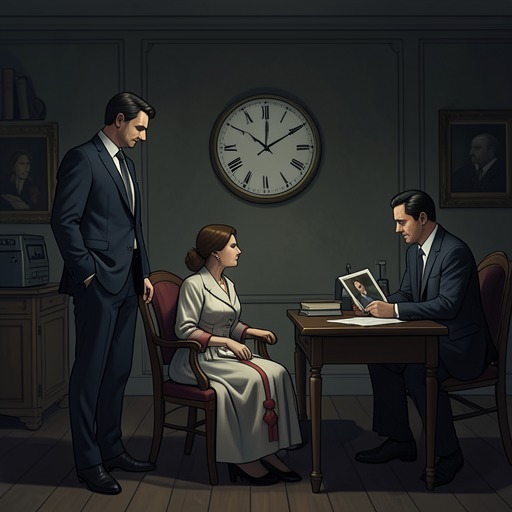
Martin Vanger's serial murders
The Girl with the Dragon TattooMartin Vanger's serial murders are the hidden contemporary crime at the center of the investigation into the biblical references in Harriet Vanger's Bible. What first appears to be a historical series of killings turns into the discovery that Martin Vanger has continued the violence into the present, using a carefully equipped private chamber, a catalogued archive of victims, and a method that exploits the social invisibility of immigrant women, prostitutes, and other outsiders.
From Historical Pattern to Living Crime
The investigation begins with the list and verse references found in Harriet Vanger's Bible. The figures are not telephone numbers but chapters and verses from Leviticus, and the underlined passages describe punishments involving sexual transgression, bodily violation, fire, and death. The associated initials lead Mikael Blomkvist and Lisbeth Salander through a chronological sequence of murders: Rebecka Jacobsson in Hedestad in 1949; Mari Holmberg, a thirty-two-year-old prostitute murdered in Kalmar in 1954; Rakel Lunde, a forty-five-year-old cleaning woman and fortune-teller killed near Landskrona in 1957; and Sara Witt, a thirty-seven-year-old woman from Ronneby murdered in 1964. The cases share restraint, sexual violence, strangulation or other brutal methods, and in Sara's case an attempted house fire. The biblical citations therefore operate less as abstract religious decoration than as a recurring code attached to real female victims.
The pattern initially suggests a sadistic killer from the past, but the discovery of Martin Vanger's activities changes the investigation's entire scale and urgency. Blomkvist realizes that the matter is not a historical mystery at all: Martin Vanger is murdering women in the present. The old cases are connected to a continuing practice rather than a closed sequence, and the apparently respectable setting around the Vanger family conceals an active source of violence.
The Murdering Apparatus
Martin Vanger has constructed his private torture chamber with deliberate, practical precision. The room contains chains and metal eyelets fixed into the ceiling and floor, a table fitted with leather restraints, video equipment arranged as a taping studio, a steel cage, and a separate area with a bench, bed, television, and shelves of videos. The architecture turns murder into a controlled procedure. Victims can be restrained, confined, observed, recorded, and kept as captive guests before their deaths.
When Blomkvist enters the chamber, Martin immediately aims a pistol at him and orders him to lie on the floor, threatening to shoot him in the kneecap when he refuses. Martin then describes a recent captive, Irina from Belarus, who had been locked in the cage while Martin dined with Blomkvist and Henrik Vanger. The contrast is central to the crime's horror: ordinary social contact and hospitality exist alongside hidden imprisonment, so that Martin's public identity provides cover for the private ritual beneath it.
Martin presents himself as an intellectual analyst of his own conduct. He says that he is more a serial rapist or serial kidnapper than a serial murderer, treating death as a consequence of having to conceal the crime and describing the victim's eventual disappointment as part of what fascinates him. His explanation does not reduce the violence; it exposes the logic by which he converts sexual domination, captivity, and killing into a private system governed by his own terminology.
Victims, Records, and the Logic of the Hunt
Martin's victims are often newly arrived immigrant women without friends or social contacts in Sweden. Others are prostitutes or social outcasts whose lives include drug abuse or other difficulties. Their vulnerability is not incidental. The lack of a strong social network makes disappearance less visible, delays questions about their whereabouts, and allows Martin to treat women who already stand at the margins of public concern as disposable.
Salander identifies a further behavioral pattern in Martin's keeping of souvenirs. He maintains a death book in which he catalogs and grades his victims, describes their suffering, and documents the killings through videotapes and photographs. The archive gives the murders a second life as objects of recollection and possession. The violence is not merely hidden; it is organized into a private record that allows Martin to revisit the pleasure he associates with control.
The records show that killing is only part of Martin's larger pursuit. On his laptop he has created a database containing more than a hundred women: employees of the Vanger Corporation, restaurant waitresses, hotel receptionists, social-security clerks, and secretaries of business associates. He has effectively pigeonholed nearly every woman who has come into contact with him. Only a fraction become victims, but every woman within his orbit is treated as a potential target. The hunt, Salander concludes, is Martin's primary interest, while murder is the endpoint of a broader practice of surveillance, selection, and imagined access.
Family Inheritance and Moral Responsibility
Martin's murders continue a first series attributed to Gottfried Vanger between 1949 and 1965. Martin was drawn into that violence as a child. According to Blomkvist's account of Martin's confession, Gottfried began his son's apprenticeship after Martin reached puberty; Martin was present at the murder of Lea Persson in Uddevalla in 1962 at the age of fourteen and actively participated in the murder of Sara Witt in 1964 at sixteen.
Martin also says that he never touched another man except his father, leading Blomkvist to infer that Gottfried raped him and compelled him to regard the abuse as a duty. The family history thus links sexual violence, paternal authority, and the transmission of criminal practice across generations. Gottfried's earlier murders are not an isolated prelude but the formative environment in which Martin learned to combine rape, torture, concealment, and killing.
The novel nevertheless refuses to turn inherited abuse into a complete explanation or an excuse. Blomkvist argues that upbringing can leave a lasting mark, pointing to Gottfried's own merciless childhood beatings. Salander rejects the idea that mistreatment removes personal responsibility: Gottfried was not the only abused child, she insists, and neither Gottfried nor Martin thereby gained the right to murder women. The exchange distinguishes causal background from moral justification. Family violence helps explain the continuity between father and son, but the murders remain choices for which the perpetrators are accountable.
Discovery and Significance
The serial murders are uncovered through the convergence of documentary evidence, biblical interpretation, police reports, crime-scene patterns, and Martin's own spaces and records. The chronological case list transforms scattered regional murders into a hidden series, while the chamber, videos, photographs, and death book reveal that the pattern has persisted far beyond the period initially associated with Gottfried Vanger.
The murders also expose how a community can mistake order for safety. Martin kills discreetly and with careful planning, sometimes one or two victims a year over roughly fifteen years, without anyone recognizing that a serial killer is operating. His selection of isolated women makes the absence of public alarm part of the mechanism of the crime. The women are not invisible because their deaths lack significance; they are made vulnerable because institutions and communities are less likely to search for them with urgency.
As a narrative event, Martin Vanger's serial murders overturn the investigation's central assumption. The search for Harriet Vanger has led to a past crime, but the past opens directly onto an ongoing threat. The biblical code, the repeated forms of abuse, the murder chamber, and the death book join religious language to modern technology and domestic respectability to organized predation. The result is not simply the exposure of one killer, but the revelation of a family and social order that allowed violence against marginalized women to remain unrecognized for decades.