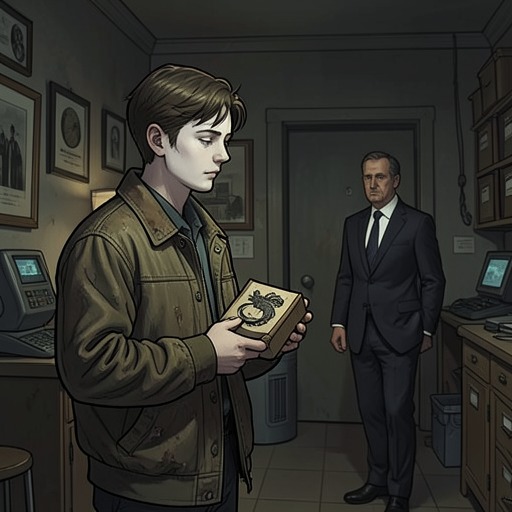
Martin Vanger's death book
The Girl with the Dragon TattooMartin Vanger's death book is the central material record of Martin Vanger's serial murders: a set of binders in which he catalogues women, describes their suffering, and preserves photographs of his crimes. Discovered in Martin Vanger's torture chamber after his attack on Mikael Blomkvist, it reveals that the investigation into Harriet Vanger's disappearance has uncovered not merely an old chain of unsolved killings but the working archive of a living predator. The files make Martin's violence legible as both organized practice and private obsession.
Discovery and Physical Form
The death book is not a conventional diary. It consists of two A4 binders containing passport photographs and handwritten notes about women, found by Lisbeth Salander while she examined Martin Vanger's basement and the adjoining evidence of his crimes. The room itself had been carefully arranged as a torture and recording facility, with chains, metal eyelets, a restraint table, a steel cage, a bed, a television corner, and video equipment. The binders therefore belong to a larger apparatus in which violence was staged, recorded, classified, and revisited.
The archive also included a collection of violent pornographic magazines and a large number of Polaroid photographs pasted into albums. In one small envelope, Salander found two faded, much-handled Polaroids of a dark-haired girl. One showed her partly dressed, turning her face away and raising an arm defensively; the other showed her naked on a blue bedspread, still hiding her face. Salander removed the photographs before burning the binders, preserving the images as evidence while destroying the larger record of Martin's victims.
Contents and Operating Method
Martin's notes catalogued and graded his victims, described their suffering, and documented the killings through photographs and videotapes. The death book thus records more than outcomes. It preserves the sequence by which a woman became an object of attention, a selected victim, and finally a documented possession. Salander's knowledge of sexual sadism led her to understand the souvenirs as reminders through which a killer could recreate the pleasure of the original violence.
The files also show that Martin's primary interest was not simply killing. Salander concluded that the hunt came first. On his laptop, Martin maintained a database containing more than a hundred women, including employees of the Vanger Corporation, restaurant waitresses, hotel reception staff, clerks at the social security office, and secretaries of business associates. The database recorded whether each woman was married or single, whether she had children, where she worked and lived, what car she drove, her education, hair and skin colour, and physical figure. The death book and the computer therefore form two parts of one system: the binders preserve completed violence, while the database maps a much larger field of potential victims.
Victims and the Leviticus Pattern
The death book gives concrete meaning to the codes hidden in Harriet Vanger's Bible. The names and initials in the Bible correspond to murdered women whose cases Salander and Mikael Blomkvist reconstruct chronologically. The sequence begins with Rebecka Jacobsson in 1949 and includes Mari Holmberg, a thirty-two-year-old prostitute murdered in Kalmar in 1954 after being tied up and abused; Rakel Lunde, a forty-five-year-old cleaning woman and fortune-teller murdered in 1957, found naked, bound to a laundry frame, gagged, and killed with repeated blows from a heavy rock; and Sara Witt, murdered in Ronneby in 1964 after being tied to her bed, sexually assaulted, strangled, and subjected to an attempted house fire.
The corresponding Bible verses come from Leviticus and describe punishments involving sexual transgression, prostitution, animal intercourse, mediums, bodily impurity, burning, stoning, and death. Harriet's underlined passages therefore operate as an index to a series of crimes whose methods and victims vary but whose punitive biblical language recurs. The death book supplies the hidden archive behind that pattern, while the Bible preserves the code that allowed Harriet to recognize it.
Martin's victim selection explains why the murders remained disconnected for so long. His victims were often immigrant women with no friends or social contacts in Sweden, prostitutes, or other social outcasts whose lives already placed them at the margins of institutional attention. Martin killed only a fraction of the women he tracked, but every woman near him could become a potential victim. The files expose the social invisibility on which his secrecy depended: the archive is extensive because his victims were difficult to connect, search for, or publicly remember as a group.
Destruction and Narrative Consequences
After reading the binders, Salander burned them in the woodstove and stirred the ashes. She then discreetly dropped Martin's laptop into the water beneath the bridge. This act has an immediate protective logic: she prevents the material from becoming a trophy or instrument of further abuse and removes Martin's organized catalogue of women. It also leaves the investigation with an uneven archive, in which the surviving photographs and the evidence recovered from the torture chamber stand against the destruction of the killer's own written classification.
The death book changes the interpretation of the entire Harriet Vanger investigation. For six months, the case has seemed to depend on photographs, police reports, family testimony, and the delayed recognition of clues. The discovery of Martin's files converts those traces into evidence of a serial process that began in the 1960s and continued for roughly fifteen years, with one or two victims a year. The archive reveals that the apparently orderly Vanger world concealed a carefully maintained private economy of stalking, sexual violence, murder, recording, and remembrance.
Its importance is therefore double. As an object, the death book is a criminal record created by the perpetrator himself; as a narrative device, it makes hidden violence visible through the material forms of classification and collection. Against the official reports that once treated Harriet Vanger's disappearance as a single unresolved case, Martin's files disclose the wider structure that Harriet had begun to identify. The archive does not restore the dead women their voices, but it prevents their murders from remaining isolated incidents and exposes the system that made their silence possible.