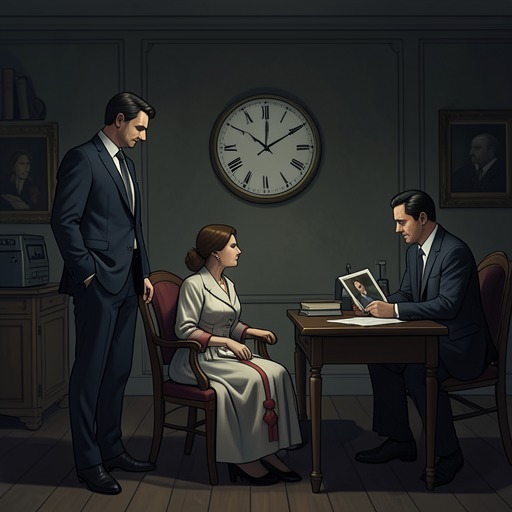
Martin Vanger's torture chamber
The Girl with the Dragon TattooMartin Vanger's torture chamber is the hidden basement room that gives material form to the violence concealed within the Vanger family. Found behind a locked steel security door beneath Martin Vanger's house, it is not merely a crime scene but a carefully maintained apparatus for captivity, torture, recording, and the preservation of evidence. Its discovery reveals that the investigation into Harriet Vanger's disappearance has led to a much larger history of serial murder.
Location and Physical Design
Martin Vanger led Mikael Blomkvist through the basement, past the boiler room and the smell of laundry, into a storage room filled with old furniture and boxes. At the back stood a steel security door with a deadbolt. Martin gave Blomkvist the keys and instructed him to open it, turning an ordinary domestic basement into a threshold between the orderly surface of the house and the violence hidden beneath it. The room was approximately ten by twenty feet and was probably situated along the north side of the house.
The chamber had been contrived with deliberate care. Chains and metal eyelets were fixed in the ceiling and floor; a table fitted with leather straps allowed victims to be restrained; and video equipment occupied part of the room as a taping studio. A steel cage stood at the back for Martin's captives. Near the door were a bench, a bed, and a television corner with videos arranged on a shelf. The arrangement combines the practical necessities of imprisonment with the furnishings of a private entertainment space, showing that Martin had made repeated violence part of the room's intended use rather than a single spontaneous act.
Discovery and Immediate Threat
Blomkvist entered the chamber under Martin's control. As soon as they were inside, Martin aimed a pistol at him and ordered him to lie face down. When Blomkvist refused, Martin threatened to shoot him in the kneecap. The chamber therefore operates first as a trap: Martin's invitation and the key conceal the fact that the room has been prepared for a victim, and the locked architecture gives his weapon and threats their full force.
The scene confirms that Martin is not simply connected to the murders through circumstantial evidence. His own private space contains the instruments and recording equipment required to carry them out and preserve their memory. Blomkvist's entry also reverses the investigative gaze. The investigator, who had been reconstructing violence from photographs, police files, and biblical references, is suddenly placed inside the environment where that violence occurred and made vulnerable to the same system.
Evidence of the Murders
After Blomkvist survived the encounter, Lisbeth Salander returned to the basement while he slept and examined and photographed the crime scene. Besides the torture instruments, she found violent pornographic magazines and a large collection of Polaroid photographs pasted into albums. She also found two A4 binders containing passport photographs and handwritten notes about the women. Along with the binders, she removed Martin's Dell PC laptop, which she had found on the hall table upstairs, and examined the computer and documents through the early morning.
The chamber's records connect it to a broader archive of predation. Martin kept what Salander identified as a death book: he catalogued and graded his victims, described their suffering, and documented the killings with videotapes and photographs. The physical room, the photographs, the binders, and the digital records together form an evidentiary chain. They preserve not only what happened to individual women but also the methodical attention Martin devoted to classifying, revisiting, and possessing their suffering.
The investigation had begun with Harriet Vanger's Bible and its underlined passages from Leviticus. The verses, identified through names and initials in Harriet's records, pointed toward cases involving women who had been subjected to sexual assault, strangulation, burning, mutilation, or other forms of extreme violence. The police files later arranged the suspected series chronologically, beginning with Rebecka Jacobsson in 1949 and continuing through victims including Mari Holmberg, Rakel Lunde, Sara Witt, and others. The torture chamber does not by itself explain every earlier case, but it supplies the concrete setting that makes the repeated violence legible as a continuing criminal pattern rather than a collection of unrelated incidents.
Martin's Hunting System
Salander concluded that the violence and killing were the goal, but that the hunt was Martin's primary interest. His laptop contained a database listing more than one hundred women: employees of the Vanger Corporation, waitresses in restaurants where he ate, hotel receptionists, clerks at the social security office, secretaries of business associates, and many other women he had encountered. He had killed only a fraction of those listed, yet every woman near him was treated as a potential victim. The chamber was therefore the terminal point of a much larger process of observation, selection, classification, and pursuit.
Martin's victims were often newly arrived immigrant girls without friends or social contacts in Sweden. Others were prostitutes or social outcasts with histories of drug abuse or other difficulties. Their social isolation made them less visible and less likely to receive immediate protection, while Martin's extensive cataloguing turned ordinary workplaces and public encounters into opportunities for surveillance. The room's cage, restraints, camera equipment, and albums represent the moment when that hidden selection process becomes physical captivity.
Family History and Moral Meaning
The chamber also clarifies the relationship between Martin's crimes and the earlier murder series attributed to Gottfried Vanger. Mikael Blomkvist concludes that Gottfried was responsible for the first series of murders between 1949 and 1965. Martin began his apprenticeship under his father after reaching puberty; he was present at the murder of Lea in Uddevalla in 1962, when he was fourteen, and took an active part in the murder of Sara in 1964, when he was sixteen. The chamber thus belongs to a line of inherited violence, but it is also Martin's own developed institution, shaped by his personal collection of photographs, videos, notes, and potential victims.
Blomkvist believes Martin's upbringing played a role in his development. Martin said that he had never touched another man except his father, leading Blomkvist to infer that Gottfried raped him and represented the abuse as Martin's duty. Blomkvist also notes that Gottfried's own father beat him mercilessly for years. These facts establish a chain of family abuse, but Salander rejects any interpretation that turns injury into destiny. She insists that mistreatment does not give Gottfried or Martin the right to murder women and that both men made their own choices. The chamber therefore resists a simple psychological explanation: its history includes transmitted trauma, but its instruments, records, and repeated procedures also testify to deliberate agency.
Narrative and Thematic Significance
The chamber's deepest significance lies in the contrast between its banal setting and its function. Laundry, storage boxes, a boiler room, and domestic rooms surround a carefully organized site of torture. The hidden basement spatializes the Vanger family's divided identity: respectable order above, concealed violence below. The revelation is horrifying precisely because the room is neither remote nor accidental; it has been incorporated into a house and maintained as part of an everyday environment.
Its discovery changes the scale and meaning of the plot. The search for Harriet Vanger, delayed for six months before the case began to crack open, becomes an investigation into decades of violence against women. The Leviticus references, the chronological police records, and the suspected connection between animal torture, arson, and sadistic murder acquire a physical counterpart. Salander's photographs and removal of the binders and computer also turn the chamber from a private instrument of domination into a source of testimony that can be examined outside Martin's control.
The chamber finally exposes the difference between a mystery and a crime archive. It contains traces of Martin's victims, but it also displays the system that made them interchangeable in his eyes: restraints, a cage, cameras, albums, ratings, and a database of possible targets. By bringing that system into view, the room makes the hidden violence impossible to treat as family rumor or isolated aberration. It is the material center of Martin Vanger's crimes and the point at which the novel's investigation confronts the organized reality behind the pattern.