Mikael Blomkvist
The Girl with the Dragon TattooMikael Blomkvist is the journalist at the center of the novel’s movement from public disgrace to investigative revelation. Known also as Carl Mikael Blomkvist, he begins under a written verdict for libelling Hans-Erik Wennerström, yet the same professional stubbornness that leaves him unwilling to abandon a story draws him into Henrik Vanger’s private mystery. His work ultimately joins the disappearance of Harriet Vanger to a history of serial murder and exposes the financial crimes surrounding Wennerström, while forcing him to negotiate the ethical costs of sources, secrecy, illegal evidence, and public disclosure.
Identity and Professional Standing
Mikael Blomkvist is presented as a careful, established reporter rather than a reckless sensationalist. He is associated with Millennium, which he reads and helps shape as an investigative publication, and his earlier reporting includes a well-known story about a bank robber gang. Henrik Vanger has followed his career for years, remembers that Blomkvist entered journalism school, and regards his work as serious enough to justify a difficult private commission.
That reputation is damaged by the trial over his reporting on Hans-Erik Wennerström. The court rules that Blomkvist libelled and defamed the financier, and the written verdict is handed down at ten o’clock on a Friday morning. Blomkvist has never doubted that he will lose and decides not to appeal. Outside the district court, reporters wait for a statement; he does not want to discuss the verdict, but understands that questions must be asked and answered. He accepts that the judicial process has taken its course without repeating his accusation on the courthouse steps.
The conviction does not settle the truth of the Wennerström affair. Dirch Frode observes that Blomkvist’s previous revelations were consistently well documented and that surrendering without a fight does not accord with his character. Frode considers several possibilities: Blomkvist may have believed a story that later proved false, may have trusted a compromised source, or may have faced a threat serious enough to make public humiliation preferable to resistance. The uncertainty establishes the central tension in Blomkvist’s professional identity: his public failure looks like incompetence, but the surrounding evidence suggests a withheld cause.
The Vanger Assignment
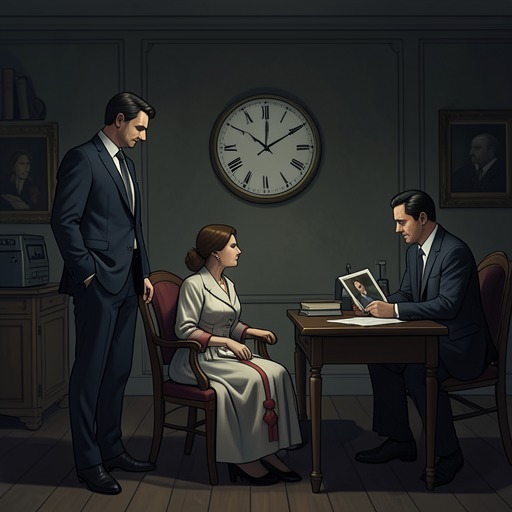
Henrik Vanger recruits Blomkvist under the apparent purpose of writing a biography of the Vanger family. The biography provides a legitimate reason to examine the family’s history, but Vanger makes clear that it is only a pretext. He places a photograph of Harriet Vanger in front of Blomkvist and asks him to scrutinize the family with the eyes of a journalist. The real assignment is to solve the mystery of Harriet’s disappearance.
Blomkvist approaches the case through documents, photographs, interviews, and accumulated recollection rather than through a single dramatic clue. He studies the police record of the disappearance, including Detective Inspector Gustaf Morell’s typed reports. Morell had arrived by boat at Hedeby Island, taken command, and interviewed Henrik Vanger, Isabella Vanger, Ulrika Vanger, Harald Vanger, Greger Vanger, Martin Vanger, and Anita Vanger. Blomkvist is struck by the objectivity and detail of the report, yet also notices how the interviews appear arranged in a descending order of importance. The archive preserves the investigation while also preserving the limits and assumptions that shaped it.
After six months of fruitless thought, the case begins to open in the first week of June. Blomkvist recognizes that the first photograph in the album is not a picture of the bridge accident but the last photograph taken of Harriet on Järnvägsgatan while she watched the Children’s Day parade. The image had been overlooked because attention repeatedly returned to the crowd and vehicles surrounding the accident. His insight is not a discovery of new physical evidence so much as a recovery of meaning from an old image: the photograph had been visible from the beginning, but its place in the sequence had concealed its importance.
A second misrecognition changes the investigation. While examining a 1966 family album, Blomkvist sees Cecilia Vanger seated at a formal dinner beside another blonde woman wearing an almost identical light-coloured dress. The women resemble twins, and the apparent solution falls into place: the woman previously identified as Cecilia in Harriet’s window was actually her younger sister Anita Vanger. Because the sisters had rarely or never appeared together in the same frame, Blomkvist and Lisbeth Salander had treated two people as one. The error demonstrates both the fragility of photographic memory and the danger of assuming that repeated images have already been correctly interpreted.
Collaboration with Lisbeth Salander
Blomkvist turns to Lisbeth Salander when the investigation requires a different kind of scrutiny. Although Dragan Armansky has described her assignment as historical research, Blomkvist tells Salander directly that he wants her help identifying a murderer. He spends an hour explaining the intricate details of the Harriet Vanger case and leaves nothing out, including his suspicion of Cecilia Vanger and the discovery of her face in Harriet’s window. His willingness to disclose the whole case marks a deliberate act of trust: Salander must understand not only the question but also the assumptions that may have distorted it.
Their partnership combines Blomkvist’s journalistic reconstruction with Salander’s technical and investigative abilities. Blomkvist works through family albums, police files, photographs, and testimony; Salander brings access to information that conventional reporting cannot obtain. Their division of labor does not produce a simple contrast between lawful journalist and illicit investigator. Instead, it makes the case depend on both forms of inquiry, while exposing the ethical conflict created when decisive evidence is acquired unlawfully.
Blomkvist also confronts the limits of institutional action. When the possibility arises of informing the police about an older murder connected to the case, he recognizes that the statute of limitations has long since expired, the earlier investigation was closed, and the police are unlikely to reopen it fifty-four years later. He therefore continues under Henrik Vanger’s authority rather than assuming that official institutions will recover the truth on their own. His method is investigative, but it is also archival: he must determine what the records failed to see, what witnesses withheld, and what time has made difficult to prosecute.
Harriet Vanger and the Recovery of Memory
Blomkvist’s reconstruction of Harriet’s final day depends on the tension between public catastrophe and private crisis. The bridge accident dominates the family’s photographs and later memory, yet Harriet’s own experience was governed by fear of Martin Vanger. When Harriet’s account is finally heard, she explains that Martin’s return to Hedestad made her realize she would never be safe. She wavered between telling Henrik and fleeing, but when Henrik had no time to speak with her, she wandered restlessly until she encountered Anita Vanger.
Harriet then remained with Anita in a guest cottage, afraid to go outside. The accident was unreal to her and, despite its importance to everyone else, did not displace her immediate danger. She had written down everything that had happened in a diary and needed to take the diary, as well as clothing, when she escaped; Anita supplied the clothes and helped her leave. Blomkvist’s investigation therefore transforms the disappearance from a presumed murder into a concealed survival shaped by sexual violence, fear, loyalty, and the failure of ordinary family communication.
The revelation also changes the meaning of the evidence Blomkvist has studied. The photograph of Harriet at the Children’s Day parade records her presence shortly before the bridge crisis, while the family photographs preserve a gathering she should have attended but did not. Anita’s hidden role explains why the visual record seemed contradictory. Blomkvist’s achievement lies in connecting these fragments without treating any single archive as complete: police reports, photographs, family recollections, and Harriet’s diary each preserve a partial version of the event.
Wennerström, Sources, and Digital Evidence
The investigation into Wennerström eventually supplies the explanation for Blomkvist’s earlier conviction. Erika Berger recalls that Millennium strengthened security because harassment was disproportionate to the story it had published. The breakthrough came when the magazine found a Deep Throat in Wennerström’s circle. The source was frightened for his life and would meet only in hotel rooms, but supplied documents showing that money from the Minos affair had been used in weapons deals during the war in Yugoslavia and that Wennerström had dealt with the right-wing Ustashe in Croatia.
Blomkvist later examines boxes of printouts from Wennerström’s computer. The material reveals an international maze of option deals, currency transactions, companies registered through post-office boxes, accounts in New York, and nearly thirty companies in twelve countries, including a dormant company holding 200,000 kronor in Santiago, Chile. The documents do not immediately provide a complete explanation; they show transactions and structures without a key to their meaning. Wennerström’s empire resembles a labyrinth of companies, accounts, funds, and securities owned through one another, so intricate that perhaps even Wennerström lacked a complete overview.
The source of the material creates a further ethical problem. Salander has hacked into Wennerström’s computer as well as the computers of several lawyers and close associates, giving Blomkvist access to information that would otherwise be unavailable. Berger’s immediate objection is that Millennium cannot use evidence obtained through illegal means. Blomkvist answers that the magazine need not explain how it acquired the documents and could present them as material supplied by a source with access to Wennerström’s computer. His reasoning restores the possibility of publication but leaves unresolved the conflict between public interest, source protection, evidentiary reliability, and the legality of the investigative method.
Change and Narrative Significance
Blomkvist’s trajectory is defined by the reversal of appearances. At the courthouse he is the convicted journalist who seems to have published an unsupported accusation. In the Vanger case he is the investigator who learns that the visible record has repeatedly been misunderstood: the crucial photograph was dismissed, Anita was mistaken for Cecilia, and Harriet’s disappearance was mistaken for a murder. In the Wennerström investigation, the apparent professional collapse is likewise reinterpreted as the consequence of a larger and more dangerous truth.
His strength is not infallibility but the capacity to continue revising his conclusions. He can accept a court’s judgment without pretending that it answers every factual question; he can acknowledge that the police archive is detailed without treating it as exhaustive; and he can admit that photographs preserve evidence while still requiring interpretation. His work depends on combining skepticism with trust, especially when he entrusts the Harriet investigation to Salander and later confronts the questionable origin of her digital evidence.
By the end of the supplied arc, Blomkvist has recovered the hidden history behind Harriet Vanger’s disappearance and acquired the material needed to challenge Wennerström’s power. He remains a journalist, but his journalism has become inseparable from investigation, personal risk, and moral compromise. The decisive change is that the man publicly branded a defamer is no longer defined by the verdict: the truth of his method and the force of his evidence are measured against the institutions and financial networks that had previously made his reporting appear impossible.