Pressed-flower ritual
The Girl with the Dragon TattooThe Pressed-flower ritual is a yearly birthday message whose meaning changes as the Vanger family’s history is gradually uncovered. Each first day of November, a beautiful pressed flower arrives anonymously for Henrik Vanger in a simple frame. For decades the object appears to be both a tender remembrance and a deliberate instrument of psychological torment, until the truth reveals that the sender intended reassurance rather than menace.
Form and Recurrence
The ritual follows an exact, almost ceremonial pattern. A flower is posted to Henrik Vanger on his birthday, wrapped in gift paper and placed in a padded envelope without a return address or message. The specimens are generally rare and attractive, pressed and mounted on water-colour paper in frames measuring six inches by eleven inches. Their regularity makes the gift recognizable as a series rather than a collection of unrelated botanical curiosities.
The flowers arrive on the first day of November, and their recurrence gives the passage of time a visible form. Most are posted from Stockholm, but the parcels have also come from London, Paris, Copenhagen, Madrid, Bonn, and Pensacola, Florida. Because there is no registry for the flowers and no licensing trail for their seeds or plants, tracing any individual specimen is effectively impossible. The sender’s mobility and the anonymity of the frame turn a modest domestic object into an international mystery without a usable forensic lead.
Origin in Henrik Vanger’s Family
The ritual began in 1958, when Harriet Vanger was eight years old and gave Henrik Vanger a framed pressed flower for his birthday. Henrik Vanger was born on November 1, and Harriet Vanger made the frame during the summer, saving it until the birthday. The first specimen was a bluebell, mounted with an amateurishness that marks it as a child’s handmade present; the following years brought flowers such as buttercup and daisy.
The annual gift therefore originated in the special relationship between Henrik Vanger and Harriet Vanger. Henrik Vanger regarded Harriet Vanger as his own daughter, and the continuing arrival of the flowers preserved a private connection that had once been direct and affectionate. The ritual’s emotional force depends on this beginning: before it became a clue, it was a family tradition created by a child for an older man she loved.
The Mystery and Morell’s Investigation
After Harriet Vanger disappeared, the flowers acquired a darker interpretation. Henrik Vanger came to believe that the yearly parcel might be sent by Harriet Vanger’s murderer, precisely because it arrived every birthday and seemed directed at him. He feared that Harriet Vanger had been taken away as part of an attempt to get at him, and the repetition made the gift feel like calculated torture. The object’s beauty did not soften that effect; its prettiness became part of its cruelty because it remained materially meaningless while carrying an apparently intimate threat.
Detective Superintendent Gustaf Morell treated the matter as the Case of the Pressed Flowers, his last unsolved and most frustrating investigation. The police examined the flowers and frames for fingerprints, handwriting, and other traces, but the sender would have worn gloves, and the frame could have been purchased almost anywhere. Morell spent thousands of hours considering the case, yet he could not establish beyond doubt that a crime had even been committed. That uncertainty distinguishes the ritual from an ordinary murder investigation: its central evidence is a repeated object whose very status as evidence remains doubtful.
The case was scrutinized by fingerprint experts, graphologists, criminal investigators, and a small circle of relatives and friends. Thirty years later, however, the circle of people still engaged with it had contracted to three: Henrik Vanger, the retired Gustaf Morell, and the unknown sender. Age itself threatened to erase the remaining witnesses and investigators. The ritual thus becomes a contest against disappearance not only because of Harriet Vanger’s fate, but also because the people capable of interpreting the flowers are themselves vanishing.
The Forty-Three Flowers and the Missing Place
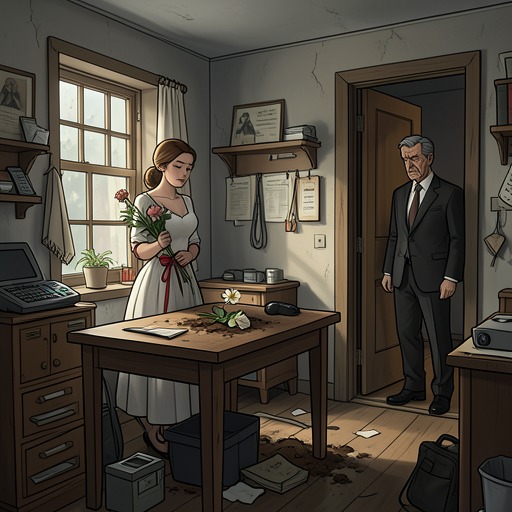
By the time of Henrik Vanger’s eighty-second birthday, forty-three pressed flowers hung above his desk. They filled four rows of ten, with four more in a bottom row. One position in the top row—the ninth slot—was empty, because the flower associated with the year of Harriet Vanger’s disappearance was missing. The new flower, identified as Desert Snow, would be number forty-four.
This arrangement converts the ritual into a visual calendar and an inventory of absence. Every frame records an annual recurrence, while the empty place isolates the year that cannot be made ordinary. Henrik Vanger first studies the new flower without knowing its name, then looks toward the wall and the missing ninth position. The display’s numerical order gives the mystery a surface of precision, but the gap at its center resists completion. His sudden tears after almost forty years show that the flowers have preserved grief more effectively than they have preserved certainty.
Resolution and Significance
The apparent threat is ultimately reinterpreted. Harriet Vanger was the person who sent the flowers, while Anita Vanger served as her channel. Harriet Vanger hoped Henrik Vanger would understand that she was alive and doing well without requiring her to appear in person. Anita Vanger worked for an airline and could post the flowers from wherever she happened to be, which explains the parcels’ scattered international origins.
The revelation changes every element of the ritual at once. The annual parcels were not a murderer’s taunt, and Henrik Vanger’s suffering arose from a tragic misreading of an affectionate signal. Harriet Vanger loved Henrik Vanger, but because Anita Vanger moved abroad after finishing her studies and never visited Hedestad, Harriet Vanger’s knowledge of events in the Vanger family was limited. She did not know how terribly Henrik Vanger suffered or that he believed the flowers came from her murderer.
The ritual’s final significance lies in that reversal from menace to care. Its repeated form first delays understanding, making an ordinary gift strange through anonymity, distance, and the unresolved history surrounding Harriet Vanger’s disappearance. Once the sender is known, the same flowers become evidence of survival and attachment. The frames do not erase the years of fear or the failure of the investigation; instead, they expose how love, when cut off from direct communication, can be received as violence and how a material sign can preserve both a relationship and a devastating misunderstanding.