The Rebecka Jacobsson Murder
The Girl with the Dragon TattooThe Rebecka Jacobsson Murder is the 1949 killing of a young Vanger Corporation employee in Hedestad, remembered for its exceptional brutality and for remaining unsolved. Within the narrative, it is more than a cold case: it becomes the private “Rebecka case” of former detective Gustaf Morell, a possible model for the biblical murder code that Harriet Vanger recorded, and the first identified entry in a wider series of attacks on women.
The Murder and Its Unresolved Afterlife
Rebecka Jacobsson was twenty-three or twenty-four when she was murdered in Hedestad in 1949. She had worked on the Vanger Corporation’s clerical staff and was remembered by Henrik Vanger as popular and very attractive. The killing provoked a tremendous public outcry, and Henrik had a small part in the events surrounding the investigation, which explains why the name remained fixed in his memory even decades later.
The crime’s distinctive horror lay in the method. Rebecka was assaulted, raped, and murdered; her killer tied her up and forced her head into the smouldering embers of a fireplace. The investigation could not establish how long she remained alive or how much suffering she endured. Experts were brought in from Stockholm, but the murder still remained unsolved, and the statute of limitations eventually expired.
Morell’s Personal Cold Case
For Gustaf Morell, Rebecka’s murder became the case that defined the lonely persistence of homicide work. He served in Hedestad from 1963 to 1968, later moved to the Gävle police department after being promoted to superintendent, and continued investigating the case even after leaving the city. His commitment was not simply an extension of Henrik Vanger’s determination. Morell described the unresolved crime as a puzzle that continued to fascinate him and that he could never release.
Morell compared his attachment to Rebecka’s case with that of an older colleague, Torstensson, who had investigated another unsolved murder year after year. Torstensson returned to the files during quiet periods, on holidays, and whenever ordinary police work allowed him time. The comparison establishes a characteristic burden of homicide investigation: relatives and friends eventually return, at least partly, to everyday life, while the officer left with an unsolved case may remain mentally bound to the victim indefinitely. Morell therefore called Rebecka his equivalent of Harriet Vanger. In Harriet’s case, the uncertainty was even more radical, because no one knew how she had died and no murder could be proved.
The Link to Harriet Vanger’s Disappearance
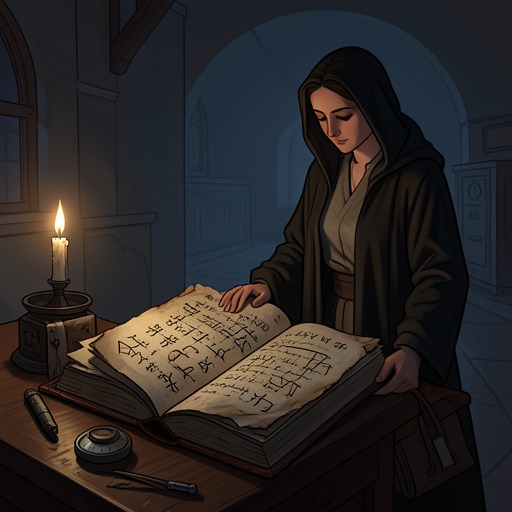
The connection between Rebecka and Harriet emerges through Harriet Vanger’s date book. Harriet wrote the initials R.J. beside a reference to an Old Testament law concerning burnt offerings. Since Rebecka Jacobsson was burned to death, the initials and the biblical subject form an unusually specific link between the 1949 murder and Harriet’s private system of notes. The connection does not prove that Rebecka’s murderer was involved in Harriet’s disappearance, but it shows that Harriet knew of, or had somehow identified with, the older case.
The link is strengthened by Rebecka’s employment. She was not merely a local victim whose name happened to resemble Harriet’s notation; she worked for the Vanger Corporation, making the murder part of the family’s institutional history. Dirch Frode therefore recognizes that the relationship between the two cases is difficult to dismiss even though its precise meaning remains unclear. The old crime operates as both clue and warning: it points toward the Vanger world while also demonstrating how violence against women can remain hidden inside official records and family memory.
Biblical Coding and Ritualized Violence
Harriet’s Bible supplies the interpretive mechanism through which the Rebecka case becomes the first item in a murder sequence. The numbers in her notes are not telephone numbers but chapter-and-verse references in Leviticus. Among them, R.J. corresponds to a passage involving fire, while other initials and references point to women subjected to sexual violence, strangulation, stoning, burning, or other forms of ritualized punishment. The Rebecka entry is consequently both a reference to a real woman and a clue to the killer’s method of translating biblical language into physical violence.
The religious framework is complicated by competing interpretations of scripture. Pastor Otto Falk insists on sola scriptura, sufficientia scripturae, and sola fide, while suggesting that a religious seeker influenced by Catholicism and esoteric material has strayed from accepted doctrine. Lisbeth Salander interprets Falk’s obscure reference to “Josef” and to texts excluded from the canon as an allusion to Josephus and the Apocrypha. This discussion broadens the Rebecka clue beyond a simple Bible citation: it places the murder code within a conflict over canon, forbidden or hidden knowledge, and who has the authority to interpret sacred texts.
The resulting pattern is a grotesque parody of biblical sacrifice rather than a straightforward religious observance. Salander connects the treatment of the victims to Levitical imagery and later observes that the killer’s actions imitate the basic structure of sacrifice, including the use of blood and an altar-like setting. Rebecka’s death by fire thus becomes the earliest known manifestation of a symbolic system that is repeated and varied across later crimes.
Place in the Wider Murder Series
Lisbeth Salander’s review of approximately five hundred pages of police material identifies Rebecka Jacobsson as the first case in a chronology extending from 1949 onward. The subsequent entries include Mari Holmberg, murdered in Kalmar in 1954; Rakel Lunde, murdered near Landskrona in 1957; and later victims whose initials correspond to Harriet Vanger’s biblical references. Rebecka’s case is therefore the chronological beginning of a hidden chain rather than an isolated historical curiosity.
The later pattern also clarifies why the crimes could remain disconnected for so long. The victims included prostitutes, immigrant women without strong social networks, and other social outcasts, people whose disappearances or deaths were less likely to receive sustained attention. Martin Vanger’s records show that he catalogued victims, graded their suffering, and documented killings with photographs and videotapes. He maintained a much larger database of potential victims, including women encountered through the Vanger Corporation, restaurants, hotels, government offices, and business contacts. In that context, Rebecka’s connection to the corporation becomes especially ominous: the institution is not only part of the family history surrounding Harriet, but also one of the environments through which the killer could identify women.
The murder’s significance ultimately rests on its double status. It is a real, unsolved crime that shaped Morell’s understanding of police duty; it is a name preserved in Henrik Vanger’s memory; and it is a coded reference that helps Mikael Blomkvist and Lisbeth Salander reconstruct the violence behind Harriet Vanger’s disappearance. Its delayed return shows how an apparently closed historical file can acquire new meaning when a later victim leaves behind the right initials, the right verse, and a chain of evidence capable of joining private memory to a wider criminal design.