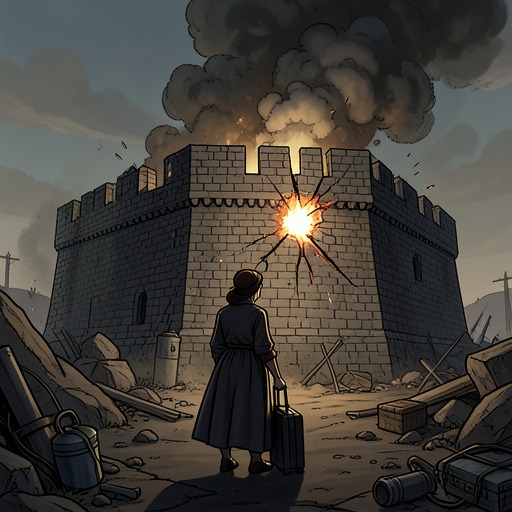
The Shooting at the Fortress
The Girl with the Dragon TattooThe Shooting at the Fortress is the attempted murder of Mikael Blomkvist at the abandoned coastal defence site known as the Fortress. While moving through its overgrown batteries, Blomkvist is struck by shrapnel, forced into cover, and pursued by three rifle shots. He survives by applying remembered military fieldcraft and escaping across exposed ground into dense brush, but the attack radically changes the investigation: the danger is no longer confined to old photographs, family testimony, and historical conjecture. Someone is prepared to kill in order to stop him.
Causes and Investigative Background
The Fortress is the surviving shoreline defence from the Second World War, consisting of concrete bunkers, trenches, a command building, and artillery batteries spread along the coast. When Blomkvist first explores it, the place is almost swallowed by long grass and scrub. The route is difficult, broken by ravines, juniper, marshland, woods, and the wreck of a Pettersson boat near a boathouse. Its physical isolation makes it useful both as a place of concealment and as a site from which the surrounding farms can be watched.
The site is already entangled with the disappearance of Harriet Vanger. Henrik Vanger’s account of the day Harriet vanished centres on the bridge accident at 2:15, when Gustav Aronsson’s car collided head-on with an oil truck. The tanker overturned across the bridge, its trailer hanging over the edge, while heating oil sprayed from the damaged tank and Aronsson remained trapped in his car. Police, rescuers, firefighters, reporters, and spectators converged on the mainland side, creating a mass of activity that cut off normal movement between the island and the mainland. Photographs taken during the confusion later showed that the window of Harriet’s room had changed from closed to open between roughly 3:40 and 3:45, although nobody admitted opening it. The accident therefore functions as an engineered-looking interruption of visibility and movement, while the Fortress belongs to the same geography of hidden routes, blocked sightlines, and concealed actions.
Blomkvist returns to the Fortress after putting away the Apocrypha and changing into his tracksuit. He locks the cottage before setting out, follows the narrow shore path, turns into the woods, and forces his way through thickets and around uprooted trees. He reaches the old artillery batteries exhausted and stops to stretch. The ordinary investigative routine has thus carried him into a space shaped by war, concealment, and defensive violence before the present attack begins.
The Ambush and Escape
The attack begins without warning. A sharp crack is followed by the concrete wall beside Blomkvist’s head exploding. Fragments of concrete and shrapnel tear a deep gash in his scalp. For a moment he stands paralysed, then throws himself into an artillery trench, landing hard on his shoulder and losing his breath. A second shot arrives as he dives, striking the concrete foundation rather than his body.
The Fortress’s layout both traps and protects him. Narrow, overgrown passages run between batteries arranged across a line of about 250 yards. Blomkvist crouches and runs south through the labyrinth, using the walls as cover while trying to determine where the marksman is positioned. He estimates that the shooter may have a rifle, perhaps a moose rifle equipped with a telescopic sight, and understands that such a weapon would give its user a restricted field of vision. He also recognises the crucial tactical fact that a single shot might be accidental, whereas two shots mean that someone is trying to kill him.
The next movement requires him to abandon cover. Blomkvist is about 300 yards from the edge of Östergården farm, with roughly 40 yards separating his battery from a nearly impenetrable thicket. The slope between them is open grassland, and crossing it will leave him completely exposed; behind him lies the sea. After watching and listening for two minutes, he takes the initiative and sprints downhill. A third shot is fired while he is halfway across, but the bullet only produces a vague smack behind him.
He dives through the brush and rolls into stinging nettles, then continues away from the gunfire in a crouch, alternating running with stops to listen. A branch cracks behind him, and he drops flat. Remembering the military instructions of Captain Adolfsson, he crawls on his knees, toes, and elbows through the undergrowth, covering the next 150 yards. Twice he hears further cracks from the thicket. One seems close, perhaps twenty paces to his right; the other comes from farther away. He remains motionless and alert, prepared either to flee or to make a desperate counterattack, until the sounds cease.
Immediate Consequences
The shooting leaves Blomkvist wounded but mobile. Fifty minutes after the shots, shortly after 8:00, he descends from Söderberget and follows the road into the village. During the escape he has considered numerous possible shooters, including people connected with the Vanger family and other figures whose movements he cannot account for. He has no proof of the marksman’s identity, and the uncertainty itself expands the field of danger: the attacker may be someone he has already suspected or someone he has not yet considered.
When Blomkvist reaches the cottage, the door is ajar. He enters in a crouch, acting almost instinctively as though the threat might still be present. He smells coffee and sees Lisbeth Salander through the kitchen window. Salander stiffens when she sees him: his face is smeared with blood, the left side of his white T-shirt is crimson, and he is pressing a soaked red handkerchief to his head. He tells her that the wound is bleeding badly but is not dangerous. His return to her is more than a physical refuge. The attack has forced the investigation’s two investigators back into direct proximity, with Blomkvist now carrying visible evidence that the case has become a lethal confrontation.
The ambush also produces a new investigative problem. Blomkvist can identify the direction and method of the attack, but not the shooter. From the Fortress he has a view toward Östergården, while the intervening batteries, thickets, slopes, and sea create a shifting pattern of exposure and concealment. The same landscape that once helped hide the truth about Harriet Vanger now enables an attempt to eliminate the person seeking it.
From Historical Site to Crime Scene
The Fortress has a double identity. In the earlier investigation it is an overgrown military relic encountered through maps and difficult paths; during the shooting it becomes a present-tense battlefield. Its trenches and concrete walls no longer signify only a vanished war. They determine who can see, who can hide, and how a person under fire can survive. The attack makes the geography itself evidentiary: distance, elevation, open grass, dense brush, and the arrangement of the batteries become part of the question of who could have fired and from where.
The event belongs to a broader pattern in which apparently ordinary or abandoned locations conceal violence. The bridge accident created a public emergency that obscured private movement; Harriet’s room was later found to have an unexplained open window; the Fortress offers a second kind of obstruction, converting a historical ruin into a place where a hidden attacker can control visibility. Later, Blomkvist and Salander discover the Vanger crypt, initially mistaken for a chapel, with the family name chiselled above its door and a Latin verse that Salander translates as a command to sleep until the end of time. Blomkvist then opens a door to what the narration calls hell. These spaces connect the investigation’s visual and architectural motifs: windows, roads, bridges, crypts, bunkers, and locked or concealed interiors repeatedly turn access into a mystery.
Narrative Significance
The shooting is a decisive value shift from investigation to survival. Before the first shot, Blomkvist is pursuing material traces and testing theories; after the third shot, his own body has become part of the evidence. The wound is not merely an obstacle. It proves that the past under examination still has protectors, and that knowledge has crossed the threshold at which it provokes immediate violence.
The sequence also gives physical form to the investigation’s recurring concern with witnessing. The bridge accident was witnessed by crowds, photographed from multiple angles, and nevertheless left a crucial action unexplained. At the Fortress, Blomkvist is the sole direct witness to the attempt on his life, but he cannot see the shooter. He can report the shots, the impact, the distances, and the escape route, yet the central identity remains hidden. The attack therefore repeats the book’s governing paradox: abundant observation does not guarantee understanding.
Blomkvist survives because he recognises the situation quickly, uses the batteries as cover, chooses the exposed slope rather than waiting passively, and applies remembered military training while crawling through the brush. His survival does not resolve the mystery; it intensifies it. The Fortress shooting confirms that the investigation has entered a phase in which every route may be an ambush and every apparently deserted structure may be part of the crime’s living machinery.