The Wennerström Libel Trial
The Girl with the Dragon TattooThe Wennerström Libel Trial is the decisive public defeat that begins Mikael Blomkvist’s crisis and later becomes the measure against which his journalistic vindication is judged. The court convicts him of aggravated libel against Hans-Erik Wennerström, imposing ninety days in gaol and 150,000 kronor in damages. Yet the verdict does not settle the truth of the allegations: subsequent evidence shows that Blomkvist’s original reporting was based on information that was substantially correct, even though he could not prove it in court at the time.
Causes and Background
The trial arose from an article in Millennium concerning the Minos affair. Blomkvist had claimed that Wennerström used state funds intended for industrial investment in Poland to finance arms deals. The court found him guilty on fifteen counts of aggravated libel, while acquitting him on seven other counts. The written judgment ran to twenty-six pages, and its financial arithmetic was brutally concrete: each guilty count cost Blomkvist ten thousand kronor and six days in gaol.
The case was especially damaging because Blomkvist was not merely a journalist employed by Millennium. He was one of the magazine’s part owners and, in what he regarded as a foolish combination of responsibilities, both its writer and publisher. Millennium barely broke even and had no unlimited corporate resources. Blomkvist therefore had to pay the damages himself, a sum that would almost wipe out his savings, while the magazine assumed the court costs. He considered selling his attic apartment on Bellmansgatan, a seven-hundred-square-foot home he had bought inexpensively after searching for a permanent residence during the prosperous end of the 1980s.
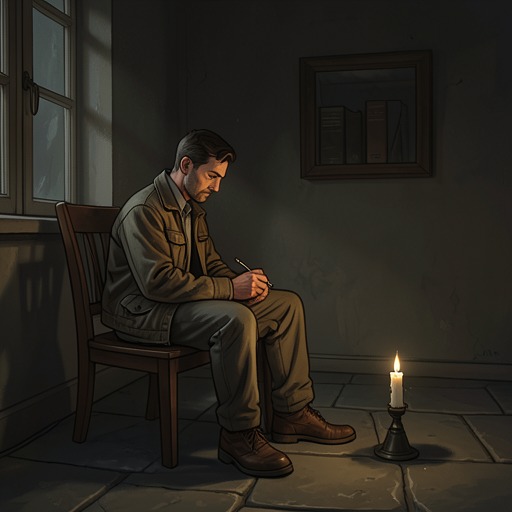
The judgment was not unexpected. Blomkvist had never doubted that he would lose, and during the two-day trial he had remained surprisingly calm. He then waited eleven days for the court to complete its deliberations. The physical force of the defeat arrived only when he held the written verdict: his stomach became heavy and uncomfortable, and the bread of his sandwich seemed to swell in his mouth so that he could scarcely swallow it. Legally, the offense was relatively minor compared with armed robbery, murder, or rape; professionally and financially, however, it threatened both his standing and the fragile economy of Millennium.
The Verdict and Public Scene
The written verdict was handed down at ten o’clock on Friday morning, and reporters waited in the corridor outside the district court. Blomkvist saw them through a doorway and slowed, knowing that the questions could not be avoided. He straightened himself and tried to smile as the journalists offered friendly, almost embarrassed greetings. The scene placed him on the opposite side of the microphone from his customary role: he was now the accused journalist being required to explain a sentence rather than the reporter asking someone else to account for one.
He accepted the formal consequences without apologizing to Wennerström or withdrawing his underlying view. Asked whether he would shake Wennerström’s hand, he said he would not. Asked whether he still considered Wennerström a crook, he avoided repeating the claim on the courthouse steps, recognizing that doing so might create a further legal problem. Instead, he stated that he regretted the court had not reached a different conclusion, believed he had had good reason to publish the information in his possession, and accepted that the judicial process had run its course. He left any future decision about the article to discussion among Millennium’s editorial staff.
The radio news converted the judgment into a compact national narrative: journalist Mikael Blomkvist of Millennium had received ninety days in gaol for aggravated libel, had been ordered to pay 150,000 SEK, and had been condemned by Wennerström’s lawyer as the author of an exceptionally outrageous libel. The broadcast made the conviction sound conclusive, while the later course of events exposes how incomplete that public version was.
Doubt About the Judgment
The trial also creates a mystery about Blomkvist’s conduct. Dirch Frode observes that Blomkvist’s earlier controversial revelations had always been carefully documented. His apparent surrender in court therefore conflicts with the established pattern of his professional character. Frode considers two possibilities: Blomkvist may have believed his story but discovered that the information had somehow become false, perhaps because a trusted source deceived him; or he may have faced a threat so serious that he chose to appear incompetent rather than fight back.
This uncertainty gives the trial significance beyond a straightforward libel conviction. The courtroom has judged the available proof, not necessarily the underlying conduct of Wennerström. Blomkvist’s refusal to appeal does not amount to a confession that the allegations were invented. It marks instead his recognition that the legal process has reached an adverse result and that repeating an unproven accusation would expose him to further consequences.
The case also establishes an ethical conflict that later returns in altered form. Blomkvist’s journalism depends on sources, documentation, and the ability to defend publication in public. His original source has failed him, disappeared, deceived him, or been unable to withstand pressure; the precise explanation remains uncertain. The later investigation must therefore recover not only facts about Wennerström but also the evidentiary chain that can convert suspicion into publishable proof.
Reversal Through New Evidence
The apparent defeat is reversed when Millennium finds a Deep Throat within Wennerström’s circle. The source is described as literally scared to death and permits meetings only in hotel rooms. This source says that money from the Minos affair financed weapons deals during the war in Yugoslavia, that Wennerström dealt with right-wing Ustashe figures in Croatia, and that documentary copies exist to support the account.
The new material is far stronger than the evidence available at the trial. Through Lisbeth Salander’s unauthorized access to Wennerström’s computer, Blomkvist gains boxes of printed source material. Salander has also hacked the computers of several Wennerström lawyers and close associates. Erika Berger initially objects that the material was obtained illegally, but Blomkvist argues that Millennium need not explain the method of acquisition and can present it as material supplied by a source with access to Wennerström’s computer. The controversy over legality remains, but the practical distinction from the first trial is unmistakable: the new investigation possesses records capable of corroborating the allegations.
Salander’s operation depends on a mirrored copy of Wennerström’s hard drive. A device developed by her friend Plague attaches to the broadband cable, intercepts incoming data before it reaches the firewall, and gradually inserts linked code into downloaded material. Once enough code accumulates, it installs an invisible program that resembles Internet Explorer while taking control of the firewall and transmitting information from the computer. The process ultimately creates a mirror image of the hard drive on a remote server, making Wennerström’s own digital records available for examination.
Those records reveal a financial structure too elaborate for ordinary scrutiny. Salander identifies nearly three thousand separate accounts and holdings across the world. The Wennerström Group consists of options, bonds, shares, partnerships, loan interest, income interest, deposits, transfers, and thousands of other elements, much of it held through post-office-box companies that own one another. Financial pundits had estimated the empire at more than 900 billion kronor, but Salander calculates its real assets at between 90 and 100 billion kronor. Beneath legitimate Swedish fixed assets, a solid American firm, and a New York bank holding liquid capital, she finds connections to illegal arms trading, money laundering for suspect enterprises in Colombia, and unorthodox businesses in Russia.
Consequences and Historical Significance
When Millennium publishes the new revelations, the Swedish Stock Exchange trembles, securities-fraud police begin investigating, prosecutors are called in, and a panicked selling spree follows. Two days after publication, the Minister of Commerce issues a statement about the Wennerström affair. The media does not accept the claims without criticism, because the allegations are too serious for unexamined belief. This time, however, Millennium can provide Wennerström’s own emails, computer copies, secret agreements, balance sheets for hidden assets in the Cayman Islands and two dozen other countries, and other records that expose the operation from within.
The new evidence changes the meaning of the earlier conviction. The trial had treated Blomkvist’s account as fifteen provable acts of aggravated libel; the later investigation presents the same broad accusation as part of what may be the largest financial scandal in Swedish reporting since the Kreuger crash of 1932. The scale of the suspected fraud makes earlier Gotabank and Trustor scandals appear minor by comparison, and journalists begin using terms such as organised crime, Mafia, and gangster empire for Wennerström and his associates.
The trial thus functions as both setback and threshold. It empties Blomkvist’s savings, threatens his home, damages his professional credibility, and exposes the limits of journalism without defensible evidence. At the same time, its unresolved question becomes the pressure driving the later investigation. Once Wennerström’s own digital archive supplies the proof that the courtroom previously lacked, the conviction no longer represents the final truth about Blomkvist’s reporting. It becomes the first, legally unsuccessful chapter in the exposure of a criminal empire whose apparent respectability depended on controlling information, sources, and public interpretation.