The investigation into Harriet Vanger's disappearance
The Girl with the Dragon TattooThe investigation into Harriet Vanger's disappearance is the central inquiry that converts an apparently exhausted missing-person case into a layered reconstruction of concealed violence, mistaken identity, religious code, and delayed testimony. Begun by Henrik Vanger after his brother's granddaughter vanished, it lasts thirty-six years before Mikael Blomkvist is asked to return to the evidence with new eyes. Its decisive achievement is not merely identifying what happened to Harriet Vanger, but exposing how police records, family memory, photographs, and private silence preserved the wrong story until their fragments were read together.
Commission and Documentary Scale
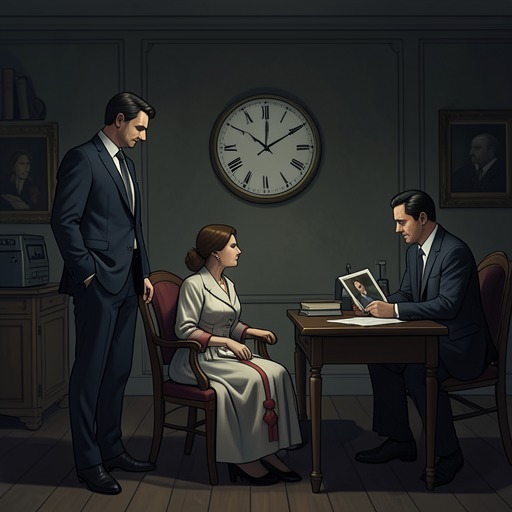
Henrik Vanger presents the investigation as both a final act of hope and an act of intellectual discipline. He tells Mikael Blomkvist that he does not know whether the truth will ever be found, but refuses to go to his grave without making one last attempt. His commission is precise: Blomkvist must live and work in Hedeby for a year, examine the report on Harriet's disappearance one page at a time, question every old conclusion as an investigative reporter would, and search for what Henrik Vanger, the police, and earlier investigators may have missed.
The surviving archive gives the inquiry an unusual physical and temporal weight. Henrik Vanger's investigation has continued for thirty-six years, assembled with the systematic persistence of an amateur archaeologist. The material is estimated to occupy twenty feet of shelving, including twenty-six binders containing copies of the police investigation. Its scale makes the case appear almost overdetermined: an ordinary missing-person report has generated an immense record, yet abundance has not produced understanding. The problem is therefore not the absence of information, but the habits of attention that have organized it.
The Police Inquiry and the Turn to Psychology
Detective Inspector Gustaf Morell becomes the investigation's most important institutional predecessor. His initials mark the moment he arrives by boat at Hedeby Island and assumes command, preparing the formal report on Harriet Vanger's disappearance. Unlike the abbreviated initial notes, Morell's typewritten reports are clear, objective, and richly detailed. He interviews Henrik Vanger and Isabella Vanger, then questions Ulrika Vanger, Harald Vanger, Greger Vanger, Martin Vanger, and Anita Vanger, in an order that Blomkvist reads as a descending scale of importance.
Blomkvist concludes that Morell was exceptionally conscientious. The inspector followed even implausible leads, asked every imaginable question, and eventually became a friend to Henrik Vanger, perhaps sharing some of the old man's consuming investment in the case. Blomkvist therefore decides that the solution is unlikely to lie in an overlooked police fact. The inquiry changes direction: instead of searching indefinitely for a missed procedural detail, he must reconstruct the psychological motives of the people involved. The first question becomes the most basic and most difficult one—who was Harriet Vanger?
Reframing the Day of Disappearance
For six months Blomkvist's thinking produces no decisive result. In the first week of June, however, the case opens through three new pieces of the puzzle, two discovered by Blomkvist and one found with assistance. The first breakthrough comes from the photograph album. While travelling through Hedestad on an unrelated matter, he suddenly understands that the crucial image is the album's first photograph: the last picture taken of Harriet Vanger on the day she disappeared, while she watched the Children's Day parade on Järnvägsgatan in Hedestad.
The photograph had been treated as peripheral because it was the only image in the album that did not depict the bridge accident. The dramatic pictures of the bridge had commanded everyone's attention, while the earlier crowd scene seemed to offer no immediate mystery. Blomkvist's insight reverses that hierarchy. The accident had made the day memorable, but the photograph suggests that the decisive movement began before the family assembly on Hedeby Island and before the crash overshadowed everything else.
This leads Blomkvist to reject the assumption that the bridge accident and Harriet's disappearance were necessarily related. He reconstructs a sequence in which Harriet saw something or someone frightening in Hedestad, returned home, and tried to reach her uncle; Henrik Vanger, unable to listen at that moment, did not receive what she was attempting to tell him. Only afterward did the bridge accident occur, followed by the murder. For the first time, Blomkvist consciously accepts Henrik Vanger's belief that Harriet was dead and recognizes that the investigation is now a search for her killer, not merely for a missing person.
Religious Clues and the Structure of Violence
The investigation later discovers that Harriet's religious development is part of the case's hidden structure. In the final year of her life, Harriet became withdrawn and uncommunicative. She attended Sunday school, said evening prayers, was confirmed, read the Bible, and went regularly to church. She briefly joined a Pentecostal congregation in Hedestad, left after two months, and began reading books about the Catholic faith. Detective Inspector Gustaf Morell inferred that some troubling event had affected her, while Henrik Vanger continued trying to discover whether she had confided in anyone.
Harriet's Bible turns the apparent telephone numbers in her notes into a scriptural cipher. The figures identify chapters and verses in Leviticus, and each cited verse has been underlined. The references include passages involving sexual transgression, execution, burning, dismemberment, mediums, and bodily impurity. Their importance lies in the way the investigation must move between material evidence and interpretation: the Bible is not simply a devotional object but a key to a pattern of murders staged through an abusive reading of biblical law.
Pastor Otto Falk's testimony expands that interpretive conflict. He insists that Harriet must read sola scriptura and understand sufficientia scripturae in order to maintain sola fide, while warning that certain books were excluded from the canon. Blomkvist initially cannot follow the reference, but the explanation identifies Josefus rather than Josef and points toward the Apocrypha, the hidden and controversial books associated with Tobias, Judith, Esther, Baruch, Sirach, and the books of the Maccabees. Falk describes Harriet as someone enthralled by esoteric sources, perhaps Catholic in his disapproving estimation. The investigation thus treats religious language not as a settled explanation but as contested evidence shaped by exclusion, misunderstanding, and the authority to decide what counts as scripture.
Photographic Error and Testimonial Recovery
A further breakthrough comes when Blomkvist studies the Vanger family photographs and notices that the woman previously identified as Cecilia Vanger is actually Anita Vanger, Cecilia's younger sister. The two women resemble each other so closely that, when seen separately or at a distance, they appear almost identical. They had never been captured together in the same frame, and no one had thought to question the assumption that the recurring figure was Cecilia. The error demonstrates how the archive can preserve a false identity through repetition: each photograph seemed to confirm the earlier reading because the original mistake remained invisible.
The investigation's final reorientation comes through Harriet Vanger's own account. On the day she disappeared, Harriet was afraid of Martin Vanger, who had returned to Hedestad, and realized that she might never be safe. She moved between the wish to tell Henrik Vanger and the wish to flee. When Henrik had no time to talk, she wandered through the village, barely registering the bridge accident because her own danger made everything else unreal. She encountered Anita Vanger, who was staying in a guest cottage with Gerda Vanger and Alexander Vanger, and decided to remain hidden with her. Anita supplied clothing, while Harriet took the diary in which she had written down everything that had happened.
This testimony changes the meaning of the investigation's earlier silence. Harriet had not simply vanished into the confusion surrounding the accident; she had used the confusion to escape Martin Vanger and relied on Anita Vanger for protection. What appeared for decades as an unsolved disappearance was therefore also a concealed survival, sustained by a private pact between two women and by Harriet's decision to carry her written testimony away with her.
Consequences and Significance
The investigation ultimately exposes the limits of official thoroughness without dismissing its value. Detective Inspector Gustaf Morell's report preserves the facts, times, interviews, and institutional responses; Henrik Vanger's files preserve decades of obsession; the photographs preserve faces and arrangements; Harriet's Bible and diary preserve coded and personal testimony. None of these forms is sufficient alone. The truth emerges only when Blomkvist changes the question, reads the margins of the archive, and recognizes that a crowd photograph may be more revealing than the celebrated accident scene.
The inquiry also changes the status of its investigator. Henrik Vanger's letter to Mikael Blomkvist expresses respect for Blomkvist's integrity and refuses to tell him what to write or publish. Although the contract remains available and Blomkvist has enough material to complete the Vanger family chronicle, the investigation has become more than commissioned research. It has turned a family obsession into a public account of violence, secrecy, and institutional misrecognition, while showing that truth may survive not as a single authoritative record but as a difficult convergence of damaged memories, misread images, coded texts, and testimony recovered after decades.