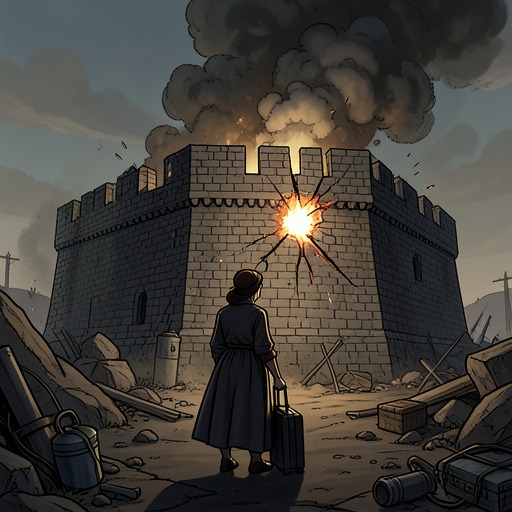
The shooting of Mikael Blomkvist
The Girl with the Dragon TattooThe shooting of Mikael Blomkvist is the decisive escalation that turns the investigation on Hedeby Island from a search for historical evidence into a present-tense attempt to kill an investigator. While running near the abandoned Fortress, Blomkvist is targeted by an unseen marksman, wounded in the scalp, and driven into improvised evasive action. His survival confirms that the crimes he and Lisbeth Salander are reconstructing remain connected to a living and dangerous perpetrator or accomplice.
Causes and Investigative Background
The attack occurs within a landscape already shaped by concealment, restricted movement, and misleading public attention. The Fortress is a neglected Second World War shoreline defence, consisting of concrete bunkers, trenches, and a command building overrun by grass and scrub. Its position near Östergården gives it both strategic visibility and dangerous exposure: Blomkvist is about 300 yards from the farm, with the sea behind him and a dense thicket roughly 40 yards ahead, but reaching cover requires crossing an open grass slope.
The investigation has been gathering force through physical traces and recurring patterns. A 1966 photograph of the Hedeby Bridge accident shows Harriet Vanger’s bedroom window open at approximately 3:40 to 3:45, although it had been closed in the preceding image and nobody admitted opening it. The accident itself created the conditions for a mass diversion: an oil tanker crashed into Gustav Aronsson’s car, overturned across the bridge, and began leaking flammable heating oil while emergency services, reporters, and spectators converged on the mainland side. The resulting obstruction helps explain how Harriet’s disappearance could occur amid apparent public scrutiny rather than in isolation.
Blomkvist and Salander have also identified a chain of murders corresponding to figures and initials in Harriet Vanger’s Bible. The cited passages from Leviticus concern sexual transgression, bodily violation, mediums, animal contact, burning, and blood, while the victims’ cases reveal recurring acts of binding, sexual assault, strangulation, mutilation, and fire. The list includes Rebecka Jacobsson in 1949, Mari Holmberg in 1954, Rakel Lunde in 1957, and Sara Witt in 1964, among other women. This pattern makes the inquiry more than a historical puzzle: it points toward a systematic killer whose methods and religious imagery may still have consequences in the present.
Course of the Attack
After preparing to leave, Blomkvist followed the shore path through woods and thickets to the Fortress, where he stopped beside an artillery battery to recover. A sharp crack suddenly struck the concrete wall beside his head, sending fragments and shrapnel into his scalp. He initially considered whether the shot might have been accidental, but a second shot made the intention unmistakable. Blood soaked his T-shirt, and the open ground between the battery and the thicket became a lethal corridor.
Blomkvist assessed the attacker as possibly using a rifle, perhaps a moose rifle with telescopic sights. He could not see the marksman or know whether the shooter was waiting for him to reappear. Remaining in the battery offered cover but risked allowing the attacker to approach and fire at close range; sprinting toward the brush would expose him completely. He chose initiative over passive concealment, left the battery, and ran down the slope. A third shot was fired when he was halfway across, but it missed him and struck somewhere behind.
He threw himself through the brush, rolled through stinging nettles, and continued away from the direction of fire in crouched bursts. Branches cracked behind him, forcing him to freeze, listen, and move by crawling through the undergrowth. He covered the next stretch on his knees, toes, and elbows, repeatedly stopping to determine whether the pursuer was near. The attack therefore becomes a contest between the shooter’s superior range and Blomkvist’s knowledge of cover, terrain, and movement; the Fortress’s military remains are repurposed as a contemporary killing ground.
Injury, Disclosure, and Immediate Consequences
Salander drove Blomkvist to Hedestad Hospital, where two stitches and a dressing closed the scalp wound. He received cortisone salve for the rash caused by the nettles on his neck and hands. The treatment was limited, but the event’s meaning was not: two shots had already established attempted murder, and the third confirmed that the danger was deliberate rather than incidental.
Blomkvist considered reporting the attack to the police but rejected the idea partly because he anticipated sensational headlines portraying him as a journalist involved in a shooting drama. His decision preserves the investigation’s secrecy while leaving the attackers unidentified. It also shows the cost of his professional position: even after being shot, he worries that public interpretation could distort the case and damage his credibility.
The attack’s most important disclosure is indirect. The marksman’s presence proves that the investigation has penetrated territory someone wishes to protect. The danger is no longer confined to the old photographs, the Bible verses, the archives, or the family history surrounding Harriet Vanger’s disappearance. It has reached Blomkvist’s body, making the previously reconstructed violence continuous with the present.
Salander’s Defensive Response
On returning to Hedeby Island after dark, Salander immediately turns the cabin into a surveillance system. She borrows equipment from Milton Security and places four battery-operated motion detectors around the house. Anyone approaching within twenty feet will trigger a radio signal and a chirping alarm in Blomkvist’s bedroom. Two light-sensitive cameras hidden in trees at the front and rear of the cabin transmit signals to a laptop concealed in a cupboard by the front door.
Salander adds a third camera inside a birdhouse above the entrance, drilling through the wall so that its lens can cover the road and the path from the gate to the door. The device takes a low-resolution image every second and stores the sequence on another laptop in a wardrobe. A pressure-sensitive doormat provides the final layer: anyone who bypasses the infrared detectors and enters the house activates a 115-decibel siren. Salander also supplies a key for disabling the system and a night-vision scope.
This response changes the investigators’ relationship to the island. Earlier, the island’s bridge, woods, shoreline, abandoned military structures, and family buildings functioned as spaces through which evidence could be traced or hidden. After the shooting, those same spaces must be watched as possible routes of approach. Salander’s equipment makes the cabin a controlled site of observation, countering the attacker’s advantage in concealment and extending the investigation into the realm of counter-surveillance.
Narrative Significance
The shooting marks a reversal in the investigation’s value structure: Blomkvist begins as an investigator observing violence from the outside and becomes its immediate target. The attack converts inference into bodily knowledge. The Bible’s verses and the murder files had described what had been done to women; at the Fortress, Blomkvist experiences the terror of being hunted, exposed, and unable to see the person who controls the weapon.
The event also binds the mystery’s spaces together. The bridge accident once created a temporary crowd and blocked passage, the open window in Harriet Vanger’s room preserved a minute physical anomaly, the Fortress conceals movement among bunkers and scrub, and the later discovery of Martin Vanger’s torture chamber reveals a deliberately constructed interior world of chains, restraints, video equipment, and a steel cage. The shooting provides the living equivalent of those earlier clues: a hidden assailant uses terrain and visibility as instruments of control.
Salander’s response prevents the attack from becoming merely a warning or interruption. It produces a new investigative method based on detection, recording, alarms, and controlled access. The case now advances under the knowledge that discovery carries an immediate physical price, and that the people searching for the truth must build their own protection against the violence their evidence has exposed.