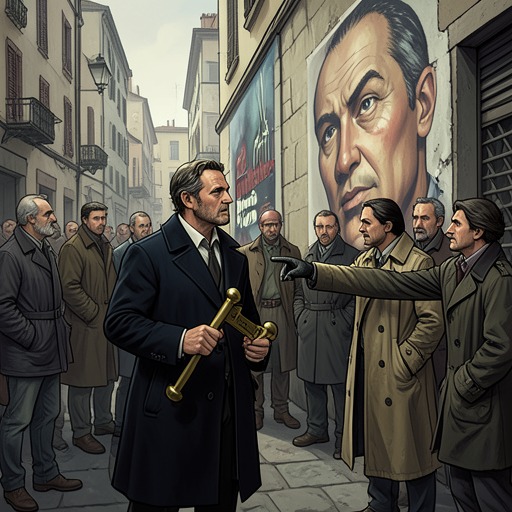
1933 New York underworld war
The Godfather1933 New York underworld war was the decisive struggle through which Vito Corleone converted organizational intelligence, political contacts, and controlled violence into regional supremacy. Provoked by Salvatore Maranzano's contemptuous rejection of a proposed partnership, the war ended with Maranzano's assassination on New Year's Eve, the absorption of his empire, and the institutional expansion of the Corleone Family. Its importance lies not only in who won, but in the model of power the victory established: protection, tribute, intelligence, and layered administration could outlast more spectacular forms of gangster violence.
Causes and Opposing Powers
The conflict began after the repeal of Prohibition threatened to cripple the Corleone enterprise. Vito Corleone had already protected Italian families operating small home speakeasies, cultivated police and judicial contacts, and accumulated influence through favors. He anticipated that the end of Prohibition would destroy one source of income and therefore sent emissaries in 1933 to Salvatore Maranzano, the acknowledged big shot who controlled gambling in Manhattan, including dockside crap games, shylocking, bookmaking, illicit poker houses, and Harlem's numbers racket.
Vito Corleone proposed an equal partnership. His organization and contacts could provide Maranzano's operations with protection and help them expand into Brooklyn and the Bronx. Maranzano rejected the offer with contempt, relying on his friendship with Al Capone, his own armed organization, his war chest, and his ties to the Tattaglia Family. That refusal transformed a possible alliance into the 1933 New York underworld war and set the two organizations against each other.
At the beginning, Maranzano appeared to possess the greater strength. His enforcers were powerful, his connections reached Chicago through Al Capone, and he had political relationships with business leaders who used his men against Jewish unionists in the garment center and Italian anarchist syndicates in the building trades. The Tattaglia Family also supported him through its control of prostitution and the limited drug traffic of the period.
Vito Corleone's forces were smaller but more coherent. He could deploy two carefully organized regimes led by Peter Clemenza and Salvatore Tessio, while his political and police connections were partly neutralized by the business interests backing Maranzano. His crucial advantage was secrecy: the underworld did not know the true strength of his soldiers and mistakenly believed that Salvatore Tessio's Brooklyn operation was separate and independent from the Corleone organization.
Vito Corleone's Strategy
The balance shifted when Maranzano called on Al Capone to send two of his best gunmen to New York to eliminate Vito Corleone. The Corleone Family maintained intelligence connections in Chicago and learned that the gunmen were arriving by train. Vito Corleone dispatched Luca Brasi against them, deliberately giving him instructions that released his most savage instincts. The resulting humiliation of the Capones persuaded them not to interfere. The immediate effect was military, but the larger effect was reputational: Vito Corleone demonstrated that his intelligence network could detect danger early and that his retaliation would be swift enough to make further intervention costly.
With the odds now more even, Vito Corleone spent six months outmaneuvering Maranzano on several fronts. He raided crap games under Maranzano's protection, found Maranzano's largest policy banker in Harlem, and deprived the operation of both a day's money and its records. He also sent Peter Clemenza and his men into the garment centers to support unionists against Maranzano's enforcers and the owners of dress firms. Clemenza's controlled ferocity complemented Vito Corleone's planning, while the reserve force held by Salvatore Tessio provided a final instrument against Maranzano himself.
Maranzano's position steadily deteriorated. His soldiers began deserting because they no longer wished to die for a losing leader. Bookmakers and shylocks started paying protection money to the Corleone organization, and Maranzano's emissaries sought peace. Vito Corleone delayed meeting them, using time itself as pressure while the rival empire lost men, revenue, and confidence.
Decisive Attack and Settlement
On New Year's Eve of 1933, Salvatore Tessio penetrated Maranzano's defenses. Maranzano's lieutenants, anxious to negotiate their own survival, agreed to lead him to a supposed meeting with Vito Corleone in a Brooklyn restaurant. They accompanied him as bodyguards, then abandoned him at a checkered table and fled when Salvatore Tessio and four of his men entered. Maranzano was shot while still eating bread. The execution ended the war with conspicuous finality: the rival leader was not merely defeated in negotiations but removed from the structure he had commanded.
Vito Corleone incorporated the Maranzano empire into the Corleone operation rather than destroying its productive machinery. Incumbents were allowed to remain in their bookmaking and policy-number positions, but they now paid tribute to the victorious organization. This arrangement preserved local expertise while redirecting its income and loyalty. The Corleone Family also gained a foothold in the garment-center unions, an influence that later became extremely important.
The settlement reveals why the war mattered beyond its battlefield episodes. Vito Corleone combined coercion with continuity. He did not replace every subordinate with outsiders or reduce the conquered territory to ruins; he retained existing operators under a new hierarchy. The war therefore enlarged both the territory and the administrative capacity of the Corleone Family.
Organization and Political Order After the War
The victory accelerated Vito Corleone's development of a layered organization. As his trucks, revenue streams, and personnel multiplied, he made Peter Clemenza and Salvatore Tessio caporegimes and placed soldiers beneath them. He appointed Genco Abbandando as Consigliere and insulated himself from operational acts by giving orders through trusted intermediaries, rarely in the presence of witnesses. The structure made responsibility difficult to trace upward and turned personal authority into a system of buffers, ranks, and controlled information.
That system also depended on deliberately managed separation. Vito Corleone split Salvatore Tessio's group from Peter Clemenza's and assigned Tessio responsibility for Brooklyn while keeping Clemenza's Bronx activity under closer supervision. Tessio understood that the restriction on social association was a security measure against conspiracy, not a sign of personal hostility. The war thus helped establish a pattern in which territorial autonomy existed inside a carefully guarded chain of command.
The postwar order rested on more than fear. During the Great Depression, people came to Vito Corleone for work, loans, help with landlords, assistance with relief applications, and intervention in jail matters. He responded with goodwill as well as material aid, and Italian voters sought his advice about candidates for local, state, and federal office. By helping talented boys from poor Italian families through college, he created future lawyers, assistant district attorneys, and judges. His criminal organization consequently operated as a form of protection and substitute government, binding recipients through gratitude and debt while extending its influence into legal and political institutions.
Long-Term Consequences and Meaning
The war's effects continued after the shooting stopped. Vito Corleone became an underworld apostle of peace, conferring with counterparts in Los Angeles, San Francisco, Cleveland, Chicago, Philadelphia, Miami, and Boston. By 1939 he had helped establish a working agreement among the most powerful underworld organizations in the United States. Each organization retained authority in its own city or state, while the agreement defined spheres of influence and enforced peace. The experience of 1933 therefore produced not permanent disorder but a broader system of negotiated criminal sovereignty.
Vito Corleone later described this collective order as cosa nostra, insisting that the families should manage their own affairs and resist outside interference. His language presented solidarity as self-government, even though the system was sustained by intimidation, tribute, secrecy, and violence. The war had shown that the Corleone Family could defeat a larger enemy by combining intelligence, disciplined force, political camouflage, and the ability to absorb rather than merely devastate conquered institutions.
The conflict also foreshadowed the family's later transformations and vulnerabilities. Vito Corleone's carefully insulated hierarchy made him difficult to implicate, while the succession of power remained more complicated than simple inheritance: later, Michael Corleone's takeover would create strain because powerful caporegimes such as Peter Clemenza and Salvatore Tessio might otherwise have expected to succeed or establish separate families. Yet the final political victory of Michael Corleone, followed by the family's move toward Las Vegas and the closing of its New York operation, would rest on the organizational foundations created by Vito Corleone's earlier war. The 1933 conflict was therefore the formative conquest that made subsequent expansion, peace-making, and eventual consolidation possible.