Ameligо Bonasera's daughter's assault
The GodfatherAmeligо Bonasera's daughter's assault is the wound at the center of the opening conflict between faith in American law and the alternative justice offered by Don Vito Corleone. The attack leaves a young woman physically devastated and her father convinced that the institutions he trusted have protected her attackers rather than restored what was taken from her.
The Assault and Its Injuries
Ameligо Bonasera had raised his daughter in what he understood as the American fashion. He gave her freedom while teaching her not to dishonor the family, and he accepted her relationship with a non-Italian young man even though the boy never came to meet her parents. Two months before Bonasera's appeal to Don Vito Corleone, the young man took her for a drive with a male friend. They made her drink whiskey, tried to take advantage of her, and beat her when she resisted.
The physical consequences are described with uncompromising specificity. At the hospital, Bonasera saw that his daughter's eyes were blackened, her nose broken, and her jaw shattered and wired together. She wept through the pain and asked her father why the two men had done this to her. Bonasera understood the injury as more than bodily damage: his daughter, once the light of his life, had trusted people and would never trust them again; in his view, she would never again possess the beauty that had been part of her identity.
The Courtroom's Failed Justice
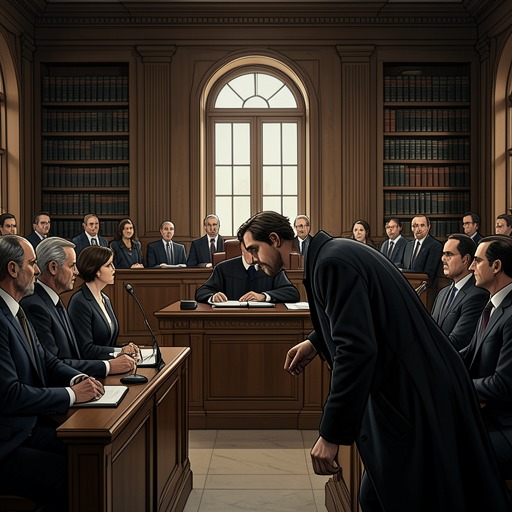
Bonasera waited in New York Criminal Court Number 3 for justice and vengeance against the two young men. The judge performed severity, condemning them as degenerates and comparing them to wild beasts, but the performance concealed a different outcome. Because of their youth, clean records, and respectable families, the judge sentenced each to three years in prison and suspended the sentence. One of the young men's fathers was a powerful politician, a fact that made the court's social hierarchy unmistakable.
The defendants walked freely from the courtroom while Bonasera's daughter remained in the hospital with her jaw wired shut. Their parents gathered around them in relieved triumph, and the young men passed Bonasera without even glancing at him. After forty years of professional mourning had restrained his emotions, hatred finally broke through: he imagined buying a gun and killing them, then told his wife that the court had made fools of them. The assault therefore becomes the event through which legal procedure is revealed as a spectacle whose language of justice does not necessarily answer the victim's suffering.
Bonasera's Appeal and the Don's Terms
Bonasera had prospered in America and had trusted law and order throughout his life. The court's decision transforms that trust into a crisis. Although he had previously kept his distance from Don Vito Corleone, he now decides that he and his wife must go on their knees to the Don for justice. His request is not simply for compensation or recognition; he asks that the two attackers suffer as his daughter suffers and defines justice as an eye for an eye.
Don Vito Corleone initially answers with the language of the system Bonasera had embraced. He tells him that the court has given justice and that he should bring flowers and candy to the hospital, forgive, forget, and accept that the young men were merely high-spirited. The irony is deliberate and controlled. When Bonasera insists that the court gave justice to the youths rather than to him, the Don asks what his justice would be. Bonasera's answer clarifies the emotional and moral stakes of the assault: he wants the attackers to suffer, not merely to be processed by law.
The Don refuses to treat the intervention as a commercial transaction. He reminds Bonasera that, had the undertaker come to him as a friend, his purse would have been available and the attackers would already have feared him. Bonasera finally asks the Don to be his friend and accepts the relationship he had once rejected. Don Vito Corleone promises that he will have his justice and describes it as a gift from his wife, the daughter's godmother, while reserving the right to call on Bonasera for a service at an unspecified future time. The assault thus creates a debt: private justice is granted through friendship, but friendship itself becomes an obligation.
From Personal Injury to Family System
The response to the assault is carried through the layered structure of the Corleone Family rather than delivered openly by Don Vito Corleone. As the newly appointed Consigliere, Tom Hagen receives the Don's private instructions. Hagen then instructs Peter Clemenza, who passes the commission to Paulie Gatto. The men expected to carry it out do not know why the task is being performed or who originally ordered it. This insulation protects the Don from direct implication and makes the assault a practical demonstration of the family's organizational method.
The same structure had been developed as the Corleone organization expanded. Don Vito Corleone placed Peter Clemenza and Salvatore Tessio over separate groups as caporegimes, made Genco Abbandando his Consigliere, and inserted layers between himself and operational acts. The handling of Bonasera's grievance therefore reveals both the personal and institutional sides of the Don's power: a father's suffering is answered as an intimate favor, but the answer travels through a disciplined chain of command.
Significance of the Conflict
The assault establishes a central contrast in the novel between formal justice and the Godfather's system of favors. Bonasera's experience shows that legal equality is compromised by youth, family reputation, political influence, and the court's willingness to suspend punishment. Don Vito Corleone's system appears more responsive because it recognizes the victim's demand and promises a consequence, yet it replaces public accountability with personal allegiance and deferred debt.
The event also explains why people approach Don Vito Corleone despite his criminal power. During the Great Depression, poor residents sought his help with relief, employment, bail, loans, and rent disputes, and he cultivated political influence by assisting talented young men from Italian families into professional and judicial careers. Against this background, Bonasera's appeal is not an isolated surrender to violence but a conscious movement toward a parallel authority that presents itself as more reliable than the official one. The assault is consequently both a family tragedy and the novel's first clear account of blackmail, patronage, revenge, and protection operating within the same moral economy.