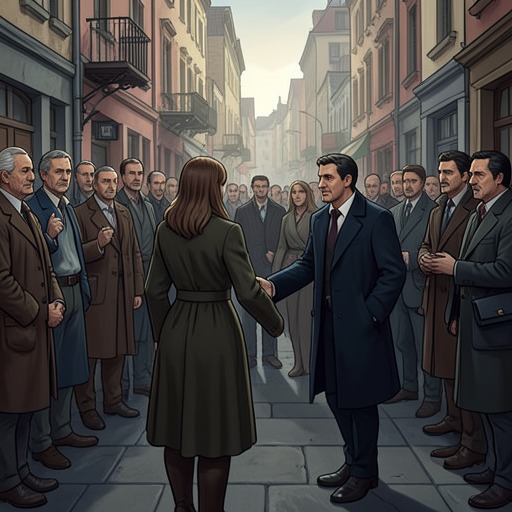
Apollonia Vitelli
The GodfatherApollonia Vitelli is the village girl whom Michael Corleone encounters during his exile in Sicily and marries within weeks. Her arrival transforms his isolation into a courtship governed by Sicilian custom, then into an intensely physical and domestic marriage. She becomes the emotional center of his life at the villa, but also the innocent victim through whom the violence pursuing Michael reaches into his new household. Her death in the Alfa Romeo marks the destruction of the temporary life he had begun to build away from America.
Identity and First Appearance
Apollonia first appears near an orange grove beyond a baronial estate, among village girls gathering flowers for a local villa. She is still in her teens, dressed in a cheap printed frock, and carries a bunch of large purple grapes while teasingly throwing individual grapes at the girls chasing her. Her ringleted hair is described as purple-black like the grapes, and her sudden pause at the edge of the grove makes her seem startled and vividly alive. Michael sees her at close range after she notices the unfamiliar color of the men’s shirts.
The encounter produces what Sicilians call the “thunderbolt,” an instantaneous passion that Michael experiences as more than ordinary desire. The attraction is presented through his physical reaction and through the possessiveness it awakens in him. When he later meets her family, he understands that he is prepared to kill anyone who touches her or takes her away. His response introduces Apollonia not merely as a romantic interest but as the catalyst for a radical change in Michael’s emotional life: the fugitive American, already marked by injury and secrecy, suddenly imagines ownership, marriage, and permanent seclusion with a stranger.
Courtship Under Sicilian Custom
Michael approaches Apollonia’s father, Signor Vitelli, through the formal protections of the village. When questioned about his intentions, he openly identifies himself as an American hiding in Sicily from the police and asks permission to meet Apollonia under family supervision. He promises that he will behave with decorum, that he seeks marriage rather than dishonor, and that he will eventually tell her father everything a prospective father-in-law should know. The declaration impresses the shepherd bodyguards because Michael speaks with command even while apologizing, and Signor Vitelli recognizes that he is not an ordinary farmboy.
Signor Vitelli permits Michael to enter the household as a friend of Don Tommasino. At their first formal meeting, Apollonia appears in a plain black Sunday dress, without ornament in her jet-black curls. She gives Michael a quick glance and a small smile before lowering her eyes and sitting beside her mother. The family reads the intensity of his reaction as proof of the thunderbolt and is reassured that he will remain captivated until the marriage.
Michael visits the village daily. On one visit Apollonia wears the gold chain he has given her, which he interprets as a signal of acceptance. She walks uphill with him while her mother follows closely, and the pair repeatedly brush against one another. Apollonia even appears to stumble against him, though her mother knows that her daughter has not stumbled on that path since infancy; the gesture is a carefully permitted form of intimacy within the limits imposed by the chaperone.
The courtship lasts two weeks. Michael brings presents on each visit, while Apollonia gradually becomes less shy. She is barely literate and has little knowledge of the wider world, yet her freshness and eagerness make her compelling to him, especially across the barrier of language. Because she is fascinated by Michael and understands that he must be wealthy, the families arrange the wedding for the following Sunday. Don Tommasino assumes the role of the bridegroom’s parent, and Calo, Fabrizzio, and Dr. Taza join the wedding party and security arrangements.
Marriage and Domestic Life
The wedding follows village custom. The procession travels on foot from the church to Apollonia’s home while villagers throw flowers, and the participants exchange sugar-coated almonds. The leftover candies form a symbolic white mound on the bridal bed, although Michael and Apollonia will spend their first night at Dr. Taza’s villa outside Corleone. Apollonia’s mother accompanies them at the bride’s request because Apollonia is young, inexperienced, and frightened, and will need someone to speak with the next morning.
Their first night begins in darkness after Michael returns to the bedroom and finds Apollonia beneath the covers. Their encounter joins her innocence to an immediate, intense sexual awakening. The marriage is subsequently defined by repeated lovemaking and by Michael’s sense of masculine power, while Apollonia responds with fervor and eagerness. The narrative emphasizes that their intimacy is not an isolated wedding-night episode but the governing rhythm of the weeks that follow.
Apollonia also changes the atmosphere of the villa. After sending her mother home the day after the bridal night, she presides over the communal table with bright, youthful charm and softens what had been a predominantly masculine household. Don Tommasino dines with the couple, Dr. Taza tells old stories over wine in the statue-filled garden, and the evenings acquire a convivial domestic pattern. The villa, protected by a stone wall and occupied by Michael’s companions and bodyguards, becomes for a short time both a marital home and a sheltered community.
Destruction and Narrative Significance
Apollonia’s marriage to Michael is built as a refuge but never escapes the logic of his exile. The household remains surrounded by precautions, and the people closest to Michael include armed protectors. The danger is finally revealed through Fabrizzio, whose furtive behavior Michael notices shortly before the bombing. Apollonia sits in the Alfa Romeo with her hands on the wheel, while Calo loads a lunch basket and Fabrizzio disappears through the villa gates on an errand that Michael finds suspicious.
Michael sees Apollonia wave from the car and realizes that she is motioning for him to stay where he is so that she can drive toward him. Calo stands beside the vehicle with his lupara, but Fabrizzio is still absent. In the instant before the explosion, Michael understands what has happened and shouts a warning. The ignition triggers a tremendous blast that shatters the kitchen door, throws Michael against the villa wall, and sends stones from the roof onto him. When he regains enough awareness to look toward the car, nothing remains of the Alfa Romeo except its four wheels and the steel shafts holding them together.
Apollonia’s death turns the “thunderbolt” from a romantic image into a tragic one. The force that made her appear suddenly and irresistibly in Michael’s life also makes her loss abrupt and absolute. She has little independent history in the recorded episode beyond her village upbringing, her family’s supervision, her courtship, and her marriage, but that very brevity is part of her function in the plot: she represents the possibility of a life founded on intimacy and local belonging, while the car bomb demonstrates that Michael cannot preserve such a life merely by fleeing across the sea. Her marriage is therefore both a genuine emotional transformation and a doomed interlude, ending when the violence attached to Michael’s identity reaches the villa and destroys its most innocent inhabitant.