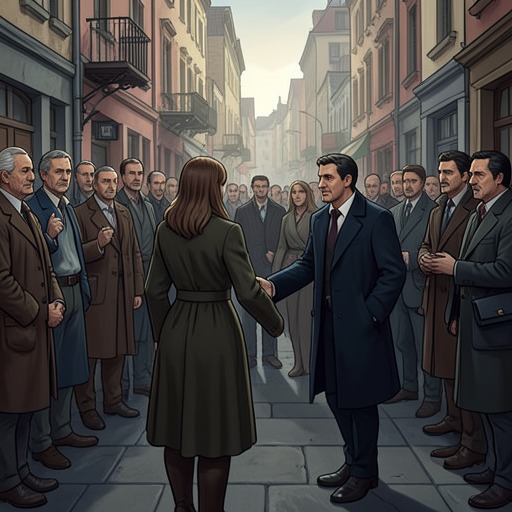
Apollonia's assassination
The GodfatherApollonia's assassination is the decisive catastrophe of Michael Corleone's Sicilian exile: a car bomb detonates beneath the Alfa Romeo just as his pregnant wife, Apollonia Vitelli, prepares to drive toward him. Apollonia and Calo are killed, Michael is thrown against the villa and badly injured, and Fabrizzio disappears. The attack turns a morning of planned departure and marital expectation into a scene of bodily shock, concealment, and irreversible return.## Causes and Immediate Context The bombing occurs on the last morning Michael and Apollonia are to spend at the villa. Don Tommasino has arranged for Michael to move to another town on the southern coast of Sicily because Michael's marriage has made him more visible and because Don Tommasino is facing pressure from younger rivals in Palermo. Apollonia, in the first month of pregnancy, intends to visit her family for several weeks before joining Michael at the new hiding place. The planned transfer therefore carries the appearance of prudent protection and domestic continuity: Michael is leaving one refuge, but his marriage and unborn child still seem to promise a future within his exile.
The villa is already organized around danger. Armed guards patrol its walls at night, shepherds remain inside with luparas, and Don Tommasino travels heavily armed with a personal bodyguard. The household's precautions, however, do not prevent the attack because the threat has entered the circle of movement and trust surrounding Michael. Fabrizzio and Calo are supposed to accompany him as bodyguards in the Alfa Romeo. Michael notices Fabrizzio lazily combing his hair with his lupara lying across a garden table, then sees him leave through the gates on an unexplained errand. The apparently casual gesture becomes ominous only when the morning's events are viewed retrospectively.
Calo helps prepare the departure, putting the lunch basket in the rear seat, while Apollonia sits behind the wheel, delighted by the possibility of driving. Her wish to handle the car is treated as an affectionate sign of her movement toward American life: Calo jokes that she will become a real American woman before reaching America. Michael has sometimes let her guide the Alfa Romeo inside the villa walls, always beside her because she occasionally presses the accelerator when she means to brake. The ordinary risk of inexperienced driving thus stands beside the concealed, deliberate risk of sabotage, making the car itself the scene's unstable object.## The Explosion Michael first goes to the kitchen and learns that Dr. Taza has gone to Palermo. He then sees Apollonia wave from the car, parked only ten paces up the driveway, and realizes that she is signaling him to remain where he is while she drives toward him. Calo stands beside the car with his lupara dangling from his hand, but Fabrizzio is still absent. At that instant, without a conscious chain of reasoning, the scattered details converge for Michael. He shouts a warning, but it is drowned by the tremendous explosion when Apollonia switches on the ignition.
The blast destroys the protective geography of the villa. The kitchen door shatters, Michael is hurled along the wall for roughly ten feet, and stones falling from the roof strike his shoulders, with one glancing off his skull. He remains conscious only long enough to see that the Alfa Romeo has been reduced to its four wheels and the steel shafts holding them together. The description shifts from domestic preparation to stripped mechanical ruin: the car that was meant to carry a family toward another hiding place becomes the unmistakable instrument of death.
The event's value reversal is complete and immediate. The morning begins with Michael marveling at Apollonia's beauty after their intimate awakening, and it proceeds through packing, farewell, food, and playful driving. It ends with the destruction of Apollonia, the death of Calo, and Michael's near death. The attack is not merely an interruption to travel; it annihilates the marriage, the pregnancy, and the imagined future that had made the Sicilian refuge feel like a home.## Recognition and Concealed Target Michael awakens in a dark room after the explosion and initially tries to seem unconscious when he hears voices near the bed. Dr. Taza is present, and Don Tommasino later confirms that Michael has been unconscious for nearly a week. Michael's physical recovery begins before his complete verbal understanding of what has happened, but memory returns with brutal clarity: he knows that his wife and Calo are dead and asks what happened to Filomena. Don Tommasino tells him that Filomena survived with only a bloody nose.
The post-explosion conversation reveals the attack's political meaning. Fabrizzio has vanished, while everyone believes Michael is dead; that mistaken belief has caused those searching for him to stop. Don Tommasino explains that the Palermo people have made peace with him because they had been pursuing Michael all along and wanted to kill Michael while making it appear that Don Tommasino was the intended victim. The bombing therefore exposes the protection system's central failure: Michael was not simply caught in violence directed at his protector. His marriage and visibility had identified him as the true target, and the attack used the guarded villa's own departure arrangements against him.
Michael's response is not an attempt to preserve the life that has just been destroyed. He offers a reward for Fabrizzio so immense that the offender's capture becomes a matter of vengeance and status across Sicily: whoever delivers Fabrizzio will own the finest pastures in Sicily. The demand gives the otherwise stunned survivor a first objective. His shock has become knowledge, and knowledge has become a future reckoning, even though Fabrizzio cannot be found during Michael's recovery or the preparations for his departure.## Consequences and Aftermath The bombing leaves Michael injured so severely that he requires a month to recover. Two additional months pass while the necessary papers and arrangements are made. He is then flown from Palermo to Rome and from Rome to New York. The attack thus ends not only the immediate household at the villa but also Michael's Sicilian period as a lived marital existence. His return is delayed by bodily damage and practical concealment, while the world around him accepts the false conclusion that he is dead.
Michael returns as a widower rather than as a husband bringing Apollonia to America. Dr. Taza remarks on the rarity of such a condition in Sicily, but the observation cannot restore what has been lost. Apollonia's death is joined to the death of the unborn child implied by her first-month pregnancy, while Calo's death removes one of the men assigned to protect Michael. Fabrizzio's disappearance leaves the crime without immediate retribution and preserves the attack as an unresolved wound during the journey home.
Before leaving Sicily, Michael asks Don Tommasino to tell Vito Corleone to bring him home and says that he wishes to be his father's son. The request marks the deepest consequence of the assassination. Exile had separated Michael from his family while his marriage offered a competing domestic identity; the bombing destroys that alternative and redirects him toward Vito Corleone, his father's authority, and the Corleone Family. In that sense, Apollonia's assassination is both a murder and a forced initiation: Michael survives physically, but the future he had begun to inhabit is gone, and the survivor who returns to America is bound more tightly to the family power he had once kept at a distance.