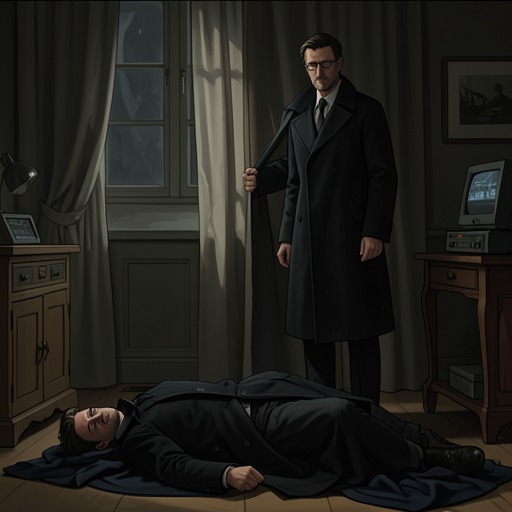
Assassination of Sonny Corleone
The GodfatherThe Assassination of Sonny Corleone is the turning point at which the Corleone Family’s violent momentum becomes a question of survival, succession, and political control. The attack begins with a domestic crisis: Carlo Rizzi beats his pregnant wife, Constanzia Corleone, and her frightened call summons her brother Santino Corleone. It ends on the Jones Beach Causeway with Sonny’s body riddled with bullets and the family’s future abruptly rearranged. His death does not simply remove an heir; it forces Vito Corleone to choose restraint over vengeance, suspend the family’s war, and seek the conditions under which Michael Corleone can return.
Causes and Immediate Provocation
The immediate trigger is Carlo Rizzi’s abuse of Constanzia Corleone. After striking her, humiliating her, and leaving her terrified in their apartment, Carlo drinks on the sofa while Constanzia waits for an opportunity to call Long Beach. When she finally reaches the Corleone household, her face is swollen and her speech is thickened by the slaps. She asks Sonny to send a car and specifically begs him not to come himself, fearing both her husband and what her brother might do.
Sonny’s response reveals why the enemy considers him both dangerous and politically inconvenient. As he listens, hatred visibly takes possession of him: the blood rises in his neck, his face tightens, and his hands tremble, although his voice remains controlled. He repeats that Constanzia should wait, then rushes from the house. Tom Hagen understands that Sonny’s reasoning has temporarily disappeared and arranges for men to remove Carlo and protect Constanzia, hoping to prevent a killing in front of witnesses. The intervention is practical, but it cannot prevent Sonny from driving toward the city.
The family war supplies the larger cause. The Five Families have concluded that killing Sonny is the only way to prevent their complete defeat. They regard his bloodthirstiness as barbaric and bad for business, while believing that Vito Corleone, known for logical reasonableness, might still be approached for peace. Carlo’s attack therefore provides more than a private grievance: it creates a predictable route by which the most volatile Corleone successor can be drawn away from protection.
The Ambush on the Causeway
Sonny leaves in a Buick registered to a member of his regime, with a gun concealed in a dashboard compartment. He does not expect to use it. He has taken the Jones Beach Causeway because it is usually deserted at that hour, and he drives fast in the hope that speed and the salt air will dissipate the dangerous tension within him. His two bodyguards follow behind, but Sonny soon leaves them far back.
The causeway is badly lit and nearly empty. Ahead, a manned tollbooth glows in the darkness. Sonny has no change, so he opens his wallet and hands over a dollar. Another car is already blocking the toll slot, apparently asking the toll taker for directions. After Sonny honks, that car moves forward just enough to let the Buick enter. The toll collector then drops the change and disappears beneath the window. The delay is not an accident but part of the trap.
Sonny notices that the other car has stopped a few feet ahead instead of continuing. At the same moment, he sees another man in the darkened booth to his right. Two men emerge from the blocking car and approach him while the supposed toll collector remains out of sight. Before the shooting begins, Sonny understands that he is going to die. The realization briefly strips away his habitual violence and leaves him lucid, as though the danger he has always carried within him has finally become external and undeniable.
His body reacts before thought can save him. He crashes against the Buick’s door and bursts the lock, but the gunman hidden in the tollbooth opens fire, striking him in the head and neck as he spills from the car. The two men in front raise their weapons after the first burst and fire into his body. They then kick his face, deliberately disfiguring it as a personal mark. The murder is therefore both an execution and a message: the attackers want Sonny dead, but they also want the violence to carry the signature of human hatred rather than appear as an impersonal battlefield casualty.
Discovery and Vito Corleone’s Command
The three assassins and the bogus toll collector escape toward the Meadowbrook Parkway. Sonny’s car and body block the tollgate slot, and when the bodyguards arrive minutes later, they do not pursue. They turn back toward Long Beach and call Tom Hagen from the first public telephone off the causeway. The message is terse: Sonny is dead and has been killed at the toll.
Hagen receives the report while Constanzia Corleone’s mother is preparing food for her daughter’s arrival. He keeps his composure and directs the bodyguards to go to Peter Clemenza’s house. When he later tells Vito Corleone, the Don asks for certainty and insists on hearing the full account only after Clemenza and Salvatore Tessio arrive. The news briefly breaks through Vito’s will: his physical strength drains from his face for a fraction of a second before he recovers.
Once the death is confirmed, Vito refuses to let grief dictate policy. He orders that no one seek vengeance, investigate the killers, or undertake further acts of war against the Five Families without his express command. The family is to stop its business operations and cease protecting its operations until after Sonny’s funeral. He assigns Peter Clemenza to remain with him as bodyguard, places Salvatore Tessio in charge of protecting the other family members, and asks Tom Hagen to summon Amerigo Bonasera for the preparation of Sonny’s body.
Vito’s instructions also turn mourning into organized family care. Constanzia Corleone is to live with her mother and husband at the Long Beach Corleone mall; women are to stay with Sandra Corleone; the family is to arrange church masses and prayers. The response joins private sorrow to administrative order. In the moment when the family might have fragmented into revenge, Vito reasserts control through assignments, ritual, and a temporary suspension of commerce.
Political Consequences and the Peace Settlement
At the later meeting with the leaders of the underworld, Vito presents the renunciation of vengeance as a sacrifice for the common good. He argues that the older generation must move beyond guns, killings, and massacres toward the methods of business people, because the future belongs to children and grandchildren who may become professors, scientists, musicians, governors, or even a President. Sonny’s death thus becomes the occasion for a public doctrine of transition: violence remains available, but its open use must be subordinated to organization, negotiation, and long-term power.
Vito also frames the settlement through the idea of Cosa nostra, insisting that the families must manage their own affairs and resist outside interference. He declares that he will forgo vengeance for his dead son and will not permit violence against any participant without just cause and extreme provocation. The promise is not an act of forgiveness in a moral or private sense. It is a political exchange in which the murdered heir becomes the price paid for ending the immediate war.
The settlement changes the balance within the underworld. The war has already brought police pressure, especially after the murder of Captain McCluskey, and the Corleone Family’s gambling operations have suffered raids, arrests, and financial losses. Earlier, Vito had built power by helping poor Italian residents, cultivating political contacts, and arranging peace among major organizations across cities including Los Angeles, San Francisco, Cleveland, Chicago, Philadelphia, Miami, and Boston. The same architecture of influence now makes negotiation possible after Sonny’s death. Protection, political access, and organized violence operate together as an alternative system of government.
The peace also serves Vito’s private objective. His youngest son, Michael Corleone, is in exile after being accused of killing Virgil Sollozzo and Captain McCluskey. Vito declares that bringing Michael home safely is his own affair and promises to clear the false charges, whether through finding the real culprits, persuading authorities, or causing witnesses and informants to withdraw their lies. Sonny’s assassination therefore converts the family’s military emergency into a diplomatic project whose most important prize is not revenge but Michael’s return.
Succession and Long-Term Significance
Sonny’s death destroys the succession he had been trying to secure. Before the ambush, he believed that Vito Corleone would recover and that he could guard the family empire, earn his father’s respect, and consolidate his claim as heir. His position was not automatically hereditary; powerful caporegimes such as Clemenza and Tessio might otherwise have succeeded to the Don’s position or broken away to form their own families. Sonny’s murder removes the most obvious internal claimant at precisely the moment when the family’s authority is weakening.
The event also exposes the danger of a leadership model built around personal force. Vito’s organization is carefully insulated: orders pass through layers, and operational men may not know who originally issued them. That structure protects the Don, but it cannot protect a successor whose temper repeatedly makes him predictable. Tom Hagen’s attempt to delay Sonny and remove Carlo fails because Sonny’s personal rage outruns the family’s systems of control. The assassination is consequently a victory not only of gunmen but of planning, timing, and knowledge of character.
The longer aftermath confirms the scale of the reversal. After the Corleone Family’s eventual bloody victory and a year of political maneuvering, Michael Corleone becomes the most powerful Family chief in the United States. The family’s New York operation is then closed and its houses and Long Beach mall property are sold, while the center of power shifts toward Las Vegas. Clemenza receives his own Family, Rocco Lampone becomes Michael’s caporegime, and Albert Neri heads security for the family-controlled hotels in Nevada. Sonny’s death is therefore the grim hinge between the old New York order and Michael’s more centralized, geographically expanding regime.