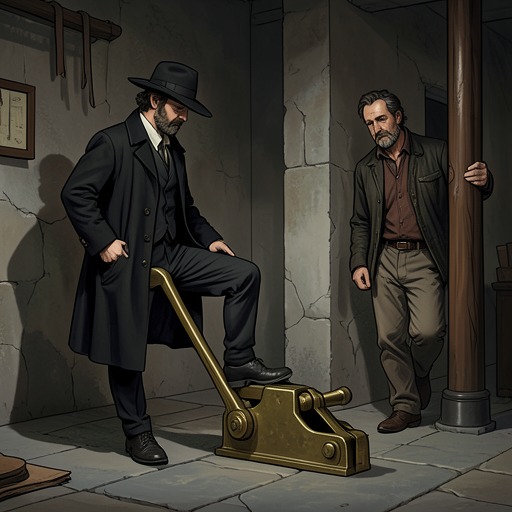
Carlo Rizzi executed
The GodfatherCarlo Rizzi executed marks the moment when Michael Corleone converts suspicion into final judgment. After learning that Carlo had betrayed Santino Corleone to the Barzini Family, Michael summons him under the pretense of sending him away to Las Vegas. Carlo is offered survival, exile, and an allowance for Constanzia Corleone, but the apparent reprieve is only the final stage of an arranged execution. In the car leaving the estate, Peter Clemenza strangles Carlo with a garrote while Michael, Tom Hagen, and Rocco Lampone have already made the sentence unavoidable. The killing avenges Santino, punishes betrayal, and helps restore the Corleone Family to its dominant position among the New York Families.
Betrayal and the Demand for an Answer
Carlo’s execution is rooted in his role in the ambush that killed Santino. He had used his marriage to Constanzia Corleone and his violent treatment of her as part of a calculated pattern: the quarrel created a situation in which Santino, protective of his sister, would rush to her aid. At the estate, Carlo is still waiting nervously for an interview with Michael when he telephones his mistress and confidently plans a late supper and overnight visit. He believes Michael’s business will take only an hour or two and changes into a fresh shirt to save time afterward. That ordinary preparation becomes grimly ironic when the knock at his door brings Michael instead, accompanied by Hagen and Lampone.
Carlo immediately recognizes Michael’s face as the face of the death he has often seen in dreams. His physical weakness and nausea reveal that he understands the visit before the accusation is fully stated. Michael tells him that he must answer for Santino, and then identifies the precise betrayal: Carlo had informed the Barzini people about Sonny, while the quarrel with Constanzia had been a fraudulent performance intended to deceive the Corleone Family. Carlo denies everything and swears on the heads of his children, but his denial cannot alter the balance of evidence or the purpose of the meeting.
The False Mercy
Michael’s method is as important as the sentence itself. He tells Carlo that Emilio Barzini and Philip Tattaglia are dead and that he intends to settle all the Family accounts that night. Yet Michael does not immediately announce an execution. Instead, he presents himself as reluctant to kill a brother-in-law and godfather to Carlo’s child. Carlo will supposedly be barred from all work with the Family, placed on a plane to Las Vegas to join Constanzia and their children, and supported by an allowance Michael will send to his sister.
This offer changes Carlo’s terror into desperate hope. Michael even asks who approached him, Tattaglia or Barzini, and Carlo, relieved that he will apparently live, answers Barzini. The confession gives Michael the final certainty he still wants. The scene’s language therefore performs two actions at once: Michael speaks as though he is granting mercy, while he is actually securing an admission and directing Carlo toward the vehicle prepared for his death. The promise of exile is not a pardon but a trap whose success depends on Carlo believing that family obligation has restrained revenge.
The contrast recalls the earlier conflict between court justice and personal justice involving Amerigo Bonasera. A judge had condemned the two men who attacked Bonasera’s daughter to three years’ confinement, with the sentence suspended because of their youth, clean records, and influential families. Bonasera rejected that ruling as justice given to the youths rather than to him and demanded that the offenders suffer as his daughter suffered. Don Vito Corleone had distinguished between a legal judgment and the injured man’s sense of justice, accepting Bonasera’s allegiance in return for a future service. Michael’s treatment of Carlo belongs to the same alternative system: judgment is private, reciprocal, and enforced by the Family rather than by a court.
The Execution in the Car
Carlo leaves the house first, followed closely by Michael, Hagen, and Lampone. The floodlights make the night outside the estate unnaturally bright, and the waiting car appears to be Carlo’s own. He does not recognize the driver or the man seated behind him. Lampone opens the front door and motions him inside, while Michael tells him that he will telephone Constanzia and say that Carlo is on his way. Carlo’s silk shirt is already soaked with sweat, an outward sign of the fear concealed beneath the supposed release.
As the car moves toward the gate, Carlo begins to turn his head toward the passenger behind him. At that instant Clemenza throws the garrote around his neck. The attack is swift and controlled: Clemenza pulls with enough force to lift Carlo’s body, maintains the pressure until it becomes slack, and keeps the rope tightened for several more minutes to ensure that the killing is complete. The death is described not as a public spectacle but as a confined operation inside a moving car, carried out by a trusted Family man while Michael’s carefully staged conversation has already done its work.
The scene’s most degrading detail is also its most concrete: Carlo’s body releases its bowels as death approaches, filling the car with a foul odor. Clemenza keeps the garrote in his pocket after releasing it, and then rolls down the window to let out the stink. The open window provides no cleansing resolution. It only vents the physical evidence of death while the larger moral contamination remains within the Family’s system of revenge.
Immediate Consequences
Carlo’s death is the personal portion of a much larger operation. During the same twenty-four-hour period, Clemenza and Lampone unleash their forces against infiltrators in Corleone territory. Albert Neri is sent to command the Salvatore Tessio regime. Barzini bookmakers are driven out of business, two senior Barzini enforcers are shot while eating in an Italian restaurant on Mulberry Street, and a notorious fixer of trotting races is killed on his return from the track. Two major waterfront shylocks disappear and are later found in the New Jersey swamps.
The coordinated violence makes clear that Carlo’s execution is not an isolated act of domestic revenge. It is the intimate opening of a comprehensive purge. Carlo represents the breach from within: his access to Constanzia and his position within the extended family allowed an enemy to turn family conflict into strategic information. The killings that follow remove the external networks built around that betrayal. Private punishment and territorial consolidation occur as one continuous action.
The result is a complete Corleone victory. Michael’s reputation is made through tactical brilliance and ruthless timing, and the Corleone Family regains its primary place among the New York Families. Important caporegimes from both the Barzini and Tattaglia Families immediately defect to Michael’s side. The execution therefore functions as a political declaration: betrayal will be answered, the Family’s boundaries will be defended, and Michael possesses the authority to impose that answer.
Justice, Family, and Michael’s Rule
The killing also exposes the tension between Michael’s wish for certainty and the brutality of the system he inherits. Hagen and Lampone are astonished that Michael asks Carlo to admit his guilt, because the evidence against him is already sufficient. Michael still fears being unjust and wants a confession to erase the remaining fraction of uncertainty. His concern does not soften the outcome; it makes the execution more deliberate. He does not kill in a burst of anger but constructs a procedure in which accusation, confession, apparent mercy, transport, and strangulation follow one another.
That procedure distinguishes Michael from Santino while preserving the family logic established by Vito Corleone. Earlier, Vito had granted Amerigo Bonasera’s request for retribution only after demanding friendship and a future service, presenting the favor as a gift from his wife, Bonasera’s daughter’s godmother. The favor system joins protection to obligation, and Carlo’s death shows its darker reverse: membership and family access cannot shield a traitor once the debt of blood has been called in. The same structure that once offered refuge to an injured father now turns kinship into evidence against a man who abused it.
Carlo’s execution thus completes more than an individual punishment. It confirms Michael as the new center of judgment, demonstrates that his promises can conceal lethal intent, and joins the settlement of Santino’s murder to the restoration of Corleone power. The supposed journey to Las Vegas ends not in exile but in a garroted body beside the road, while the Family’s broader campaign transforms that hidden death into the foundation of Michael’s public reputation.