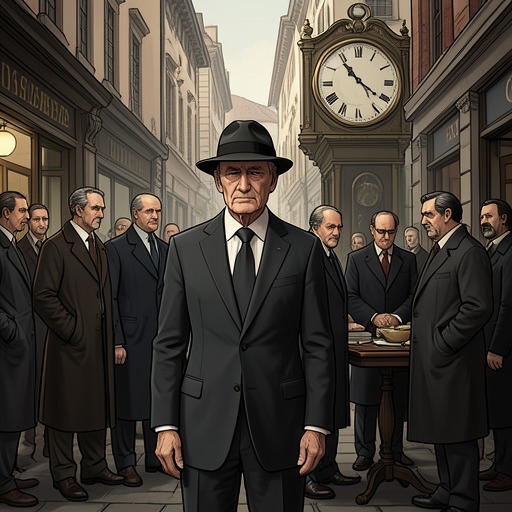
Genco Pura Olive Oil Company
The GodfatherGenco Pura Olive Oil Company is the enterprise that gives Vito Corleone's power a respectable commercial face and a practical economic base. Built on the relationships of immigrant neighborhoods, it combines importing, salesmanship, protection, political access, and carefully distributed obligation; as it expands, it becomes inseparable from the organization later known as the Corleone Family.
Founding and Structure
Genco Pura begins as a partnership between Vito Corleone and his boyhood chum Genco Abbandando. Genco handles the technical and logistical side of the business: importing olive oil from Italy, buying it at the proper price, and storing it in his father's warehouse. Vito supplies most of the capital and therefore heads the firm, though he refuses, with characteristic modesty, to name the product after himself. Peter Clemenza and Salvatore Tessio serve as salesmen, visiting Italian grocery stores first in Manhattan, then in Brooklyn and the Bronx, persuading proprietors to stock the company's oil.
The division of labor gives the company both an ordinary business structure and an unusual reserve of personal influence. Clemenza and Tessio conduct routine sales negotiations, while Vito Corleone is summoned when a store owner resists. He does not present himself as a conventional advertising executive; he relies on personality, reputation, and the expectation that a reasonable request from a respected man carries consequences. The company's market reach therefore rests not only on the quality of its product, which is explicitly described as no better than that of its competitors, but on the social authority surrounding its head.
Expansion and Market Power
For several years Vito Corleone lives the demanding life of a small businessman devoted to building an expanding enterprise. Genco Pura Olive Oil Company becomes the bestselling imported Italian oil in America, and its organization grows with it. Vito applies familiar commercial tactics—undercutting rivals, persuading store owners to reduce the space given to competing brands, and seeking a monopoly by forcing competitors to withdraw or merge with his company—but he cannot depend on the usual methods of legitimate business. He does not believe in advertising, and the company's product has no inherent superiority sufficient to explain its success. Word of mouth and the reputation of a man of respect supply the missing advantage.
The company's growth also exposes the coercive underside of its commercial strategy. Some Brooklyn wholesalers, fiery and unwilling to accept Vito's patient explanation of the supposed efficiencies of monopoly, refuse to cooperate. Vito responds by sending Tessio to establish a Brooklyn headquarters and solve the problem. Warehouses are burned, truckloads of olive-green oil are dumped into the waterfront streets, and one wholesaler who appeals to the authorities disappears before his complaint can proceed. His wife and children, left behind, are sufficiently grown to take over the business and come to terms with Genco Pura. The company thus achieves market consolidation through a mixture of persuasion, economic pressure, sabotage, and violence, while the code of Omertà prevents the formal legal system from exposing the mechanism.
Protection, Debt, and the Family Network
Genco Pura's commercial success is embedded in a wider network of favors. Before and alongside the olive-oil business, Vito Corleone protects small Italian speakeasies, intervenes for store owners troubled by young hoodlums, and accepts payment for this protection. He shares income with Clemenza and Tessio without being asked, treating their loyalty and labor as relationships requiring reciprocal recognition rather than as a simple payroll expense. The same logic shapes his dealings with Genco Abbandando and with the grocers who become customers of the company.
The network expands into law enforcement and the courts. Because some of the company's trucks are inevitably stopped by police, Genco Abbandando hires a lawyer with contacts in the Police Department and the judiciary. A payoff list, or “sheet,” is established for officials receiving monthly payments. When the lawyer worries about the expense and wants to keep the list small, Vito Corleone instructs him to include everyone, even officials who cannot help immediately, because friendship should be demonstrated before it is needed. The company's operating environment is therefore protected not by one isolated bribe but by a broad reserve of obligations and access.
This system makes Genco Pura more than an importing firm. It supplies the commercial activity through which Vito Corleone accumulates money, allies, information, and leverage. The family's later ability to influence labor leaders, judges, politicians, banks, and other businesses grows from the same principle: economic transactions are secured by social ties, while social ties are strengthened by economic advantage. Even during a later dispute involving Jack Woltz, Tom Hagen can invoke Vito's old relationships with labor leaders because those leaders still owe him debts of friendship established when he first built his strength by helping them.
Organization and Criminal Power
As the Corleone empire grows, Vito Corleone reorganizes the men associated with his commercial operations. Clemenza and Tessio receive the title of caporegime, with their subordinates designated soldiers; Genco Abbandando becomes Consigliere. Vito places layers of insulation between himself and operational acts, issuing orders separately to Genco or to one caporegime and rarely allowing witnesses. Tessio's group is assigned responsibility for Brooklyn, while Clemenza remains connected to the Bronx under closer supervision because he is more reckless and cruel. The structure that supports Genco Pura therefore becomes the organizational template for the larger Corleone Family.
The company's early commercial conflicts also help prepare Vito for the transformation of his enterprise into a criminal empire. During Prohibition, when alcohol may no longer be legally sold, he moves from being a ruthless businessman to becoming a major Don in criminal enterprise. The transition is gradual rather than instantaneous, but by the end of Prohibition and the beginning of the Great Depression he is known as Don Corleone. Genco Pura remains the respectable surface of a system whose real strength includes protection, political influence, controlled distribution, and disciplined violence.
Decline, Relocation, and Significance
By the period of Michael Corleone's succession, Genco Pura is one component of a far larger portfolio. The family owns valuable midtown New York real estate, interests in banks and brokerage houses, garment-center partnerships, and illegal gambling operations, while the olive-oil business is still important enough to be named among the interests that may be sold. Michael's stated plan is to move the family to Las Vegas, dispose of its interests in the olive-oil business, and use ownership in a hotel and casino as the foundation for the family's future.
The proposed sale marks a historical reversal. Genco Pura had been the vehicle through which Vito Corleone entered legitimate commerce and built the relationships that made his power possible; now the family considers selling it as part of a transition toward a more openly respectable and geographically broader enterprise. The move does not erase the company's legacy. Its model of embedded commerce—where distribution, friendship, protection, political access, and obligation reinforce one another—has already shaped the family organization that Michael inherits.
Genco Pura Olive Oil Company is consequently both a business and an institutional origin story. Its warehouses, sales routes, grocery accounts, payoff networks, and personal loyalties show how Vito Corleone's authority is manufactured in everyday exchanges before it is displayed in spectacular acts of violence. The company makes the family's power portable: a product can travel through immigrant neighborhoods, while the obligations surrounding its distribution create a network reaching from storefronts to courts, labor organizations, banks, and the higher levels of American business.