Great Depression
The GodfatherThe Great Depression is the historical crisis during which Vito Corleone’s authority becomes most visibly institutional. Widespread unemployment and official indifference expose the limits of law, charity, and government relief, allowing Don Corleone to present his organization as a more dependable order. He does not merely profit from the crisis: he turns assistance into a system of loyalty that combines protection, employment, political influence, and controlled violence.
Economic Crisis and the Rise of Don Corleone
The Great Depression arrives after Vito Corleone has already expanded from an ordinary but ruthless businessman into a powerful criminal entrepreneur. Prohibition had enabled him to redirect the six delivery trucks of the Genco Pura Olive Oil Company toward the distribution of smuggled Canadian alcohol and whiskey. The repeal of Prohibition later threatened that empire, but Vito Corleone had accumulated contacts, money, and organizational experience. By the beginning of the Great Depression, he had become the Godfather and Don Corleone.
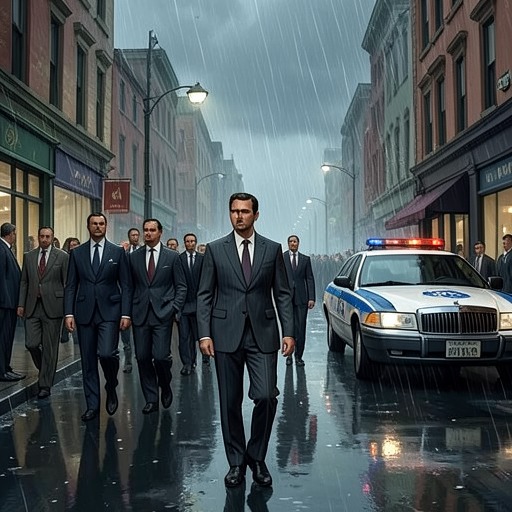
The Depression greatly magnifies the contrast between his world and the official world outside it. Honest men seek honest work without success, while proud families are forced to accept public relief from contemptuous officials. By contrast, men employed by Don Corleone walk through the city with money in their pockets and without the immediate fear of losing their jobs. The organization therefore appears not simply as a criminal enterprise but as a functioning social order for people whom the surrounding economy has abandoned.
Employment, Discipline, and Mutual Obligation
Don Corleone’s protection extends beyond wages. When one of his employees is arrested and imprisoned, his family receives the same living allowance that the man earned while free. This generosity is explicitly practical rather than saintly: the imprisoned employee understands that silence will preserve his family’s support and secure his welcome when he returns. A homecoming may include food, homemade ravioli, wine, pastries, relatives, friends, and money sufficient to give the family a short period of leisure before the man resumes work.
The arrangement converts economic security into disciplined allegiance. The employee is protected because he belongs to the organization, and the organization protects him because it expects loyalty and silence in return. The system’s apparent compassion therefore has a coercive underside. It replaces the impersonal insecurity of the Depression with a personal debt that can be redeemed through obedience, endurance, and refusal to inform the police.
Organization and Alternative Government
The pressure of the Depression encourages Don Corleone to think that he governs his own world better than his enemies govern the larger one. Poor residents come to him for help obtaining home relief, finding work for a young man, securing release from jail, borrowing urgently needed money, or persuading landlords to stop demanding rent from unemployed tenants. He responds with material aid and encouraging words, easing the humiliation attached to charity.
This assistance produces political authority. Italian residents consult Don Corleone about candidates for state, city, and congressional offices, while party leaders treat him as a political power. He strengthens that influence by helping talented young men from poor Italian families attend college; those beneficiaries later become lawyers, assistant district attorneys, and judges. His patronage thus reaches from neighborhood hardship into the institutions of law and government, creating a long-term network that serves both the community and the expansion of the Corleone Family.
The organization itself becomes increasingly bureaucratic in structure. Vito Corleone appoints Peter Clemenza and Salvatore Tessio as caporegimes, places soldiers beneath them, and makes Genco Abbandando his Consigliere. Orders pass through insulated layers so that operational acts cannot easily be traced to the Don. The same logic later governs the response to Amerigo Bonasera’s grievance: Don Corleone gives instructions privately to Tom Hagen, Hagen passes them privately to Clemenza, and Clemenza directs Paulie Gatto, leaving the lower-level participants unaware of the original source. The Depression therefore coincides with the consolidation of a hierarchy that resembles an alternative administration, though its enforcement rests on secrecy and violence.
From Local Power to National Stability
The Depression-era expansion gives Don Corleone the resources to pursue peace beyond his own neighborhood. He recognizes that external disorder threatens internal prosperity and later travels among underworld communities in Los Angeles, San Francisco, Cleveland, Chicago, Philadelphia, Miami, and Boston. By 1939 he has helped establish an agreement among the most powerful criminal organizations in the United States. Each organization retains authority in its own city or state, while the agreement regulates spheres of influence and enforces peace.
This political achievement reveals the broader logic of Don Corleone’s rule: violence is useful, but stability is more profitable. During World War II, with the underworld at peace, the Corleone Family participates in black-market food and gasoline stamps, travel priorities, war contracts, and scarce industrial materials. The organization also uses doctors and draft-exempt war positions to keep eligible men from serving. The Depression has therefore prepared the conditions for a criminal system that can function like a state, a business network, and a welfare structure at once.
Legacy and Contradiction
The Great Depression strengthens Don Corleone because it makes personal protection appear more reliable than formal law. Yet the same system depends on relationships that are never truly free. Help creates debt; employment creates silence; political assistance produces influence; and security is maintained through violence kept at a distance from the Don by organizational insulation. Amerigo Bonasera’s turn toward Don Corleone after losing faith in law and order dramatizes this substitution of family justice for public justice.
Don Corleone later describes this social order as a world that must manage its own affairs rather than submit to outsiders. His language of mutual defense and self-government gives criminal solidarity the vocabulary of sovereignty. The Depression is therefore not merely background history. It is the pressure that makes an alternative government persuasive, allowing Don Corleone to convert failure in the public economy into authority within the private world of the Corleone Family.