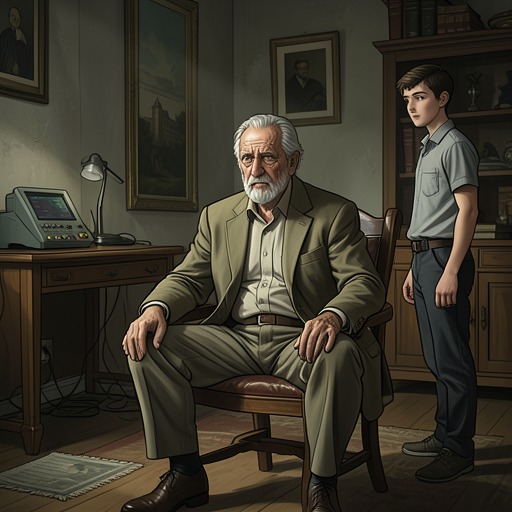
Life is so beautiful
The Godfather“Life is so beautiful” is the last phrase spoken by Vito Corleone, and one of the clearest expressions of his character. He says it while dying in the garden he loves, at the moment when the natural world, family devotion, and the certainty of death converge. Michael Corleone later treats the words not as a sentimental farewell but as a demanding standard: if he can meet death with the same conviction, then power, grief, and worldly achievement become secondary.
The Phrase in Its Immediate Setting
Vito Corleone is dressed not as a Don but as a gardener: baggy gray trousers, a faded blue shirt, and a battered dirty-brown fedora with a stained gray silk hatband. He claims that tending the tomato vines is good for his health, but the deeper truth is that he genuinely loves the garden. Its rows of beans, scallions, and tomato vines return him to his childhood in Sicily, though without the terror and sorrow associated with his father’s death. The garden therefore joins memory to recovery: it recalls the past while offering a version of that past no longer governed by fear.
His work is practical and exact. He waters the plants before the sun becomes hot enough to turn water into a burning prism on the leaves, searches for ants that signal lice among the vegetables, and supports the final plants with sticks. The scene gives him an ordinary concentration, almost domestic in its scale, immediately before fate interrupts it. The garden is not merely a backdrop to the phrase; it is the lived world that makes the phrase credible. Vito is attentive to growth, weather, insects, soil, and the limits imposed by heat, even as the narrative places him under the shadow of his own failing body.
Death and the Final Recognition
The interruption arrives with violent speed. The sun seems to descend close to Vito’s head, and the air fills with dancing golden specks. Michael’s oldest boy runs toward him, enclosed in a shield of blinding yellow light. Vito interprets the vision as a concealment of death and waves the boy away. His warning comes just in time: a sledgehammer blow inside his chest makes him choke, and he falls forward into the earth.
Michael Corleone and several men from the mall gate carry him to the shade of the stone-flagged patio while an ambulance and doctor are summoned. Vito opens his eyes with great effort and sees his son once more. The massive heart attack has turned his face almost blue; he is already in extremis. Yet his final perception remains attached to the garden. He smells it, sees the yellow light strike his eyes, and whispers, “Life is so beautiful.” The sentence does not deny the physical facts of dying. Its force comes from the contrast between the heart’s catastrophic failure and the beauty still apprehended in the world around him.
Vito dies before the women return from church, before the ambulance arrives, and before a doctor can reach him. He is surrounded by men and holding the hand of the son he loved most. The phrase is thus also a final act of relation. It is spoken neither to an assembled public nor as a formal statement of doctrine, but in the presence of Michael, after the father has seen him one last time. Its intimacy keeps the words from becoming a public slogan even though the funeral later gives them a much larger resonance.
Memory at the Funeral
At the funeral, the phrase moves from Vito’s private consciousness into Michael’s memory. Michael recalls that his father had said, “Life is so beautiful,” while dying, and observes that he cannot remember Vito ever having spoken about death. The omission matters. Vito appears to have respected death too much to philosophize about it, and the final sentence consequently sounds less like an explanation of mortality than a direct encounter with existence at its edge.
The funeral itself demonstrates the scale of the life behind the words. The Five Families send their Dons and caporegimes, as do the Tessio and Clemenza Families. Johnny Fontane attends despite Michael’s advice not to appear and publicly calls Vito his Godfather and the finest man he has ever known. At the cemetery, Michael walks with Kay Adams behind the caporegimes, soldiers, and the many humble people Vito had helped, including Nazorine, the widow Colombo, her sons, and even former enemies who come to honor him. The phrase is therefore surrounded by competing interpretations of Vito: criminal ruler, benefactor, father, friend, and figure of nobility.
Michael’s Standard for the Future
Michael Corleone watches the mourners with a tight, polite smile and is not impressed by the spectacle. The public honor does not persuade him that the funeral’s ceremony captures his father’s real significance. What does move him is the possibility contained in the final words. He thinks that if he can die saying, “Life is so beautiful,” then nothing else is important and nothing else matters.
This thought turns the phrase into a test of inner belief. Michael does not simply inherit Vito’s empire; he measures himself against Vito’s ability to affirm life at the point where power can no longer protect the body. The words also expose a difference between the two men. Vito’s acceptance occurs in a garden, amid family and the immediate textures of cultivated life. Michael’s response arises at a funeral, amid political succession and the visible machinery of the family’s future. He wants the spiritual certainty of his father’s ending even while preparing to govern a transformed organization.
Michael resolves to care for his children, his family, and his world, but he intends for his children to grow up differently. They will become doctors, artists, scientists, governors, or presidents; he will place them within the general family of humanity while keeping a wary eye on that larger society. The phrase thus carries a double inheritance. It expresses Vito’s gratitude for life as it is experienced, while prompting Michael to redesign the social world in which his descendants will live.
Thematic Significance
“Life is so beautiful” concentrates the novel’s tension between violence and ordinary vitality. Vito’s public identity is associated with authority, danger, and the obligations of a criminal empire, yet his final attention is fixed on tomato vines, sunlight, soil, and the presence of a child. The sentence does not erase the violence surrounding his life; instead, it places that violence beside a form of perception that cannot be reduced to domination.
Its imagery also makes beauty inseparable from danger. The sun nourishes the garden but, mixed imprudently with water, can burn the leaves. The golden light that seems beautiful to the boy becomes, in Vito’s recognition, a shield behind which death waits. The phrase emerges from that ambiguity: life is beautiful not because death has been excluded, but because beauty remains visible when death has become unavoidable.
Finally, the sentence is both an ending and an unfinished instruction. Vito dies without explaining what life’s beauty means, and Michael must supply the practical and moral consequences. He rejects the empty grandeur of the funeral while accepting the private words that preceded it. In this way, the phrase survives as an open inheritance: a compact statement whose meaning lies not in a doctrine Vito spells out, but in the garden, the son’s hand, the father’s death, and the future Michael chooses to impose upon his family.