Murder of Sollozzo and McCluskey
The GodfatherMurder of Sollozzo and McCluskey is the turning point at which Michael Corleone chooses violence as the only practical defense of Vito Corleone and the Corleone Family. Planned as a public assassination under the protection of a seemingly legitimate police captain, the act kills both Virgil Sollozzo and Captain McCluskey, destroys Michael’s former distance from the Family business, and sets in motion the repression and exile that reshape the conflict.
Causes and Background
The immediate cause is the continuing war surrounding Virgil Sollozzo’s narcotics enterprise and the attempted destruction of Vito Corleone. Michael argues that Captain McCluskey must be killed alongside Sollozzo because McCluskey is not merely a police officer carrying out his duty: Michael proposes presenting him as a corrupt official involved in racketeering. The purpose is both tactical and political. If the police captain can be publicly discredited, the Corleone Family may reduce the consequences of killing a law-enforcement officer, while removing Sollozzo eliminates the man regarded as a continuing threat to Vito Corleone.
Michael’s proposal marks a sharp reversal in his position. He had resisted involvement in the Family business, but now he designs the operation himself: a meeting in a public restaurant or bar during the dinner hour, with Sollozzo and McCluskey believing that Michael will be safe because he is searched before the meeting. The essential problem is how to place a weapon in the room after that search. Peter Clemenza is therefore involved in concealing a small pistol in the restaurant bathroom, creating the narrow opportunity on which the assassination depends.
The stakes extend beyond the three men at the table. Tom Hagen explains that the Tattaglia Family and its allies are pressing the Corleone Family toward the narcotics trade and toward using political influence to protect it. The Corleone Family’s refusal to enter that business has left its exposed gambling and bookmaking operations vulnerable, while other families control prostitution, unions, construction, loansharking, and government contracts. The murder is consequently both a defensive strike and a bid to alter the balance of power in the wider New York underworld.
The Restaurant Operation
At the meeting, Virgil Sollozzo remains suspicious, and Captain McCluskey confirms that Michael has been thoroughly frisked and is carrying no weapon. Michael then invents an urgent need to use the bathroom, claiming that the wine has gone to his bladder. Sollozzo searches him again, roughly checking his crotch, while McCluskey dismisses the concern by saying that he has frisked thousands of young men and knows Michael is clean. The feigned embarrassment conceals the operation’s central maneuver: Michael must leave the table without causing the two men to suspect that the real danger lies inside the bathroom.
In the bathroom, Michael finds the pistol secured behind the enamel water cabinet. A pink bar of soap sits in the urinal inside a wire net, while the blunt-nosed gun has been fastened with tape for him to retrieve. He tears it loose, remembers Clemenza’s instruction not to worry about leaving prints on the tape, places the weapon in his waistband, and buttons his jacket over it. He washes his hands, wets his hair, and wipes his fingerprints from the faucet with a handkerchief before returning to the table. The careful removal of evidence contrasts with the physical panic he feels: his legs tremble, and he is relieved to sit down again.
Michael does not follow Clemenza’s advice to emerge from the bathroom firing immediately. He instead returns to the table, aware that a sudden movement might get him killed. This hesitation makes the scene more precarious, not less. Once seated, he waits with the gun beneath his jacket while Sollozzo leans toward him and speaks. Michael cannot comprehend the words because the pounding of his blood has overwhelmed his attention. The apparent conversation becomes a suspended interval in which the table, the bathroom door, and the concealed weapon define the entire field of action.
The opportunity comes when the waiter approaches to take the men’s order and Sollozzo turns his head. Michael pushes the table away with his left hand, thrusts the pistol almost against Sollozzo’s head, and fires. Sollozzo attempts to fling himself away, but Michael’s youth and sharper reflexes prevail. The bullet strikes Sollozzo between the eye and ear, killing him instantly. Michael knows that one shot has been sufficient because he sees the life disappear from Sollozzo’s eyes.
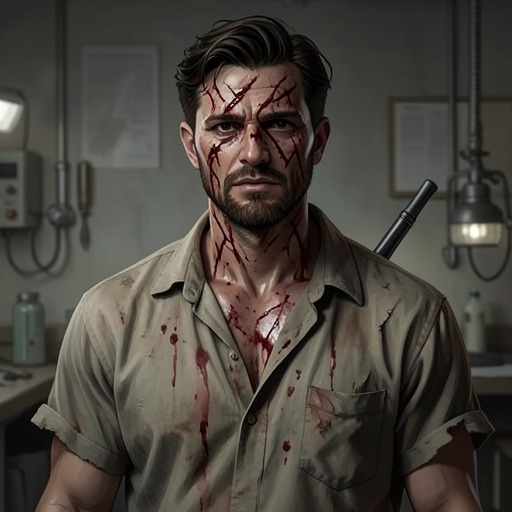
Michael then pivots toward Captain McCluskey. The captain is still staring at Sollozzo with confident outrage, apparently expecting Michael either to surrender or flee. Michael shoots him in the throat, but the first shot is not immediately fatal. McCluskey chokes and coughs blood from his shattered lungs; Michael then fires again through the top of the captain’s white-haired skull. The killing is completed within seconds, but its meaning is larger than its duration: the supposedly protected meeting has become an execution chamber, and Michael has crossed the line from protected son to direct killer.
Immediate Consequences and Escape
After the shootings, Michael leaves with help from the Family. His clothes are changed in a car, and within twenty minutes he is aboard an Italian freighter bound for Sicily. Two hours later the ship puts out to sea. From his cabin, Michael sees the lights of New York City burning in the distance and feels overwhelming relief. He compares the sensation to being evacuated from a battlefield after receiving a slight wound: the fighting continues, but he is no longer physically inside it.
That relief is inseparable from the knowledge that the violence has not ended. Michael has escaped the immediate scene, but the murders make him a hunted man and place the Corleone Family under extraordinary pressure. His departure is therefore not a victorious return to safety. It is a forced separation from New York City, from Kay Adams, and from the life in which he had claimed not to belong to the Family’s criminal world.
The next day, police captains and lieutenants in every station house in New York City order a complete suspension of unlawful business activity until Captain McCluskey’s murderer is found. Gambling, prostitution, and other deals stop, and massive raids begin throughout the city. The assassination thus produces an immediate value reversal: Michael removes two enemies, but the Corleone Family’s ordinary operations are brought to a standstill, and the Five Families conflict becomes more openly militarized.
Political and Criminal Significance
The murder exposes the dependence of organized crime on political protection. Captain McCluskey’s death cannot be treated as an isolated underworld killing because he represents the law’s ability to shield or destroy criminal enterprises. The resulting raids show that police power can interrupt the same businesses that rival families use to generate income, while the Corleone Family’s political influence is temporarily weakened because its leader, Vito Corleone, remains incapacitated.
The surrounding dispute also clarifies why the assassination has such broad consequences. Emilio Barzini later argues that Sollozzo and the Tattaglia Family could not establish their narcotics business without access to Vito Corleone’s judges and politicians. In this account, Vito Corleone’s refusal to share political influence is not neutral independence but an economic injury to the other families. The demand that rival organizations be allowed to draw on the same protective apparatus turns favors into obligations and refusal into aggression. Michael’s action therefore takes place within a system where violence, political influence, and commercial access are inseparable.
The event also reveals the logic that the Corleone Family has cultivated over time. Vito Corleone’s power grew through friendship, protection, carefully distributed profits, and coercion disguised as reasonableness. The baker Nazorine’s long loyalty illustrates the reciprocal favor system, while the expansion of Genco Pura Olive Oil shows how commercial monopoly and organized force developed together. Michael’s assassination inherits that structure but intensifies it: the old Don’s persuasive authority is replaced, for this crucial moment, by a pistol, concealment, and deliberate execution.
Narrative Turning Point
Murder of Sollozzo and McCluskey is a revenge plot, a defensive operation, and a maturation crisis compressed into one scene. Michael begins as the Family member who claims separation from its methods; he ends the episode as the person capable of conceiving and carrying out its most consequential counterstrike. The scene’s suspense depends on the gap between what Sollozzo and McCluskey think they control and what Michael has already arranged beneath the surface.
The episode is narrated through ordinary chronological third-person narration, but its dramatic force comes from restricted access to Michael’s physical and mental state. The reader follows the false request, the hidden pistol, the trembling legs, the incomprehensible speech, and the split-second decision to fire. The bathroom functions as both hiding place and threshold. Michael enters apparently unarmed and returns armed, while the restaurant remains outwardly a place for dinner even as it becomes the site of two planned killings.
Its lasting significance lies in the contradiction between personal feeling and criminal doctrine. Michael’s enemies and relatives can describe the conflict as business, yet the violence is also bound to family loyalty, injury, fear, and revenge. The act protects Vito Corleone, but it also makes Michael permanently accountable for the Family’s methods. By killing Sollozzo and McCluskey, Michael wins the immediate encounter and loses the possibility of simply standing outside the world he has entered.