New York Police Department
The GodfatherThe New York Police Department represents the official legal order in the novel, yet its conduct repeatedly reveals how fragile that order becomes when police power is entangled with money, politics, and organized crime. The department is not simply an antagonist to the Corleone Family: it is also a rival authority, an occasional instrument of public morality, and a system whose own personnel can be bought, manipulated, or persuaded. Its presence forces characters to choose between formal law and the family’s private conception of justice.
Authority and Its Limits
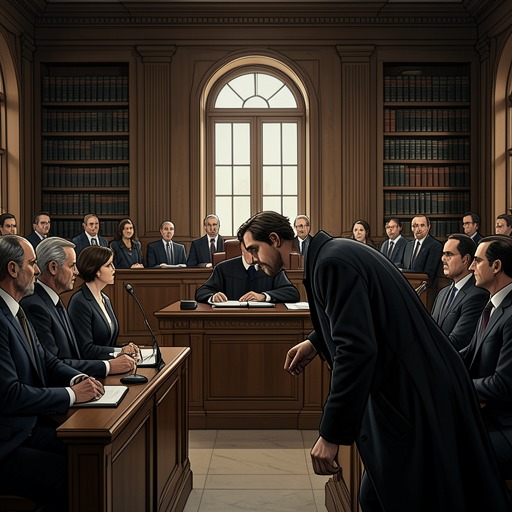
The department appears most sharply in Amerigo Bonasera’s failed appeal to the courts. After the two young men who attacked his daughter were arrested and pleaded guilty, the judge sentenced them to three years in prison but suspended the sentence, allowing them to leave the courtroom that same day. Bonasera had trusted law and order throughout his American life and had prospered under it, but the outcome leaves him feeling humiliated and abandoned. His hatred turns toward fantasies of buying a gun and killing the attackers, before he decides that he must ask Don Vito Corleone for justice. The department and the courts have followed procedure, yet procedure has not produced what Bonasera recognizes as justice.
Don Vito Corleone treats Bonasera’s choice as more than a practical mistake. He reproaches him for going first to the police rather than coming to the Don, contrasting months of legal delay, expensive lawyers, and a judge who can sell himself with the immediate protection offered through personal allegiance. In this contrast, the New York Police Department belongs to a bureaucratic system that demands money and patience while disclaiming responsibility; the Corleone system answers through friendship, obligation, and enforceable fear. The department’s formal authority therefore helps create the social conditions in which the Don’s authority appears more responsive.
The Hospital Confrontation
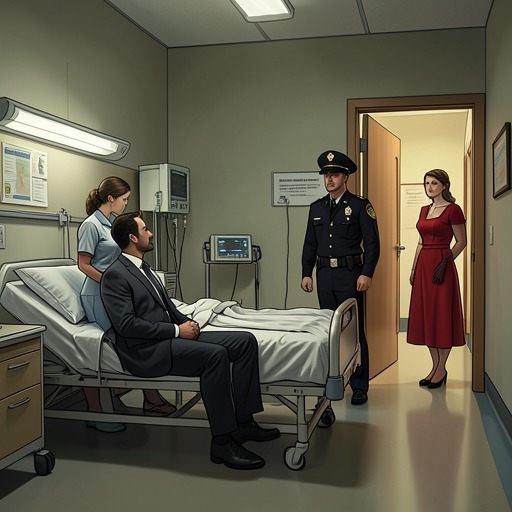
The department’s hostility becomes physical during the Hospital defense, when Michael Corleone remains outside the hospital room where his father is recovering. After police sirens announce the arrival of a patrol car and two additional squad cars, two large officers seize Michael’s arms and another searches him. A police captain with gold braid, a red face, and white hair approaches and demands to know who Michael is and what he is doing there. A detective identifies him as the Don’s son, but the captain’s recognition does not lead to protection; it intensifies the confrontation.
Michael asks what happened to the detectives who were supposed to guard his father and who removed them from the detail. The captain admits that he did it and declares that he would not lift a finger to prevent the old man from being killed. He orders Michael away from the hospital and then tells a detective to lock him up when Michael refuses to leave until guards are placed around his father’s room. The encounter shows the department using its legal power not to preserve a threatened patient but to clear the way for that patient’s possible assassination.
Michael also suspects that the captain may be cooperating with Virgil Sollozzo. He considers whether Sollozzo saw him outside the hospital and then contacted the captain to ask why Corleone men were still present after the police had supposedly been paid to remove them. The narration does not reduce the scene to a simple accusation, but Michael’s reasoning makes the institutional danger clear: the police may be functioning as part of the conspiracy rather than as a barrier against it. The department’s uniform and procedure conceal a private arrangement between official power and criminal power.
Police Power and the Five Families War
After Michael kills Virgil Sollozzo and Captain McCluskey, the department reacts with extraordinary force. On the following day, police captains and lieutenants in every station house in New York City send out orders that there will be no more gambling, prostitution, or other deals until McCluskey’s murderer is captured. Massive raids begin throughout the city, and unlawful business activity stops. The department thereby demonstrates that it can attack the economic infrastructure on which the Corleone Family and its rivals depend.
The crackdown also changes the scale of the conflict. When an emissary from the Families asks whether the Corleone Family will surrender Michael, the family refuses. That night, a bomb is thrown at the Corleone Family mall in Long Beach, and two of the family’s button men are killed while eating in a small Italian restaurant in Greenwich Village. The police response to McCluskey’s death thus becomes one of the pressures that help ignite the Five Families War of 1946. State enforcement does not end the underworld struggle; it drives the competing organizations into a more dangerous and open conflict.
The later war remains costly because police pressure continues after McCluskey’s death. The department’s raids strike especially hard at the Corleone Family’s numbers operations: runners are caught, gambling banks are located and raided, and heavy financial losses follow. The bankers complain to the caporegimes, but the family can offer no remedy and orders them to close. In Harlem, local Black freelancers are allowed to take over the richest territory, operating in scattered ways that make them difficult for police to suppress. The department therefore reshapes the criminal economy even when it does not control it, weakening established structures and opening space for more decentralized operators.
Corruption, Information, and Public Legitimacy
The department’s moral authority is contested by evidence that McCluskey had accepted large sums of cash shortly before his death. Tom Hagen plants newspaper stories linking the captain to Sollozzo and supplies the information behind them. The Police Department refuses either to confirm or deny the reports, but the stories begin to influence the force. Through informers and police officers on the family payroll, the department receives the further message that McCluskey was a rogue cop who had taken not merely ordinary graft but money connected with murder and drugs.
The distinction matters within the police culture described by the novel. Officers may tolerate or rationalize the collection of fees from criminals, especially when they believe their own risks and family obligations justify it. But accepting the dirtiest money, tied to murder and drugs, crosses a boundary that rank-and-file policemen cannot forgive. Hagen understands that police officers possess an almost innocent belief in law and order even while resenting the public they serve and learning to profit from the criminals they police. McCluskey’s exposure therefore damages the department not only as an organization but as a moral community: the captain has violated the code by which the force justifies its power.
The New York Police Department is consequently vulnerable to competing labels. To Bonasera, it is the institution that failed to make punishment match injury. To Michael, it is a possible accomplice in an assassination attempt. To the police themselves, McCluskey becomes a rogue whose association with murder and drugs threatens the department’s honor. To the Corleone Family, the department is both an obstacle capable of shutting down entire markets and a network that can be influenced through payrolls, political connections, and planted information. The same institution can appear as law, protection, predation, or opportunity, depending on who is confronting it.
Contrast with the Corleone System
The department’s role becomes more intelligible beside the Corleone Family’s layered organization. Don Vito Corleone gives orders privately through Tom Hagen, Peter Clemenza, and Paulie Gatto, placing buffers between himself and operational acts so that responsibility cannot easily be traced to the top. The family’s structure imitates, and in some ways rivals, a state apparatus: it has ranks, territories, channels of information, punishments, and systems for protecting dependents. The police department’s official hierarchy is mirrored by the family’s caporegimes and soldiers, but the two systems draw obedience from different sources.
The department claims authority through law, badges, arrest, raids, and the state’s monopoly of legitimate force. The family relies on personal loyalty, debts, secrecy, and the threat of violence. Yet the novel repeatedly makes the contrast unstable. The police can be corrupted; the family can provide employment, welfare, and protection. Don Vito helps people find work, obtain loans, escape jail, or negotiate with landlords, while the department and courts leave Bonasera feeling that legal compliance has made him a fool. The result is not an endorsement of either system as wholly just. It is a portrait of competing normative orders, each claiming to protect a community while demanding submission and reproducing its own forms of coercion.
The department also participates in the novel’s larger movement from violence toward institutional consolidation. Don Vito argues that the time for guns and killings has passed and that the families should become more like business people, seeking security for their children and grandchildren. But the police response to McCluskey’s murder demonstrates that formal institutions remain inseparable from force, political influence, and economic control. By the time Michael Corleone has established himself as the most powerful Family chief in the United States and closes the New York operation, the Corleone Family has become unchallengeable, with its power redistributed among Las Vegas, Long Beach, and other family structures. The New York Police Department has not disappeared from this transformation; its raids, corruption scandals, and failures of protection have helped shape the conditions under which the family relocates and consolidates.
Narrative Significance
As an organization, the New York Police Department is central to the novel’s examination of legal pluralism: state law, family rules, personal allegiance, commercial arrangements, and neighborhood custom operate simultaneously, and characters move between them when one system fails to deliver what they need. Bonasera’s journey from confidence in the police to allegiance to Don Vito is the clearest example, while Michael’s hospital confrontation shows the danger of assuming that a uniform guarantees impartial protection.
The department’s deepest significance lies in its ambiguity. It possesses enough power to freeze the city’s illicit economy and unleash massive raids, yet it cannot prevent corruption within its own ranks. It can condemn a rogue captain, but only after information has been planted and circulated through the very networks that the department officially opposes. It represents public order while exposing the private interests beneath public institutions. Against that unstable authority, the Corleone Family presents itself as an alternative government—more intimate, more responsive, and more openly coercive. The novel’s tension comes from the fact that neither order is pure: each depends on loyalty, enforcement, and selective justice, and each becomes most powerful where the other has failed.