Omertà
The GodfatherOmertà is the Sicilian law of silence, a rule that transforms silence from mere secrecy into a social obligation. It forbids vulnerable people and organized men alike from exposing grievances, naming assailants, or seeking justice through authorities believed to serve the powerful. In the world of the Corleone Family, Omertà is both a code of loyalty and the hidden infrastructure of an alternative government: it protects the organization from legal investigation while binding its members to the Don’s authority.
Origins in Sicilian Experience
Omertà is presented as the historical answer of a people living under repeated forms of official violence. Michael Corleone learns in Sicily that the word Mafia originally meant a place of refuge before becoming associated with a secret organization resisting rulers who had crushed the country and its people. The Inquisition, landowning barons, princes of the Catholic Church, and the police all appear in this history as instruments of domination rather than dependable sources of justice. In such a society, the authorities are not neutral arbiters. They are identified with the forces from which ordinary people need protection.
Under those conditions, people learn not to expose their anger, announce threats, or make themselves vulnerable. A spoken threat can invite immediate reprisal, while an appeal to official justice promises little. The result is a social habit of withholding information and carrying grievances elsewhere. People seeking redress turn to the underground Mafia, whose local capo-mafioso functions as a protector, provider of food and work, and unofficial district authority. Omertà therefore grows from distrust of the state, not from an abstract devotion to criminality alone.
The code’s severity is shown through its most extreme prohibition. The greatest crime for a Mafia member is to tell the police the name of the man who shot or injured him. The rule extends even to civilians: a woman whose husband has been murdered is expected not to identify the killer, not even when the victim is her child or daughter. Silence becomes a form of collective discipline, described as a religion of the people. Its force lies precisely in its social reach: it governs not only professional criminals but also families and communities whose experience has taught them that official justice will not protect them.
Omertà Within the Corleone Organization
Within the Corleone Family, Omertà is a test of whether a man can be trusted with power. The traditional Consigliere must be a full-blooded Sicilian born to the ways of Omertà, because the position stands between Vito Corleone and the men who carry out his orders. Tom Hagen’s appointment breaks that long-standing tradition. Although Hagen has been raised as a member of the family and is Vito Corleone’s closest companion and counselor, his non-Sicilian birth remains a structural disadvantage in a post whose central qualification is the capacity to keep faith and keep silent.
The organization’s chain of command is designed to make Omertà operational. Vito Corleone gives an instruction privately to Hagen; Hagen passes it privately to Peter Clemenza; Clemenza tells Paulie Gatto to carry out the commission. Paulie Gatto and his men are not supposed to know why the task is being done or who originally ordered it. The arrangement creates layers of insulation between the Don and the act itself. For Vito Corleone to be implicated, every link would have to turn traitor. The organization’s remedy for that possibility is stark: only one link in the chain has to disappear.
This structure makes silence more than a moral preference. It is an administrative technology that limits knowledge, distributes responsibility, and protects the organization’s highest authority. The Consigliere is the one man who knows almost everything the Don knows and could bring him to destruction if he betrayed him. Yet loyalty is rewarded with wealth, influence, respect, and protection for one’s wife and children in the event of misfortune. Omertà thus rests on both fear and reciprocity. Silence preserves the Don, while fidelity promises that the organization will preserve the faithful man’s family.
The same standard governs promotions. When Clemenza considers a replacement for Paulie Gatto, the prospective button man must be tough, intelligent, and safe. He must not be someone who would talk to the police if he got into trouble; he must be deeply saturated in the Sicilian law of Omertà. A soldier’s reliability is therefore not measured only by courage or competence. It is measured by whether danger can force him into speech.
Silence, Information, and Surveillance
Omertà operates in tension with rival systems of record keeping and investigation. At Constanzia Corleone’s wedding, Federal Bureau of Investigation agents openly write down the license numbers of cars parked outside the Long Beach home. Santino Corleone reacts with anger, but Vito Corleone accepts the agents’ presence with the practical recognition that he does not own the street. The scene places the family’s private code beside the state’s effort to create an external record. The agents collect visible information; the family survives by controlling what cannot be openly said.
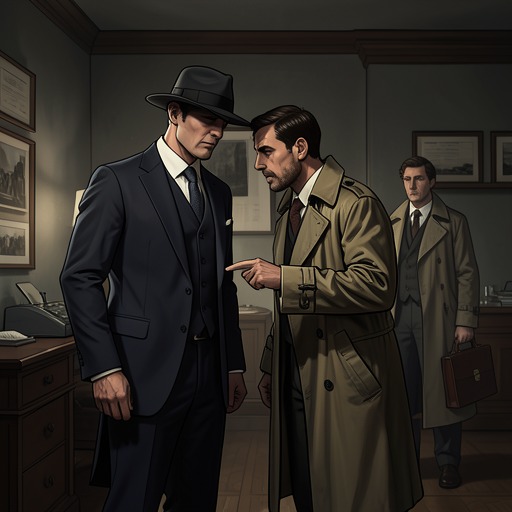
Santino Corleone answers the threat of hidden disloyalty with another form of information gathering. From a blue leather indexed book, he finds Ray Farrell’s name and the notation of a five-thousand-dollar Christmas Eve payment. He asks Farrell to obtain three months of incoming and outgoing calls for the homes of Paulie Gatto and Peter Clemenza. The family’s own surveillance network therefore supplements Omertà: silence is demanded from members, while records are secretly acquired about possible traitors. The code does not eliminate information. It centralizes and restricts it.
The hospital episode demonstrates the practical consequences of a breakdown in protective arrangements. Michael Corleone arrives at the French Hospital to find the street and lobby deserted, the expected guards absent, and no detectives outside Vito Corleone’s room. He immediately recognizes the tactical failure: even men without military training should have established outposts. His alarm reflects a world in which security depends on controlled knowledge, watchfulness, and the ability to detect an approaching threat before it becomes an attack. Omertà protects only when the network around it remains intact.
After Captain McCluskey’s death, Tom Hagen uses information rather than open confession to shape public understanding. Newspapers publish evidence that McCluskey received large sums of cash shortly before his death, and the police learn through informers and officers on the family payroll that he had been involved with murder and drug money. The Police Department refuses to confirm or deny the reports, but the story takes effect because it places McCluskey outside the moral boundary recognized by ordinary policemen. Hagen does not simply reveal facts; he manages which facts become speakable and which interpretation of them governs institutional response.
Omertà and the Family’s Justice
Omertà supports the Corleone Family’s claim to administer justice independently of the state. Amerigo Bonasera comes to Vito Corleone because official justice has failed him, and the Don’s system requires a public declaration of friendship rather than proof that the petitioner can repay the favor. Once the Don accepts a man’s trouble into his heart, the resulting obligation is understood through gifts, respect, and the possibility of a future service. Silence and indebtedness work together: the petitioner receives protection, while the family gains a durable personal bond outside ordinary law.
Vito Corleone’s earlier conflict with Fanucci shows the code’s connection to territorial power. Fanucci demands payment for protection, claiming connections with brutal associates, the police, and Maranzalla, a reputed leader in extortion, gambling, and armed robbery. His authority depends partly on the fear that he can mobilize others or manipulate official forces. Vito Corleone studies Fanucci’s past violence and concludes that the man lacks the genuine connections he claims. The episode contrasts a crude extortionist’s threats with the deeper, more disciplined system that Vito will build, one in which protection and silence are organized rather than merely announced.
As the Corleone empire expands, Vito Corleone formalizes the organization through caporegimes, soldiers, and a Consigliere, while placing layers between himself and operational acts. The arrangement resembles the social order Omertà makes possible: authority is personal, but its execution is distributed; loyalty is intimate, but accountability is deliberately obscured. The family can act as a protector and a governing institution precisely because its members do not speak across every boundary or expose every command.
The code also shapes the family’s response to war. When the Five Families kill Corleone allies, seize control of waterfront access, threaten bookmakers, and murder a major numbers banker in Harlem, Santino Corleone orders the organization to enter a full-scale war. The family establishes two apartments equipped with mattresses, food, guns, and ammunition for its button men, while bookmakers receive bodyguard teams. These arrangements convert loyalty into coordinated defense. Yet the conflict also exposes the limits of inherited discipline: Vito Corleone is too weak to use his political strength, Clemenza and Salvatore Tessio have lost some of their fighting capacity, and Tom Hagen is judged unsuited to counsel the family in wartime because he is not Sicilian.
When Santino Corleone’s death is confirmed, Vito Corleone invokes the code’s discipline against immediate vengeance. He orders the family to cease business operations and protection until after the funeral and forbids any act of revenge or inquiry into the murder without his express command. The prohibition is not surrender. It is a sovereign decision to control the family’s response, suspend ordinary operations, and prevent grief from forcing the organization into uncontrolled escalation. Silence here becomes a means of delaying action until the Don can redefine the conflict.
The Code’s Political Meaning and Limits
At the peace meeting, Vito Corleone explicitly connects Omertà with collective self-government. He argues that the families must manage their own affairs rather than submit to powerful outsiders who declare wars for their own interests. The family’s world is described as its own world, one that must be defended from outside meddlers. He renounces vengeance for Santino Corleone for the common good and promises that no one will be attacked without just cause and extreme provocation. At the same time, he separates his personal objective from the general settlement: bringing Michael Corleone home safely and clearing him of the murders of Virgil Sollozzo and Captain McCluskey remains his own affair.
This distinction reveals both the strength and the danger of Omertà. The code can restrain collective violence when the Don commands restraint, but it does not abolish violence; it relocates judgment from public institutions to a private sovereign. The same silence that protects a powerless family from corrupt authorities can conceal murder, suppress witnesses, and make an entire organization answerable only to its internal hierarchy.
Michael Corleone’s later reasoning shows that Omertà has become part of the family’s political vocabulary even as the organization changes. He tells Vito Corleone that his contemplated action is not purely revenge for Apollonia Vitelli and Santino Corleone, but the right thing to do, and he agrees that Tom Hagen should remain outside the plan. The decision depends on separating those who can be trusted with the secret from those whose role makes them unsuitable. In this way, the old code survives inside a more calculated succession strategy.
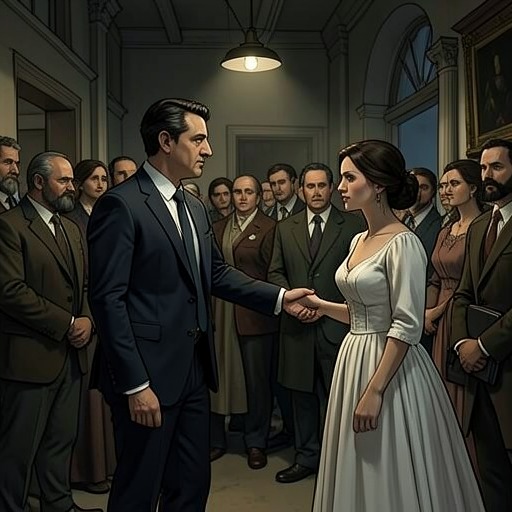
The final exposure of the family’s killings makes the limits of silence unmistakable. After Carlo Rizzi’s death, Constanzia Corleone confronts Michael Corleone and accuses him of having waited until Vito Corleone was dead before killing her husband. She identifies the broader pattern as well, naming Emilio Barzini, Philip Tattaglia, and others among the men Michael had killed. Michael’s bodyguards wait for his orders while he remains impassive and lets her finish. Omertà can prevent an immediate public response, but it cannot erase the knowledge carried by those closest to the family. The code’s silence may preserve authority; it cannot guarantee innocence, mutual trust, or permanent concealment.