Paulie Gatto
The GodfatherPaulie Gatto is a young operative of the Corleone Family whose importance lies less in personal stature than in the system he serves and eventually endangers. At Connie Corleone’s wedding he appears as a deferential subordinate, attending Peter Clemenza while imagining petty theft; later, his unexplained absences and suspected betrayal help trigger a tightly organized investigation. His execution by Clemenza and Rocco Lampone turns him into a concrete example of how the family converts suspicion into punishment while preserving distance from its highest authority.
Identity and Place in the Family
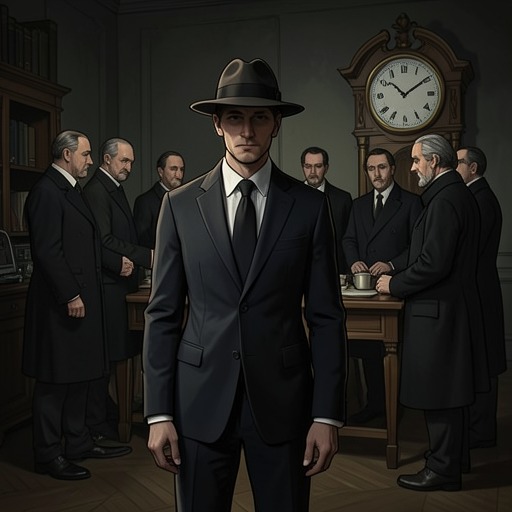
Paulie Gatto is presented as a dapper young man with a sleek, ferretlike head, a subordinate whose habitual attention is fixed on opportunities and orders. During the wedding he studies Connie’s silk purse and wonders how he might hijack it, but recognizes the fantasy as idle dreaming rather than an actionable plan. The episode establishes both his criminal instincts and his limited position: he is close enough to observe the family’s wealth, yet not powerful enough to seize it openly.
His immediate superior is Peter Clemenza, an immensely large caporegime whose authority remains visible even in the midst of celebration. While Clemenza dances the Tarantella with exuberant skill, Paulie brings him icy black wine and wipes his sweating brow with a silk handkerchief. Clemenza does not reward the service with warmth; he orders Paulie to stop acting as a spectator and patrol the neighborhood to ensure that everything is secure. Paulie therefore belongs to the practical machinery behind the family’s public ceremony. The wedding may look festive, but his assigned work is surveillance and protection.
Paulie’s background also reveals the family’s ability to manufacture protection for its members. He is twenty-six, unmarried, and has avoided the draft through false medical documents claiming that he received electrical shock treatments for a mental condition. The exemption was arranged by Clemenza after Paulie had made his bones in the family business. His advancement is expected, but not immediate: Michael Corleone understands that Paulie is not yet rich and must put in his time like everyone else. The family offers him status and security, but advancement depends upon continued service.
Duties, Habits, and Character
Paulie dislikes quick jobs, especially violent ones, because he prefers to plan ahead. Even while drinking beer and watching two young men with women at a bar, he scans the room and evaluates how the assignment might develop. The men are Jerry Wagner and Kevin Moonan, college students under suspended sentences for assaulting Amerigo Bonasera’s daughter. Paulie regards their draft deferments, probation violations, and pursuit of women with contempt, yet his own draft exemption rests on equally false documentation. His judgment of them exposes the double standard of the criminal world: evasion is despicable when practiced by outsiders and acceptable when secured through family connections.
The contrast between Paulie’s apparent conscientiousness and his underlying opportunism is central to his portrayal. He can perform routine protection work, care for the practical demands of an assignment, and understand that a minor mistake may produce serious consequences. At the same time, his first memorable impulse is to imagine stealing from the wedding purse, and his later conduct places the family itself at risk. He is not depicted as a grand strategist. He is a functionary whose ambitions and anxieties operate within a hierarchy built by men above him.
His unreliability first appears indirectly. When Paulie fails to report for work, telling the family that he is sick with another cold, Vito Corleone notices that it is the third such absence in the month and suggests finding a healthier man for the job. The repeated illness is therefore not merely a personal inconvenience; it becomes a pattern that makes his loyalty questionable. Because Paulie handles access, transportation, and routine information, small lapses acquire political meaning during the family crisis.
Suspicion and Investigation
After Vito Corleone is shot, Santino Corleone treats the family’s vulnerability as a problem of information. He consults an indexed blue-leather book containing favors and payments, finds Ray Farrell’s entry for Christmas Eve and five thousand dollars, and orders a record of the calls made to and received by Paulie’s and Clemenza’s homes over the previous three months. The request shows that Paulie’s fate is decided through the family’s own surveillance infrastructure: favors create a network of informants, telephone records turn private contact into evidence, and suspicion is tested through organized documentation.
The investigation preserves distinctions within the family. Santino initially considers whether the betrayal reaches Clemenza, but finally tells Michael that Clemenza is all right and that Paulie is the traitor. Tessio is visibly relieved because the danger has not reached so high in the hierarchy. Paulie’s position makes the betrayal both damaging and containable. He may possess enough access to assist an enemy, but he is still only one link in the chain between policy and execution.
That chain is the family’s central security device. Vito Corleone gives instructions privately to Tom Hagen; Hagen passes them privately to Clemenza; Clemenza instructs Paulie or another lower operative without revealing the original source. The men who carry out a commission need not know why it is being done or who ordered it. If one link turns traitor, only that link must disappear to protect the Don. Paulie’s suspected betrayal thus activates the very structure that his service had helped maintain: secrecy is answered by erasure.
Execution and Aftermath
The execution is arranged as an ordinary return journey. Clemenza, Paulie, and Rocco Lampone travel toward Long Beach in silence. On a dark stretch of road leading into the city, Clemenza asks Paulie to pull over, using his known weak bladder as a familiar and credible pretext. Paulie drives onto soft earth beside the swamp, and Clemenza walks into the bushes before returning to the car. He looks up and down the unlit highway, confirms that no one is watching, and tells Paulie to proceed.
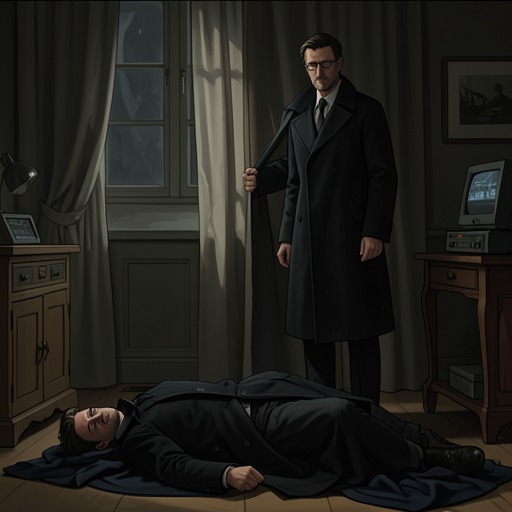
A second later, the car is shaken by a gunshot. Paulie’s body is thrown against the steering wheel and collapses over the seat; Clemenza has stepped back to avoid the fragments of skull and blood. Rocco comes out of the back seat still holding the gun and throws it into the swamp. The disposal of the weapon and the immediate change of vehicles show that the killing is not an eruption of anger but a practiced operation, designed to remove evidence and separate the participants from the scene.
Rocco then drives Clemenza home by an indirect route through Merrick, the Meadowbrook Parkway, the Northern State Parkway, the Long Island Expressway, the Whitestone Bridge, the Bronx, and Manhattan. The elaborate route extends the logic of the killing beyond the shot itself. Paulie is not only physically removed; the men who killed him also work to dissolve the path that could connect them to his death.
When Clemenza later reports to Santino that Paulie has been taken care of, he says only that Paulie will not be seen again. Michael experiences a shock when he realizes that the cheerful wedding dancer has murdered the small subordinate. The contrast is deliberate: the same Clemenza who performed for the guests and accepted Paulie’s attentions is also the officer who executes him. Paulie’s death reveals the family’s ability to keep violence continuous with ceremony, hospitality, and ordinary routine.
Narrative and Thematic Significance
Paulie’s career compresses the Corleone Family’s governing principles into a minor but revealing arc. He receives a favor, earns advancement by committing violence, patrols the family’s spaces, and benefits from a chain of command that protects its originators. Yet the same chain makes him expendable once his loyalty is doubted. In the family’s system, proximity to power is not protection in itself; protection depends upon silence and obedience.
His story also illustrates the contrast between public authority and private enforcement. Federal agents openly record the license numbers of cars at Connie Corleone’s wedding, while Santino secretly obtains telephone records through a favor network. The FBI’s notebooks and the family’s blue-leather ledger are opposing forms of surveillance, but both transform movement and association into information. Paulie operates inside the family’s private order and is destroyed by it, while the broader conflict later depends on controlling what police and newspapers believe about the Corleone Family’s enemies.
Paulie remains a relatively flat character in the structural sense: his defining traits are opportunism, subordinate ambition, caution about violent work, and eventual treachery. His limited interior development is part of his function. He is a replaceable link in a system that values hierarchy over individuality, and his death makes that system visible. The wedding, the sick calls, the telephone investigation, the roadside deception, and the final report form a sequence in which apparently minor details acquire causal force. Paulie’s significance is therefore not that he transforms, but that his removal demonstrates how the family preserves itself by making every individual—however familiar, useful, or socially embedded—answerable to its code.