Pizzo
The GodfatherPizzo is the Mafia practice of taking a share of someone else’s earnings under the language of protection, courtesy, or reciprocal obligation. Its literal image is the beak of a small bird, and the phrase “wet my beak” turns that image into a demand for tribute. The practice is important because it reveals how the criminal order converts intimidation into a routine economic institution: payment is presented as a favor, refusal as an insult, and violence as the enforcement mechanism behind an apparently negotiated transaction.
Meaning and First Appearance
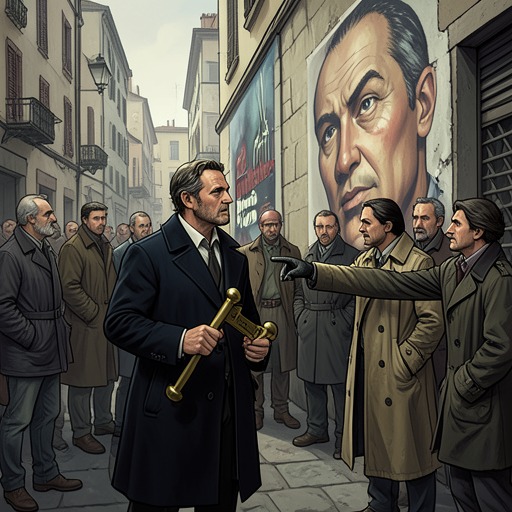
Pizzo is introduced through Fanucci’s demand after Vito Corleone, Peter Clemenza, and Salvatore Tessio rob a silk truck in 1919. Fanucci approaches Vito in his neighborhood, wearing a cream suit and white fedora, and tells him that the three young men have treated him shabbily because the neighborhood is his territory. He invokes the Sicilian Mafia expression “Fari vagnari a pizzu,” explaining that pizzo means the beak of a small bird such as a canary. In practical terms, he is demanding part of the robbery’s proceeds.
The demand is deliberately flexible. Fanucci first asks for five hundred dollars, then threatens to involve the police, disgrace Vito’s family, and leave his wife and children destitute. He lowers the minimum to three hundred dollars while insisting that he must receive something. The apparent bargaining range does not make the encounter voluntary. Fanucci’s gun, displayed by the casual opening of his jacket, gives the language of courtesy its coercive force.
Vito immediately understands what Fanucci means but does not answer at first. His silence is strategic rather than submissive: he waits for a definite demand and studies the older man’s habits, allies, and actual power. When he finally speaks, he remains courteous and claims that Clemenza and Tessio hold his share of the money. He allows Fanucci to believe that he is inexperienced and respectful, even thanking him for speaking to him as a godfather. Fanucci is reassured by the performance and tells Vito to let Clemenza guide him in such matters.
Tribute, Fear, and Negotiation
The episode shows that pizzo depends on more than raw violence. Fanucci’s authority rests on territory, reputation, implied access to the police, and the expectation that younger men will recognize an older man’s status. His demand is framed as a matter of manners: the young robbers have failed to acknowledge the neighborhood’s established power. Pizzo therefore transforms a threat into a social obligation. The victim is expected to pay not merely because the collector can attack him, but because the surrounding order treats payment as the proper response to another man’s standing.
Clemenza and Tessio’s reaction exposes the system’s reach. Although they possess guns and believe that the three of them are stronger than Fanucci, they assume that the tribute must be paid. They argue over whether Fanucci might accept two hundred dollars, then conclude that the scarred collector will demand at least three hundred. Their acceptance demonstrates how pizzo solves the problem of uncertainty for the collector: once the demand is recognized as an established rule, the threatened men begin calculating compliance before any violence occurs.
Vito turns that expectation against Fanucci. He asks Clemenza and Tessio to give him two hundred dollars each and promises that Fanucci will accept that sum from him. He instructs them not to bargain or quarrel, but to say that they are willing to pay and must obtain the money through Vito. Vito will perform the argument over price himself, keeping the two younger men from appearing defiant. This arrangement separates the visible negotiation from the underlying decision and places the risk on Vito.
The scene is the first clear demonstration of Vito’s distinctive method. He does not meet the demand with an open threat, nor does he accept the demanded amount. Instead, he makes himself appear compliant while controlling the terms of the exchange. Pizzo is thus shown as a contest over interpretation: Fanucci sees a frightened beginner, while Vito sees a solitary predator whose authority may be less secure than it appears.
From Extortion to Organized Protection
The practice later becomes embedded in Vito’s own rise. After Fanucci is removed, Vito becomes known in the neighborhood as a “man of respect.” A card-game operator voluntarily pays him twenty dollars a week for his “friendship,” asking only that Vito visit the game once or twice so players understand that it is under his protection. The payment resembles pizzo even though it is described as voluntary. The difference between extortion and protection has shifted: Vito’s reputation makes the threat implicit, allowing the protected party to present tribute as a sensible investment rather than a forced surrender.
Store owners also approach Vito when young hoodlums cause problems. He intervenes and receives payment, eventually earning one hundred dollars a week, an enormous income for the period. He shares part of this money with Peter Clemenza and Salvatore Tessio without being asked, turning private protection revenue into a durable alliance. The money is not simply consumed; it distributes loyalty, finances organization, and confirms that those who help maintain the system will receive a recognized share.
Vito’s business methods extend the same logic into the olive-oil trade. With Genco Abbandando handling imports and warehouse operations, and Clemenza and Tessio selling to Italian grocers across Manhattan, Brooklyn, and the Bronx, Vito builds Genco Pura Olive Oil into the leading imported Italian oil in America. He undercuts rivals, restricts their access to distribution, and seeks monopoly through persuasion, merger, and pressure. Because the product is not superior and Vito does not rely on advertising, his decisive resources are personality and the reputation of a “man of respect.”
When wholesalers resist, the distinction between commercial competition and coercive protection collapses. Warehouses are burned, truckloads of oil are dumped in the streets, and one wholesaler who appeals to the authorities disappears. His wife and children are left with a business that must come to terms with Genco Pura Olive Oil. Pizzo belongs to this same continuum: economic access is controlled by a combination of payment, personal influence, and violence, while the arrangement is justified as efficient order. During Prohibition, Vito’s accumulated authority carries him from a ruthless businessman into the position of Don Corleone.
The Wider System of Favors and Power
Pizzo is not confined to street-level collectors. The novel presents the Corleone system as a network in which favors create obligations and access to institutions becomes a source of revenue. At the Corleone family gathering, the baker Nazorine is treated as an old friend rather than an ordinary petitioner. He had supplied elaborate pies for Easter and pastries for Christmas and family birthdays, paid dues to the bakery union organized by Vito, and once sought only black-market OPA sugar coupons during the war. When Nazorine asks for help keeping Enzo in America so that Enzo can marry his daughter, Vito treats the request as the return owed to a loyal relationship. The exchange differs from Fanucci’s demand in tone and personal history, but both depend on a system in which economic contributions establish claims on power.
The same logic governs the conflict over narcotics. Tom Hagen explains that the other Families want access to the Corleone Family’s political influence so judges and officials will treat narcotics cases gently. Their proposal is effectively a demand to draw water from Vito’s institutional well: if Vito controls political protection, the other Families insist that they should be allowed to use it, perhaps in return for payment. Emilio Barzini argues that refusal takes bread from their families and turns the denial of a favor into an act of aggression. Here pizzo has expanded from a collector’s share of loot into a struggle over who may convert political influence into commercial protection.
The comparison clarifies the difference between a simple payment and a governing structure. Fanucci demands money because he claims neighborhood authority. Vito’s organization uses protection revenue, business control, union influence, political connections, and selective violence to organize an entire field of transactions. What looks like generosity in one encounter and extortion in another belongs to the same economy of dependence: people seek safety or access from the person who can obstruct them, and the resulting obligation binds them to his authority.
Narrative and Thematic Significance
Pizzo marks the novel’s movement from isolated criminal acts to an alternative political economy. The payment is never merely cash. It acknowledges territory, recognizes rank, purchases noninterference, funds allies, and creates a relationship that can later be called upon as a favor. Its language of respect masks a hierarchy enforced by the possibility of ruin, police involvement, exclusion from markets, or physical violence.
The concept also explains Vito’s transformation. As a young man, he is unwilling to surrender money to Fanucci simply because an older criminal demands it, yet he learns from the encounter that power is maintained by controlling expectations as much as by using weapons. Later, he reproduces and reorganizes the same mechanism, presenting his own extractions as friendship, reason, protection, or efficient business. The central contrast is therefore not between coercion and benevolence, but between crude predation and a more stable system capable of distributing benefits while preserving the threat beneath them.
Pizzo finally illuminates the novel’s recurring claim that favors and business are inseparable from power. A petitioner who approaches Don Corleone does not enter a neutral marketplace; he enters a moral and political economy where prior gifts, family ties, dues, and services determine what may be requested and what must eventually be repaid. The beak that Fanucci asks to wet becomes an image of an entire order feeding on every exchange, until protection, commerce, friendship, and domination can no longer be cleanly separated.