Salvatore Tessio
The GodfatherSalvatore Tessio is an old associate of Vito Corleone and one of the two men who help transform Vito’s precarious beginnings into an organized criminal empire. His defining significance lies in the contrast between enduring personal friendship and the impersonal logic of succession: Tessio is trusted for decades, given authority over Brooklyn, and treated as a founding partner, yet he ultimately becomes expendable when Michael Corleone consolidates power.
Identity and Early Association
Tessio enters Vito Corleone’s life during a period of unemployment and hardship. Vito has a wife and children to support, little work, and only food parcels from Genco Abbandando to sustain the household while he considers his future. Tessio and Peter Clemenza approach him with an invitation to join their gang, which hijacks trucks carrying silk dresses after the merchandise has been loaded at a factory on Thirty-first Street. The drivers are subdued at gunpoint, the trucks are taken to a friendly warehouse, and the clothing is distributed through Italian neighborhoods, including Arthur Avenue in the Bronx, Mulberry Street, and the Chelsea district in Manhattan.
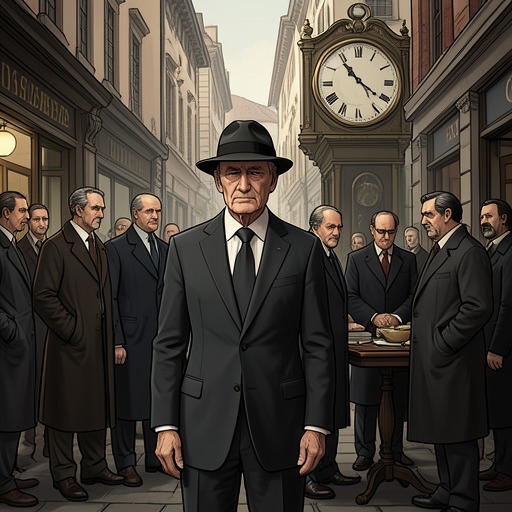
Tessio and Clemenza specifically need Vito because he can drive. He has experience chauffeuring the Abbandando grocery delivery truck, and in 1919 skilled automobile drivers are valuable. Vito accepts, despite judging the plan careless: the job is badly organized, the distribution of the loot is imprudent, and his companions seem rash. Even so, he considers them sound in character. Clemenza’s bulk inspires trust, while the lean, saturnine Tessio inspires confidence. Tessio is therefore present at the point where Vito’s moral hesitation begins to yield to practical necessity and strategic calculation.
Position in Vito Corleone’s Organization
As Vito prospers, Tessio becomes more than a companion from the old neighborhood. Vito protects Italian families running small home speakeasies, builds contacts with lawyers and police officials, and develops a network of obligations that turns friendship into durable power. Tessio benefits from and participates in the environment in which Vito’s good deeds, protection, and criminal enterprise become inseparable.
When the growing organization becomes unwieldy, Vito formalizes its structure. He appoints Tessio and Clemenza as caporegimes, or captains, and places soldiers beneath them. He divides Tessio’s group and assigns it responsibility for Brooklyn. The division is both a promotion and a restraint. Vito gives Tessio a free hand in Brooklyn, but he keeps the two caporegimes from associating socially except when necessary, ensuring that neither can easily conspire with the other. Tessio understands that the separation is a security measure rather than an expression of personal hostility.
The arrangement reveals Tessio’s place within Vito’s system. He is trusted with territory and men, but his authority remains delegated. Vito places layers between himself and operational acts, issuing orders privately to Genco Abbandando or to a caporegime. The same structure later allows instructions to pass from Vito through Tom Hagen, Clemenza, and Paulie Gatto without the men at the end of the chain knowing the original source. Tessio is thus both an early builder of the organization and a subject of the organization’s increasingly bureaucratic security logic.
Loyalty, Territory, and the Succession Crisis
By the time Michael assumes control, Tessio’s position is complicated by the Family’s decline in New York. The peace made with the Five Families has weakened the Corleone Family, while the Barzini Family, allied with the Tattaglia Family, has become the dominant power in the area. Barzini’s people move into Corleone gambling territories and establish bookmakers after testing the family’s weakened reactions.
At a meeting in Vito Corleone’s library, Tessio speaks for the practical danger facing the old organization. Michael has announced semiretirement for Vito and intends to move the center of power westward, while Clemenza and Tessio may eventually operate independently. Tessio asks permission to recruit new men because Barzini’s people are encroaching on his territory. He proposes teaching them a lesson, but Michael refuses and insists that the matter will be negotiated before the family leaves.
Tessio then addresses Vito directly, risking Michael’s displeasure under the protection of their years of friendship. He argues that the Nevada enterprise cannot succeed without strength in New York. If Michael and Vito leave, Barzini and the Tattaglias will overwhelm the remaining Corleone forces, placing Tessio and Clemenza under their control. Tessio’s proposal is to move from strength rather than weakness and recover at least the lost territories in Staten Island. His intervention is not merely resistance to change; it is a territorial assessment shaped by his responsibility for Brooklyn and by his fear that western expansion will abandon the organization’s original base.
The meeting also exposes the unstable nature of succession. Control of a Family is not automatically hereditary, and powerful caporegimes such as Tessio and Clemenza could, under other circumstances, have succeeded to the position of Don or broken away to form independent Families. Michael’s authority therefore depends on more than bloodline. It must be asserted against men whose experience, territorial power, and long-standing relationships give them plausible claims of their own.
The Trap and Execution
Tessio’s final appearance turns the language of friendship into an instrument of entrapment. After Albert Neri assassinates Emilio Barzini in public and escapes through a prepared sequence of cars and disguises, Tessio waits in the kitchen of Vito Corleone’s old house, drinking coffee. Tom Hagen tells him that Michael is ready and instructs him to call Barzini and tell him to begin his journey.
Tessio goes to the wall telephone and tells Barzini’s office that they are on their way to Brooklyn. He hangs up smiling and expresses hope that Michael will give them a good deal that night. Hagen answers gravely that he is sure Michael will. The exchange is outwardly ordinary, even companionable, but the reader knows that Tessio has been marked for death. The apparently routine phone call is therefore the final movement of a carefully staged betrayal.
Hagen escorts Tessio toward Michael’s house, where a bodyguard stops them. The guard says that Michael will arrive in a separate car and orders Tessio and Hagen to go on ahead. Tessio is being isolated under the pretense of ordinary procedure. His long relationship with Vito and his candid warning about New York no longer outweigh Michael’s judgment that he has become dangerous or disloyal. The old Don’s system of personal debts and friendship has been replaced by a regime in which suspicion is settled through removal.
Change, Ending, and Narrative Role
Tessio’s trajectory moves from trusted neighborhood companion to territorial captain and finally to condemned intermediary. In Vito’s era, his confidence and sound character help establish a durable partnership. Vito’s organizational reforms reward Tessio with Brooklyn while simultaneously limiting the possibility that his alliance with Clemenza might threaten the Don. Under Michael, however, the same institutional structure becomes harsher: authority is centralized, information is compartmentalized, and a caporegime’s history of service cannot guarantee survival.
His fate also sharpens the difference between Vito’s and Michael’s styles of rule. Vito accumulates loyalty by helping people, accepting friendship as the basis of obligation, and making his network feel personal. Michael inherits that network but uses its channels with greater secrecy and finality. Tessio is not publicly denounced or granted a chance to defend himself. He is induced to make a call, separated from protection, and taken toward the consequence prepared for him.
The aftermath confirms that the organization has survived the sacrifice. A year of political maneuvering establishes Michael as the most powerful Family chief in the United States. Clemenza has his own Family, Rocco Lampone serves as Michael’s caporegime, Albert Neri heads security for the family-controlled hotels in Nevada, and Tom Hagen belongs to Michael’s Western Family. Tessio’s absence is absorbed into the new order. His death marks the cost of the transition from Vito Corleone’s personal coalition to Michael Corleone’s centralized and expanding power.