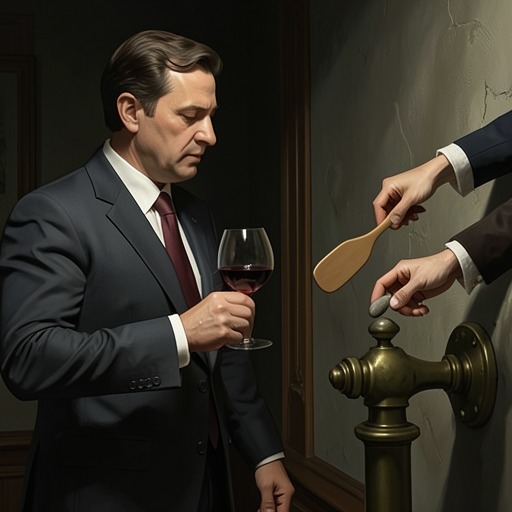
The Godfather’s system of favors
The GodfatherThe Godfather’s system of favors is the reciprocal order built around Vito Corleone’s personal authority. A petitioner receives protection, money, justice, political access, or practical assistance; in return, the petitioner publicly acknowledges friendship and accepts an open-ended obligation. The system presents itself as humane and personal, yet it also functions as an alternative government, converting gifts and gratitude into loyalty, information, labor, influence, and eventual service.
Definition and Social Logic
The system begins with a request rather than a contract. At the wedding of Constanzia Corleone in August 1945, visitors from New York City arrive with cream-colored envelopes filled with cash instead of checks. Each gift identifies its giver and measures the respect owed to Don Vito Corleone. The money is not described as a commercial payment; it is a ceremonial declaration of standing within the Don’s circle.
Vito’s authority rests on the promise that no supplicant will be dismissed with an excuse that stronger forces make action impossible. The petitioner need not be wealthy, powerful, or even capable of repayment. The essential requirement is that he personally proclaim friendship. Once that declaration is made, Vito takes the petitioner’s trouble upon himself and pursues a solution. The reward he requests is friendship, the title of Don or Godfather, and the acknowledgment that the recipient is indebted to him.
The obligation is deliberately elastic. Small gifts such as homemade wine or peppered taralles signify respect rather than profit, but good manners require the giver to admit that Vito may call upon him later for a service. The gift therefore carries three values at once: its material value, its public symbolism, and its potential political use. What appears to be voluntary generosity creates a relationship in which future assistance can be demanded without being specified in advance.
Favors in Practice
The baker Nazorine’s appeal demonstrates how the system joins affection, bureaucracy, and payment. Nazorine has known Vito since childhood in Italy and has maintained the relationship through recurring Easter pies, Christmas pastries, and loyalty to the bakery union Vito organized in his early years. During the war, Nazorine did not ask for a major favor; he merely sought access to black-market OPA sugar coupons. After the war, however, his debt gives him the confidence to ask for help saving his daughter’s relationship with Enzo, a Sicilian prisoner of war who is about to be repatriated.
Vito answers the emotional crisis with a political procedure. He proposes a petition to the district Congressman and a special bill allowing Enzo to become a citizen, estimating the prevailing price at two thousand dollars and guaranteeing that the arrangement will be carried out. Nazorine accepts the cost because the favor is not represented as charity. Tom Hagen immediately recognizes the economic result: the payment secures both a son-in-law and a cheap lifetime helper for the bakery. Vito then expands the arrangement into a system, instructing Hagen to use a Congressman in another district, alter the home addresses, and prepare for many similar postwar cases without raising the price.
The same structure governs smaller requests. Anthony Coppola needs five hundred dollars to open a pizzeria and cannot obtain credit. Vito’s own roll of bills is insufficient, so he borrows one hundred dollars from Hagen and supplies the full amount, apologizing that the elaborate wedding has left him short of cash. The gesture is intimate and improvised, but it also extends a family connection from Vito’s youth into a new business and creates another grateful dependent.
The system can also operate as protection and tribute. In the neighborhood, a man running card games voluntarily pays Vito twenty dollars each week for friendship, needing only Vito’s occasional appearance to signal that the games are protected. Store owners ask him to intervene with young hoodlums and reward him for doing so. His income rises to one hundred dollars a week, which he shares with Peter Clemenza and Salvatore Tessio because they are his allies. Protection thus moves along the same continuum as friendship: the payment is voluntary in form, but the surrounding power makes the relationship unmistakably unequal.
Vito also invests in friendship before it produces an immediate return. He becomes godfather to Mrs. Colombo’s youngest son and gives the boy a twenty-dollar gold piece. When police stops threaten his trucks, Genco Abbandando hires a lawyer with contacts in the Police Department and the judiciary, and the organization establishes a monthly payoff list for officials. When the lawyer worries about expense, Vito orders that everyone be placed on the list, even officials who cannot help immediately, because he believes in showing friendship first. The network is built through advance commitments, not merely through payments made after a favor is rendered.
Justice Beyond the Law
Amerigo Bonasera’s petition reveals the system’s moral and coercive edge. Bonasera has gone first to the courts after his daughter is beaten, only to encounter delay, expensive lawyers, and a judge whom Vito describes as corrupt. Vito contrasts that legal process with the resources he would have offered had Bonasera come to him initially: money, immediate justice, and protection so complete that anyone who harmed an honest man under his friendship would become Vito’s enemy.
Bonasera finally says that he accepts Vito’s friendship. Only then does Vito promise justice, presenting it as a gift from his wife, the daughter’s godmother, while warning that one day—perhaps a day that may never come—he will call upon Bonasera for a service. The promise is compassionate and threatening at the same time. Vito gives the undertaker what the courts failed to provide, but he also converts the failure of public justice into a permanent private allegiance.
Vito’s instructions afterward show that even a violent response is absorbed into an organized chain rather than carried out as an open personal act. He assigns the matter to Clemenza and insists on reliable people who will not be carried away by the smell of blood. The favor is therefore framed as measured justice, not uncontrolled vengeance, even though its execution depends on the family’s capacity for concealed violence.
From Personal Debt to Organization
The system scales because Vito translates personal loyalty into layers of administration. Tom Hagen becomes Consigliere despite the long-standing tradition that the position belongs to a full-blooded Sicilian. Hagen serves as counselor, closest companion, and auxiliary brain, but he also occupies the crucial buffer between Vito’s policy and the men who carry out orders. Vito tells Hagen what must be done; Hagen privately instructs Clemenza; Clemenza instructs Paulie Gatto; and the final operatives need not know either the original order or its source. The favor network is therefore protected by secrecy as well as affection.
As the organization grows, Vito names Clemenza and Tessio caporegimes and places soldiers beneath them. He separates Tessio’s Brooklyn group from Clemenza’s Bronx operation and discourages the two caporegimes from social association, not because of personal hostility but to prevent conspiracy. Friendship remains the language of the organization, while insulation, ranks, and restricted information supply its security. The Godfather’s system of favors thus develops from an interpersonal ethic into a disciplined power structure.
Its reach extends beyond neighborhood clients. Vito’s early support for labor leaders leaves many of them indebted to him, allowing Tom Hagen to secure an appointment with Jack Woltz through Billy Goff and to hint that a labor strike might follow if the interview produced no satisfactory result. The Corleone Family’s technical territory may remain centered on New York, but old friendship carries its influence into the movie industry and labor politics. The system’s strength lies precisely in these connections across institutions that are formally separate.
Political Use and Historical Consequences
At the peace meeting among the rival Families, Vito uses the Bocchicchio clan as negotiators and arranges hostages to guarantee the safety of the participants. The arrangement makes treachery materially dangerous: if Michael Corleone is killed, a Bocchicchio hostage held by the Corleone Family will die, and the Bocchicchios will seek vengeance against the responsible party. Because the clan’s vengeance is considered unavoidable once its members are betrayed, its hostages become credible insurance. Here the system of favors operates not through sentimental trust alone but through reciprocal obligations backed by inherited reputation and punishment.
The meeting takes place in a bank whose president owes Vito Corleone a debt and whose stock is effectively held for Vito even though it is registered in the president’s name. When the president offers written proof of the arrangement to prevent suspicion, Vito rejects the implication that formal evidence is needed, declaring that he would trust the president with his fortune, his life, and the welfare of his children. Yet Vito also keeps written records so his heirs will know what is held in trust. Personal confidence and documentation coexist: the system distrusts ordinary institutions while quietly preserving its own records.
The same logic resolves the legal crisis surrounding Felix Bocchicchio. Vito initially refuses to perform a miracle for a condemned man, but after Hagen explains the case in detail, he offers the Bocchicchio family a pension for Felix’s wife and children in exchange for Felix confessing to the murders of Virgil Sollozzo and Captain McCluskey. The confession must contain true details, implicate the police captain in narcotics, and be supported by a persuaded waiter’s identification. Vito also guarantees the children’s college expenses. A doomed prisoner receives no rescue from the electric chair; instead, his death is reorganized into a final service that protects his family and serves the Corleone Family’s political position.
The system reaches its later strategic form when Michael Corleone announces plans to move the Corleone Family’s interests to Las Vegas. The family intends to sell its olive oil interests and use friends’ ownership of a hotel and casino as the foundation of its western future. Moe Greene is expected to sell his share so the property can be wholly controlled by friends of the Family, and Michael reduces the dispute to the principle that he will make Greene an offer he cannot refuse. The old language of friendship now accompanies expansion, acquisition, and succession.
By the end of the story, the network has been converted into a durable political and economic machine. After a year of maneuvering, Michael becomes the most powerful Family chief in the United States, divides his time between Long Beach and Las Vegas, and closes the New York operation. Clemenza has his own Family, Rocco Lampone is Michael’s caporegime, Albert Neri controls security for the family-controlled hotels in Nevada, and Hagen belongs to Michael’s Western Family. Personal debts have outlived the original neighborhood and the original Godfather; they have become the connective tissue of a reorganized empire.
Significance
The Godfather’s system of favors is powerful because it answers real failures in public life. Courts are slow or corrupt, banks treat borrowers as supplicants, immigrants face bureaucratic barriers, workers need protection, and small businesses lack credit. Vito supplies immediate solutions where official institutions provide delay, humiliation, or indifference. His authority therefore appears not simply as criminal domination but as competence, memory, generosity, and personal recognition.
Its generosity, however, is never free of structure. The cream-colored wedding envelopes, the pastries, the twenty-dollar gold piece, the weekly twenty-dollar protection payment, the two-thousand-dollar citizenship arrangement, and the pension promised to Felix Bocchicchio’s family all encode relationships in which gratitude can later be activated. Friendship becomes a form of capital, and the public declaration of friendship is the first payment into an account whose final withdrawal may involve money, political influence, silence, protection, or violence.
The system also exposes the tension between personal legitimacy and institutional legitimacy. Vito’s authority depends on character and reputation, but it requires lawyers, Congressmen, labor leaders, police contacts, banks, written records, and organizational ranks. It does not remain outside the state; it penetrates and repurposes the state’s channels. In that sense, The Godfather’s system of favors is both an alternative government and a method for converting unofficial relationships into official-looking results.
Its central paradox is that intimacy makes power persuasive. Vito embraces the baker, places a hand on his shoulder, reassures Bonasera, remembers old friends, and treats rich and poor guests alike. These gestures create the moral image of a man who cares for his people. Yet the same tenderness establishes dependency, and the same faith that makes betrayal unthinkable allows the organization to command without explaining itself. The system endures because its participants experience obligation not merely as fear, but as friendship, honor, gratitude, and the practical knowledge that the Godfather can accomplish what ordinary institutions cannot.