Vito Corleone
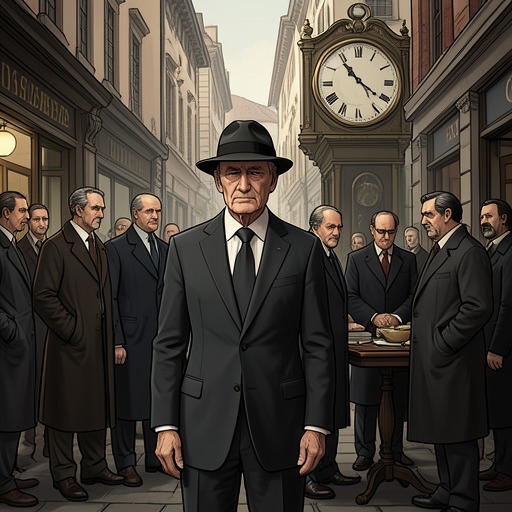
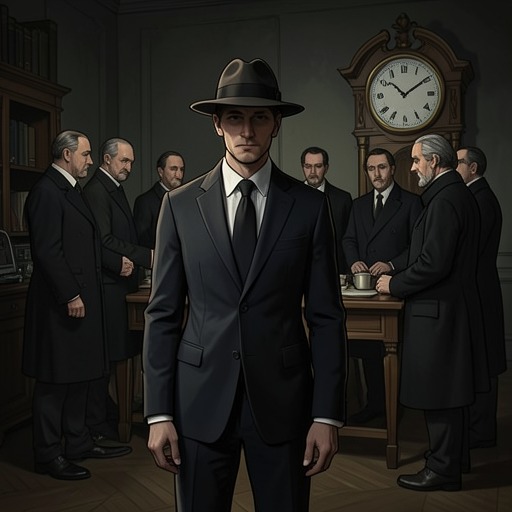
The GodfatherVito Corleone is the central patriarch of the Corleone Family and the figure known as Don Corleone and the Godfather. His decisive achievement is to turn exile, violence, and neighborhood dependence into a durable system of rule: people come to him because official law has failed them, while soldiers, politicians, judges, labor leaders, and allied families sustain an organization designed to protect his authority from direct exposure. His power is personal in its language, bureaucratic in its structure, and coercive in its consequences.
Identity and Origins
Vito Corleone was born Vito Andolini in the Sicilian village of Corleone. At twelve, after his father killed the local Mafia chief and was murdered in retaliation by lupara blasts, Vito became a target because the surviving Mafia men feared that he would eventually avenge his father. His mother hid him and sent him to America, where he stayed with the Abbandando family. Taking the name Corleone preserved a sentimental connection to his birthplace, one of the few openly sentimental gestures attributed to him.
In New York, Vito worked in the Abbandando grocery store in Hell's Kitchen. He married a sixteen-year-old Italian girl from Sicily, settled with her in a tenement near his workplace, and became the father of Santino Corleone. This immigrant beginning is important to his later authority: Vito's power does not originate in inherited American wealth or official office, but in survival, memory, personal alliances, and an intimate understanding of a community that feels neglected by the state.
Building an Empire
Vito first established himself as a businessman associated with the Genco Pura Olive Oil Company. He became known as a man of reasonableness who avoided empty threats and sought arrangements in which every party received a share of the profit. Yet this language of fairness served a hard strategic purpose. He understood that free competition was wasteful and monopoly efficient, and when Brooklyn oil wholesalers resisted his vision, Salvatore Tessio was sent to establish a headquarters. Warehouses were burned, oil was dumped into waterfront streets, and one wholesaler who appealed to authorities disappeared, leaving his family to take over the business and reach terms with the company.
Prohibition marked Vito's decisive rise. Through Peter Clemenza, Canadian bootleggers asked to use his six delivery trucks and men to distribute alcohol and whiskey through New York City. Their offer included a threat, but Vito assessed it without anger, recognized that it lacked conviction, and accepted the enormous fee, shifting the trucks almost entirely from olive oil to smuggling. The enterprise gave him more than money: it supplied contacts, information, experience, and the practical knowledge from which a larger criminal organization could be built.
He also made himself useful to Italian families operating small speakeasies from their homes. He became godfather to Mrs. Colombo's youngest son, protected neighborhood businesses, and arranged a system of payments through a lawyer with contacts in the Police Department and the judiciary. Vito insisted that even officials who could not immediately help the organization should be included, because friendship had to be demonstrated before it could be called upon. His generosity therefore functioned as both social care and investment in future obedience.
As the organization expanded, Vito formalized its hierarchy. He made Tessio and Peter Clemenza caporegimes, placed soldiers beneath them, and appointed Genco Abbandando as Consigliere. Orders passed through layers of insulation: Vito generally communicated with only one intermediary, rarely before witnesses, so that operational acts could not be traced directly to him. Tessio received Brooklyn as his territory, while Clemenza's Bronx operations remained more tightly controlled because he was considered braver, more reckless, and crueler. The division was not merely administrative; it prevented the caporegimes from easily conspiring against their Don.
The Godfather's System of Favors
Vito's public authority rests on the steady exchange of assistance for acknowledged friendship. On the wedding day of Constanzia Corleone, guests stream to his Long Beach home carrying cream-colored envelopes filled with cash rather than checks. The gifts record the giver's identity and respect, while the title of Don or Godfather publicly recognizes the debt created by his protection. Small gifts such as homemade wine or peppered taralles reinforce the same relationship: the recipient need not repay him immediately, but must accept that Vito may call upon the friendship later.
Amerigo Bonasera's appeal reveals how this system competes with American law. Bonasera had trusted law and order throughout his years in America and had prospered by doing so, but after two young men brutally attacked his daughter and escaped meaningful punishment, his faith collapsed into fantasies of buying a gun and killing them. He concluded that he and his wife had been made fools of and decided that justice required them to go on their knees to Don Corleone. Vito's authority therefore grows not only from fear; it grows from the perception that he can deliver the justice that courts theatrically promise but fail to provide.
His response is also organized through the same layered structure that protects him from exposure. Vito gives private instructions to Tom Hagen, Hagen privately instructs Peter Clemenza, and Clemenza passes the commission to Paulie Gatto, who gathers the necessary men without knowing the original source or full reason for the order. The arrangement makes the Don appear distant from the violence while ensuring that the request of a supplicant can become an action in the world.
During the Great Depression, unemployed and humiliated Italians came to Vito for work, help with relief applications, assistance for sons in trouble, small loans, or intervention against landlords demanding rent from jobless tenants. He provided aid with encouraging words that softened the sting of charity. Families of imprisoned employees received living allowances, and silence was rewarded with welcome, food, money, and continued protection upon release. The arrangement was not Christian charity: it bound dependents to the organization and assured them that loyalty would protect their families even when they themselves were imprisoned.
Vito's influence consequently extends into electoral politics. Italians uncertain about whom to support for the state legislature, city offices, or Congress asked his advice, and practical party chiefs consulted him as a political power. He strengthened that influence by helping gifted boys from poor Italian families attend college, anticipating that they might become lawyers, assistant district attorneys, or judges. Patronage thus moves in both directions: immediate help produces gratitude, while long-term educational investment creates institutional allies.
Peace, War, and Political Intelligence
The repeal of Prohibition threatened Vito's empire, but he had already prepared for the change. In 1933 he sent emissaries to Salvatore Maranzano, who controlled gambling, shylocking, bookmaking, illicit gambling houses, and Harlem's numbers racket. Vito proposed an equal partnership, offering his organization, police contacts, and political connections as protection for Maranzano's expansion into Brooklyn and the Bronx. When Maranzano rejected the proposal, Vito's power was forced into a more openly contested phase, though the supplied account emphasizes that Vito's preferred instrument is strategic consolidation rather than uncontrolled disorder.
By 1937, peace and harmony had been restored in New York City apart from incidents that could still prove fatal. Vito then looked beyond his own territory, observing the international crises preceding the Second World War. He recognized that prosperity could be extracted from wartime conditions only if peace prevailed among the criminal organizations competing within America. He traveled and conferred with compatriots in Los Angeles, San Francisco, Cleveland, Chicago, Philadelphia, Miami, and Boston, acting as an underworld apostle of peace.
By 1939, these negotiations had produced a working agreement among the most powerful underworld organizations in the country. Each organization retained internal authority in its own city or state, while the agreement established spheres of influence and mechanisms for enforcing peace. When the United States entered the war in 1941, the Corleone Family was positioned to profit from black-market OPA food and gasoline stamps, travel priorities, war contracts, and scarce materials for clothing firms. Through doctors and draft-exempt industrial positions, the organization also protected eligible young men from military service. Vito's system thereby resembles an alternative government: it allocates resources, regulates conflict, shields dependents, and uses connections to redistribute the burdens of national policy.
His confidence in this order produces a revealing contradiction. Vito believes he has been good to the young men who serve him and expects that goodness to outweigh their obligations to the United States. Yet Michael Corleone refuses the Don's assistance and volunteers to fight for his country, as do some other members of the organization. Vito is astonished and angry, but he ultimately excuses them as he has excused Michael. His private empire can command loyalty, but it cannot entirely replace the larger civic identity that some of its members retain.
Patriarch, Counselor, and Succession
Vito's treatment of Johnny Fontane shows the paternal form of his authority. When Johnny arrives broken by career failure, marital disorder, estrangement from Ginny Fontane and his children, and the loss of his singing voice, Vito does not offer immediate sympathy. He tells Johnny to begin by acting like a man, grabs him by the hair in a gesture described as savagely affectionate, and condemns the choices that brought him to his crisis. The rebuke is theatrical and intimate at once: Vito humiliates Johnny so that he can restore his self-command, and Johnny's startled laughter becomes evidence that the godfather's intervention has begun to work.
The same mixture of affection and calculation governs Vito's dealings with Jack Woltz. Woltz refuses to cast Johnny because Johnny has taken a woman Woltz had cultivated and made the producer feel ridiculous. Tom Hagen recognizes that Woltz possesses money, political connections, influence in Hollywood, and an association with the Federal Bureau of Investigation, making him appear secure against ordinary intimidation. But Vito has promised his godson that he will obtain the part, and the narrative establishes that Vito does not break such promises. His authority depends on converting a private pledge into an enforceable public result.
Vito's position also depends on the Consigliere as a trusted buffer and auxiliary mind. After Genco Abbandando's death, Vito appoints Tom Hagen to the post, breaking the old tradition that the Consigliere must be full-blooded Sicilian and formed by the law of Omertà. The decision shows that Vito values tested loyalty and competence over blood alone. Hagen becomes counselor, closest companion, driver on important trips, and the man who knows almost everything the Don knows. The office offers wealth, power, and protection to a faithful holder, but its design also makes betrayal nearly impossible to survive.
By the time of the meeting in the library at Vito's house, Vito has announced his semiretirement and Michael Corleone's takeover of the Family business. The transition is not automatically hereditary: powerful caporegimes such as Peter Clemenza and Salvatore Tessio might in another Family have inherited the position or separated to form their own organizations. Moreover, the peace with the Five Families has weakened the Corleone Family, while the Barzini Family and the Tattaglia Family have begun moving into its gambling territory. Vito's achievement therefore includes not only the construction of power but the creation of a succession problem: personal authority must be transferred into an organization whose members may regard inheritance as neither natural nor guaranteed.
Change, Legacy, and Narrative Significance
At the peace conference following the war, Vito appears wounded, defeated, and surrounded by the wreckage of his empire, with Michael Corleone hidden in Sicily and Fredo Corleone protected in the West by the Molinari Family. He nevertheless speaks as if nothing has happened. He thanks the assembled Dons, declares himself present not to quarrel but to reason, and offers his word that he will do everything possible for them to part as friends. This composure is not denial so much as political technique: Vito turns visible weakness into a platform for negotiation and makes reasonableness itself a form of power.
His rule is thus built from several overlapping kinds of legitimacy. Tradition gives him the inherited language of the Sicilian Don; personal charisma makes supplicants proclaim friendship; violence gives his promises weight; and organization converts individual loyalty into offices, territories, buffers, records, and networks. The apparent contradiction between fatherly care and criminal coercion is the foundation of his authority rather than a flaw outside it. Vito protects families, arranges work, influences elections, and sustains imprisoned employees, but the same favors create debts and the same organization carries out hidden punishments.
Vito's long-term legacy is the structure Michael inherits. After the bloody victory of the Corleone Family and a year of political maneuvering, Michael becomes the most powerful Family chief in the United States. The family later closes the New York operation and sells its houses and mall property, while Clemenza forms his own Family, Rocco Lampone becomes a Corleone caporegime, Albert Neri oversees security for the Nevada hotels, and Tom Hagen joins Michael's Western Family. These developments show both continuity and transformation: Vito's architecture of delegated power survives, but its center moves westward and its criminal empire begins the transition toward a more institutional and potentially legitimate future.